A quantum experiment involving electrons shot through empty space reveals something strange: changing a magnetic switch flips the electrons' behavior, even though the magnetic field itself is zero. This isn't supposed to happen according to textbook physics. The phenomenon split the physics community and raised a question that physicists are still debating today: do mathematical tools like potentials represent something real, or are they just useful tricks?
The Three-Body Problem
The story begins with one of mathematics' oldest unsolved problems. In the 1770s, Joseph-Louis Lagrange was working on the three-body problem—predicting how three objects will move under their mutual gravitational pull. Two bodies are straightforward; Newton solved that over 300 years ago. But adding a third body turns everything into chaos.
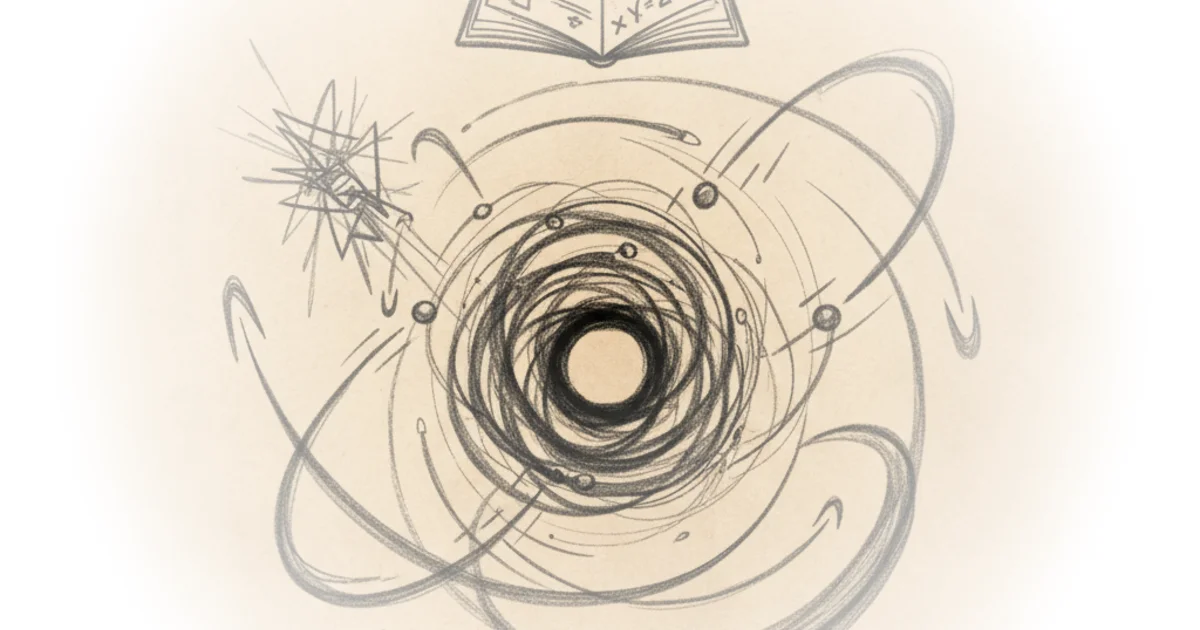
Lagrange had a breakthrough idea: assign a value to every point in space around a massive object like a star. This value acts as an altitude on a mathematical landscape. He called it the gravitational potential—a scalar with magnitude but no direction. At any point, you could draw an arrow pointing downhill, representing how steep the terrain is.
This was genius. Forces are vectors—adding them is hard. But potentials are scalars; adding them is easy. To find the combined potential of multiple bodies, you just add their individual potentials and then derive the forces from that sum.
For a two-body system like Earth orbiting the Sun, this landscape has five points where the gradient equals zero—places where a tiny third body would maintain a perfectly stable orbit if undisturbed. These are now known as Lagrange points.
The Power of Potentials
The potential method became revolutionary for solving physics problems. It simplified everything from pendulums to planetary motion. Physicists started wondering if other forces could be expressed through similar potentials.
In the 1810s, Simeon Denis Poisson noticed this worked beautifully for electricity—just swap masses for charges. But magnetism was different.
Take a bar magnet. Its field looks similar to electric dipoles at first glance. But when you look inside, something fundamental changes: magnetic field lines form loops with no beginning or end. They don't have origins like electric fields do.
This required an entirely new mathematical approach.
Lord Kelvin and the Curl
William Thompson—later Lord Kelvin—was an undergraduate in the 1840s when he invented a new function called "the curl." It describes how a vector field rotates around a point, like currents in a liquid where a paddle wheel would spin.
Thompson realized that magnetic fields could be defined as the curl of something called the magnetic vector potential. This made calculations easier, though Thompson himself thought it was just a helpful device—not representative of actual physics.
By the late 1800s, physicists had three fundamental equations relating potentials to their respective fields. The method became standard: use potentials instead of forces.
David Bohm's Odyssey
In 1942, twenty-three-year-old David Bohm was working on his particle physics dissertation when Robert Oppenheimer invited him to join the Manhattan Project. It was a life-changing opportunity—but there was a problem.
General Leslie Groves ran a background check and found that Bohm had briefly joined the American Communist Party in California. Groves deemed him a security risk and banned him from the project. Worse, his dissertation topic was classified, so he couldn't even write it up.
Oppenheimer certified that Bohm had done good work, allowing him to graduate. After the war, Princeton refused to reinstate him after he was acquitted of communist allegations. He left for Brazil, then Israel.
It was in Bristol in the 1950s that Aharonov and Bohm stumbled on something unexpected: a magnetic switch that changed electron behavior without changing any magnetic field at all.
The Discovery
The experiment involves sending electrons through a region with zero electric or magnetic fields—literally no forces acting on them. But flipping a switch changes their behavior. How?
The answer lies in the potential itself. Even when the magnetic field equals zero, the magnetic vector potential can be non-zero. And that potential actually influences the electrons.
This was revolutionary. For decades, physicists had argued that potentials were just mathematical conveniences—arbitrary numbers you could add without changing anything. You could add ten, a million, any constant, and the forces would remain unchanged.
But Bohm and Aharonov demonstrated something different: the potential itself carries physical meaning. When electrons pass through regions of non-zero magnetic potential—even with zero field—they experience changes that are observable. The potential isn't just convenient; it's real.
Even when the magnetic field equals zero, the magnetic vector potential can be non-zero—and that potential actually influences the electrons.
Counterpoints
Critics might note that this experiment doesn't automatically apply to all forces. Gravitational and electric potentials remain valid mathematical tools without necessarily representing physical reality in the same way. The magnetic case is special because magnetic fields form closed loops—something unique about topology that doesn't generalize to other forces.
The biggest vulnerability: this discovery doesn't solve any practical problems. It's a profound insight into how nature works, but it hasn't led to new technologies or applications. It simply confirms that our understanding of fundamental physics was incomplete—and that mathematical tools sometimes carry more meaning than we assumed.
Bottom Line
The strongest part of this argument is its historical depth—showing how centuries of mathematical development led to a discovery that even the experts considered impossible. The biggest weakness is that it remains a conceptual insight rather than a practical one. This piece matters because it reveals something fundamental about reality: sometimes the abstract tools we create to simplify calculations turn out to be more real than the forces they were supposed to help us calculate.