Jordan Schneider's conversation with nuclear policy veterans Pranay Vaddi and Chris McGuire cuts through the sci-fi hype to expose a terrifying reality: the world's most dangerous weapons are being integrated with the world's most opaque technology, and the only thing standing between us and catastrophe is a fragile human consensus. While pop culture fixates on autonomous robots launching missiles, the actual debate centers on a much more subtle, yet equally perilous, shift in how early warning systems and decision-support tools function under the extreme pressure of a nuclear crisis.
The Human-in-the-Loop Illusion
Schneider frames the discussion not around the fear of a rogue AI, but around the practical erosion of human control in a crisis. The piece highlights a rare diplomatic victory: the 2024 joint statement between the United States and China agreeing that "In all cases, the United States will maintain a human in the loop for all actions critical to informing and executing decisions by the President to initiate and terminate nuclear weapons employment." This is a significant diplomatic win, yet as Vaddi notes, it is merely the starting point. The real challenge lies in the gap between high-level rhetoric and the technical reality of how AI is already embedded in Nuclear Command, Control, and Communications (NC3).
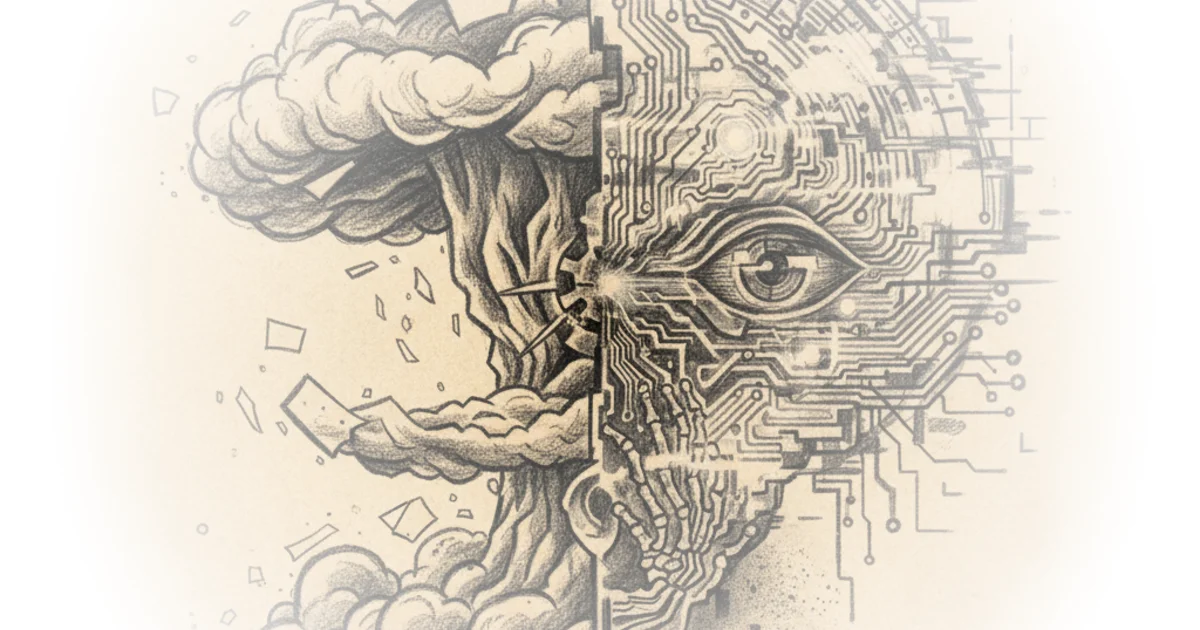
The authors argue that AI is not being banned from these systems; rather, it is being welcomed as a tool to process data faster than any human could. As Chris McGuire explains, "People sometimes garble this and say 'no AI in NC3,' which is profoundly wrong. AI has to be throughout our NC3 complex. It's going to be hugely beneficial to our early warning systems and detection capabilities." This distinction is crucial. The policy isn't about stopping automation; it's about ensuring the final "press the button" moment remains a human act. However, this raises a critical question: if an AI system filters the data a president sees, effectively curating the reality of an incoming attack, is the human truly in control, or are they merely rubber-stamping a machine's conclusion?
"We have a lot of other problems. Why do we need to talk about artificial intelligence within our nuclear policy for the first time?" This question from the nuclear policy community highlights a dangerous lag between technological capability and strategic adaptation.
The commentary effectively uses historical context to ground these fears. By referencing the Soviet "Dead Hand" system (Perimeter), the authors remind us that the world has flirted with automated retaliation before. The difference today is that modern AI doesn't just automate a specific retaliatory trigger; it automates the perception of the threat itself. As Vaddi points out, the utility of AI lies in "rapid intelligence and battle domain awareness," which could give a president more time. But critics might note that in a scenario where seconds matter, a system designed to speed up decision-making could inadvertently compress the time available for human deliberation, creating a "use it or lose it" dynamic that favors escalation.
The Fog of War and the Algorithm
The conversation takes a darker turn when addressing the psychological and operational realities of a nuclear exchange. Schneider references Eric Schlosser's Command and Control, noting the terrifying scenario where leadership is decapitated, leaving a low-level officer to decide the fate of the world. In such a chaotic environment, the promise of AI is that it can cut through the "fuzzy picture" of war. "General nuclear war is going to be a pretty fuzzy picture," Vaddi admits. "How are human beings supposed to keep track of all of that in real time?"
This is where the argument becomes most compelling. The authors suggest that AI could recommend targets that are no longer viable or identify that an attack has already been neutralized by other means. Yet, this introduces a new class of failure modes. If an AI system misinterprets a glitch as a first strike, or if it optimizes for speed over nuance, the result could be a catastrophic error that humans are too slow to correct. The piece acknowledges that while physical safety mechanisms (like the Titan II accident prevention) have improved, the digital layer adds a new, unpredictable variable.
"If we're in that moment and it's AI making decisions, we seem pretty fucked anyway."
The authors do a masterful job of avoiding the trap of saying AI is inherently evil. Instead, they present it as a double-edged sword that could either prevent accidents by clarifying the fog of war or trigger them by accelerating the pace of conflict. The discussion on how AI systems in war games are "more trigger-happy than humans" serves as a stark warning: the logic that optimizes for military victory in a simulation may not align with the logic of survival in reality.
Bottom Line
Schneider's coverage succeeds by shifting the focus from the sensationalist idea of a robot apocalypse to the sobering reality of algorithmic influence on human judgment. The strongest part of the argument is the distinction between AI as a decision-maker (which is officially banned) and AI as a decision-shaper (which is already happening). The biggest vulnerability remains the lack of transparency; without knowing exactly how these systems are integrated into NC3, the "human in the loop" promise may be an illusion. The reader must watch for how the administration handles the next generation of early warning systems, as the line between "support" and "substitution" is thinner than ever.