Nate Hagens reframes the looming economic and ecological transition not as a failure of policy, but as a psychological trap where our past investments dictate our future paralysis. The piece's most striking claim is that the "Great Simplification" will be stalled less by a lack of technology or capital, and more by our inability to emotionally let go of the lifestyles we have already paid for. This is a vital perspective for anyone trying to understand why rational solutions to climate and energy crises are consistently ignored in favor of doubling down on failing systems.
The Identity Trap
Hagens begins by dismantling the textbook definition of "sunk cost," arguing that while economists view it as a financial error, humans experience it as an existential threat. He writes, "We protect past investments as if they were living things, as if they were literally us." This distinction is crucial; it explains why individuals and nations cling to inefficient systems even when the data suggests a pivot is necessary. The author argues that our careers, homes, and social circles are not just assets but the very stories we tell ourselves about who we are. When reality shifts, the anxiety we feel is not merely about money, but about the disintegration of our self-concept.
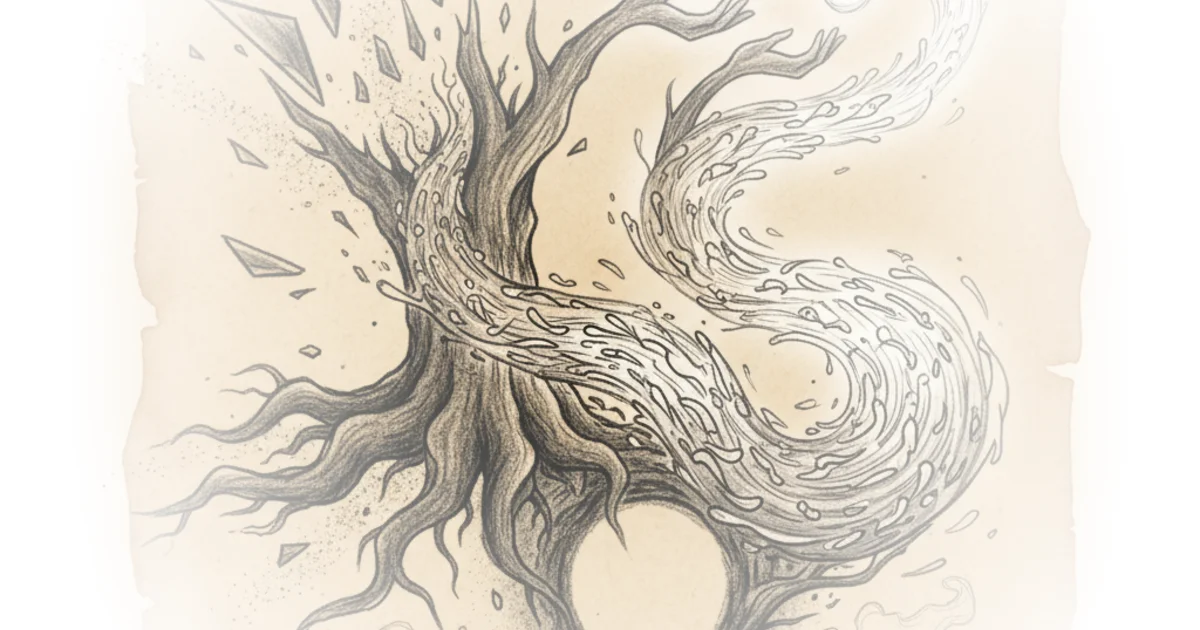
This framing effectively moves the conversation from "bad decision making" to "human nature." However, it risks underestimating the role of pure greed and institutional inertia, which often override even our deepest emotional attachments. Critics might note that not all resistance to change is psychological; sometimes, powerful stakeholders simply refuse to let go of their profits, regardless of their personal identity.
"When we think about employment, we're not just choosing between positions or companies – we're choosing between versions of ourselves, which will also define how others see us."
The Built Environment as a Sunk Cost
The commentary then shifts to the physical world, where the stakes are even higher. Hagens points out that our suburbs, highways, and energy grids were built on the assumption of cheap energy and infinite growth. He notes, "All of this continues to work as long as energy is cheap... But as we recognize that those conditions are becoming more precarious, the rational response would be to stop doubling down on this system." The author suggests that the sheer scale of this infrastructure creates a feedback loop where we must spend more just to maintain the status quo, making alternative, lower-energy options like walking or biking seem impractical.
This argument gains significant depth when viewed through the lens of urban decay. Just as cities in the Rust Belt struggled to repurpose massive industrial zones that no longer served an economic function, our current suburbs face a similar fate. The sunk cost here is not just the concrete, but the decades of policy that mandated single-family zoning and car dependency. As Hagens illustrates with the example of Interstate 94 in Minneapolis, the psychological weight of the original construction prevents the city from imagining a future where that space is returned to neighborhoods.
"There's no mayor in this country that wants to be the one who 'shrunk the city,' even if it improves citizens' quality of life."
This observation highlights a profound political paralysis. The fear of being the one to admit that a system has failed is a more potent force than the promise of a better future. Yet, one might argue that the solution isn't just psychological but structural; without federal mandates or financial incentives to "shrink" cities, local mayors are indeed powerless against the momentum of private markets.
Rewriting the Narrative of Progress
Hagens identifies the "story of progress" itself as the ultimate sunk cost. For a century, we have equated success with more material throughput, more square footage, and more speed. He writes, "We've spent a century or more selling a story that progress is synonymous with more material throughput... That story is a sunk cost as well." The author contrasts this with emerging narratives of "enough-ness," such as the Swedish concept of lagom, which prioritize repair and local resilience over expansion.
The piece suggests that the transition to a sustainable future requires a cultural shift that is as difficult as the physical one. Hagens proposes a thought experiment where everyone wakes up in identical, durable tents. In this scenario, the pressure to "keep up with the Joneses" vanishes, revealing that much of our resource demand is driven by social comparison rather than actual need.
"The tent thought experiment relieves the pressure of having to choose to let go of that particular sunk cost. It relieves us of the pressure to 'keep up with the Joneses,' which I think might be a quarter or a half of the reason for our modern exhibitions of material grandeur."
This is a powerful rhetorical device. It forces the reader to confront the arbitrary nature of their desires. However, the counterpoint is that human societies are rarely egalitarian in practice; even if the physical structures reset, the drive for status often finds new, perhaps more insidious, forms of expression. The psychological need for hierarchy is as deep as the need for shelter.
Practices for a New Reality
Finally, Hagens moves from diagnosis to prescription, offering practical steps to loosen the grip of sunk cost. He suggests a "write-down" ritual for identity, where individuals explicitly acknowledge that certain roles or possessions no longer serve them. He advises, "Name the roles and purchases that served you well and thank them, then explicitly lower their book value in your mind." He also advocates for pre-committing to a future of "friendly defaults," such as choosing repairable appliances or flexible housing.
The most compelling suggestion is to shift the definition of status. Instead of celebrating accumulation, Hagens argues we should "hold the neighbor who repairs, mentors, plants shade trees, and bikes in high regard." This reframing is essential because, as he notes, "status will be an antidote to sunk cost like nothing else."
"We've become attached to our specific arrangements. In fact, the arrangement has actually become the thing we value."
This insight cuts to the heart of the problem. We are not just protecting our assets; we are protecting our arrangements. The author's call to action is not to abandon our lives, but to consciously edit them, separating the utility of an object from the symbolism it carries.
Bottom Line
Nate Hagens delivers a compelling argument that the greatest barrier to a sustainable future is not a lack of resources, but the psychological weight of our past investments. His strongest move is linking the economic concept of sunk cost to the deeply personal realm of identity, making the abstract concrete. The piece's vulnerability lies in its reliance on individual psychological shifts to solve systemic problems that may require more aggressive policy intervention. However, the core insight remains: until we learn to let go of the "story" of infinite growth, we will remain trapped in a system that is rapidly running out of energy.