In an era where wellness influencers champion protein as the ultimate elixir for longevity and muscle, Dr. Eric Topol delivers a stark, data-driven reality check that challenges the very foundation of the current dietary frenzy. While the mainstream narrative insists that more is always better, Topol marshals evidence suggesting that this obsession may be accelerating cardiovascular disease rather than preventing it. For busy professionals relying on quick health fixes, this is a critical intervention that questions the safety of the very supplements and bars dominating the market.
The Engine of Obsession
Topol begins by dissecting the cultural machinery behind the protein craze, noting that social media has become a primary driver of misinformation. He points out that a search for "200 grams of protein a day" on TikTok yields dozens of instructional videos, creating a feedback loop where non-professional athletes get 40% of their information from unverified sources. The podcast he critiques, The Daily, confidently asserts, "Well, it's unlikely that eating too much protein is actually going to harm you. Unless you have a specific kidney issue, we can eat a lot of protein. And it's not going to be bad for you." Topol immediately dismantles this claim, labeling it a dangerous oversimplification that ignores a growing body of contradictory research.
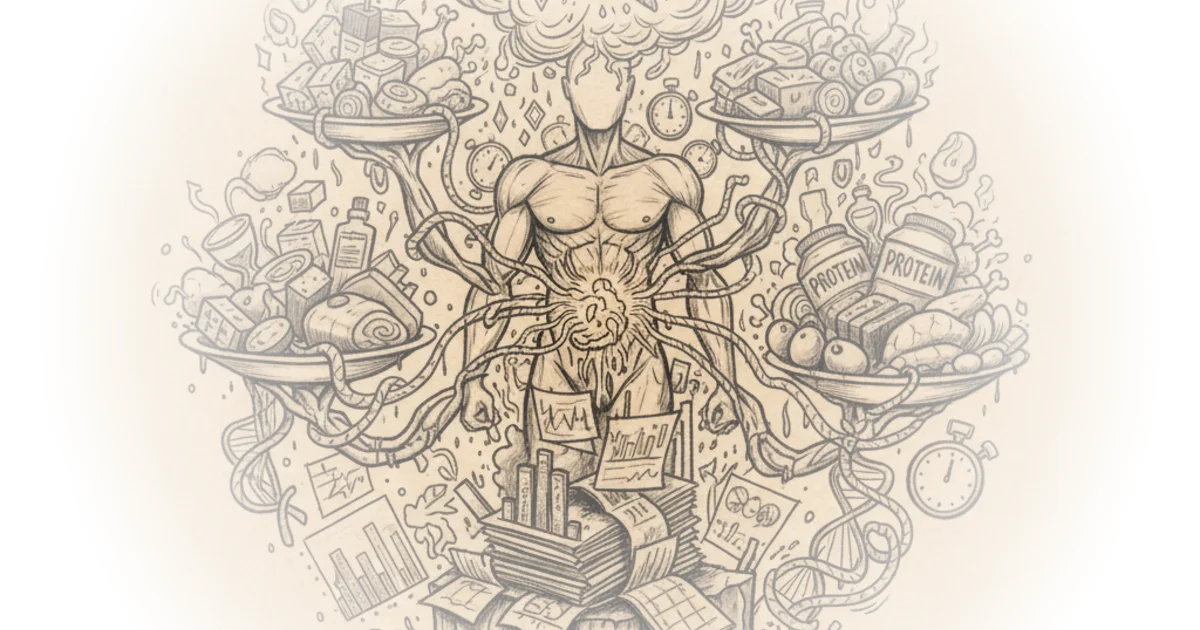
He highlights how commercial interests are fueling this movement, specifically pointing to the David bars, which promise high protein density through a modified plant fat called EPG. These products, promoted by influential figures like Peter Attia and Andrew Huberman, are on track to generate $180 million in sales. Topol argues that the pervasive call for higher intake stems from a manufactured fear that people are not meeting the 0.8 g/kg/day recommendation, despite USDA data showing that 55% of men and 35% of women already exceed this. As Topol notes, "It's no wonder. Social media is chock full of protein promoters," yet the reality is that the federal recommendation is already being surpassed by a majority of the population.
"It's baloney. But there's a generation, particularly young men, and now an increasing number of young women, who are absolutely brainwashed by what they hear online."
This quote from protein expert Stuart Phillips, cited by Topol, underscores the disconnect between scientific consensus and public perception. The argument here is compelling because it exposes the gap between the marketing of "optimal" health and the physiological reality that most people are already over-consuming protein. Critics might argue that active individuals or older adults have different needs, but Topol counters that even for these groups, the data does not support the extreme levels advocated by influencers.
The Illusion of Benefit
The core of Topol's analysis shifts to the clinical evidence, where he finds the support for high protein intake to be remarkably thin. He reviews meta-analyses and systematic reviews, most authored by Stuart Phillips, and concludes that there are no data to support more than 1.6 g/kg/day of protein intake. Topol scrutinizes the famous Morton study, often cited to justify high protein goals, revealing that the graph used to support a "sweet spot" is statistically flawed. He explains that the vertical line drawn at 1.6 g/kg/d is an illusion, noting that "If you take away the vertical and horizontal lines from the graph, you see it is a contrived regression, a scatterplot... that does not support any optimal level of protein intake."
Furthermore, Topol addresses the specific claims regarding older adults, a demographic often targeted by longevity advocates. He points out that in the 50+ group, randomized trials show no benefit of high protein on top of resistance training compared with resistance training alone. "So we don't even know at this point whether resistance training alone is enough to improve lean body mass, let alone what is the optimal dose of protein intake in older adults," he writes. This uncertainty is starkly contrasted with the confident prescriptions of influencers like Peter Attia, who advocates for 2.2 g/kg/day—almost three times the established recommendation.
The argument is strengthened by Topol's observation that higher protein intake does not necessarily lead to weight loss or satiety as promised. In fact, multiple studies suggest the opposite: "the higher the protein intake, the greater the number of calories (energy) consumed." This challenges the fundamental premise of the protein diet industry, which relies on the idea that protein is a magic bullet for weight management. A counterargument worth considering is that individual variability in metabolism might mean some people do benefit from higher intake, but Topol emphasizes that the aggregate data does not support a blanket recommendation for the masses.
The Hidden Dangers
Perhaps the most alarming section of Topol's commentary focuses on safety, specifically the link between high protein intake and cardiovascular disease. He cites observational studies showing an association between high-protein diets and increased risks of type 2 diabetes, heart failure, and all-cause mortality. Topol brings attention to recent work by Babak Razani and his team at Washington University, which identified a specific biological mechanism: the essential amino acid leucine. This compound, abundant in animal products and supplements, was found to activate the mammalian target of rapamycin (mTOR) in macrophages, promoting atherosclerosis.
Topol explains that this mechanism is particularly ironic for those seeking longevity, as mTOR activation is the opposite of what drugs like rapamycin aim to achieve. "This leucine discovery is important because leucine is one of the 3 branched chain essential amino acids that is widely used as a supplement by people training and athletes and one with putative anti-aging properties," he writes. The implication is that people are inadvertently accelerating their cardiovascular aging while trying to optimize their health. He notes that studies in mice and humans show that high protein intake can lead to "striking increase in inflammation and atherosclerotic plaque in the arteries."
"Habitual or chronic high protein intake is associated with epidemiological evidence of harm, and, at high doses, the studies I reviewed raise the concern about pro-inflammatory effects and increasing cardiovascular risk, promoting the process of atherosclerosis."
This warning is particularly potent given that 1 in 7 adults has kidney disease, often undiagnosed, making them vulnerable to the strain of high protein loads. Topol also highlights that unlike carbohydrates and fat, the body has no way to store excess protein. "You can eat a ton of protein. You can digest a ton of protein. But the key question is: How much can you use? And we don't have a way of stocking away extra amino acids," he quotes Stuart Phillips. The excess is simply excreted as urea, rendering the extra intake not just useless, but potentially harmful.
Bottom Line
Dr. Eric Topol's critique is a necessary correction to a wellness narrative driven more by marketing than by robust science, effectively dismantling the myth that "more protein" equates to better health. The strongest part of his argument is the synthesis of mechanistic data linking leucine to atherosclerosis, which provides a biological plausibility to the epidemiological warnings often dismissed as correlation. However, the piece's biggest vulnerability lies in the difficulty of translating complex metabolic pathways into actionable advice for individuals with varying activity levels and health statuses. Readers should watch for future longitudinal studies that can definitively separate the effects of protein source (animal vs. plant) from total protein load, but for now, the evidence suggests a return to moderation is the safest path.