Most industry observers are asking if Okta is being broken apart feature by feature, but Ross Haleliuk argues the company is facing something far more insidious: a multi-front squeeze from every direction. This piece cuts through the hype of "unbundling" to reveal that Okta's real vulnerability isn't a single startup stealing a niche, but a fundamental structural flaw born from an acquisition-heavy growth strategy. For busy leaders managing identity infrastructure, the distinction matters because it changes the risk profile from a competitive threat to a platform integrity crisis.
The Illusion of Unbundling
Haleliuk begins by dismantling the popular narrative that startups are chipping away at Okta's core. The author reframes the situation by noting that "unbundling happens when a market incumbent ceases fully serving the needs of specific customer segments or niches." While this is a classic startup playbook, Haleliuk points out that Okta isn't a unified platform in the traditional sense. Instead, the company is "less of a unified platform and more of a collection of products competing in multiple related markets."
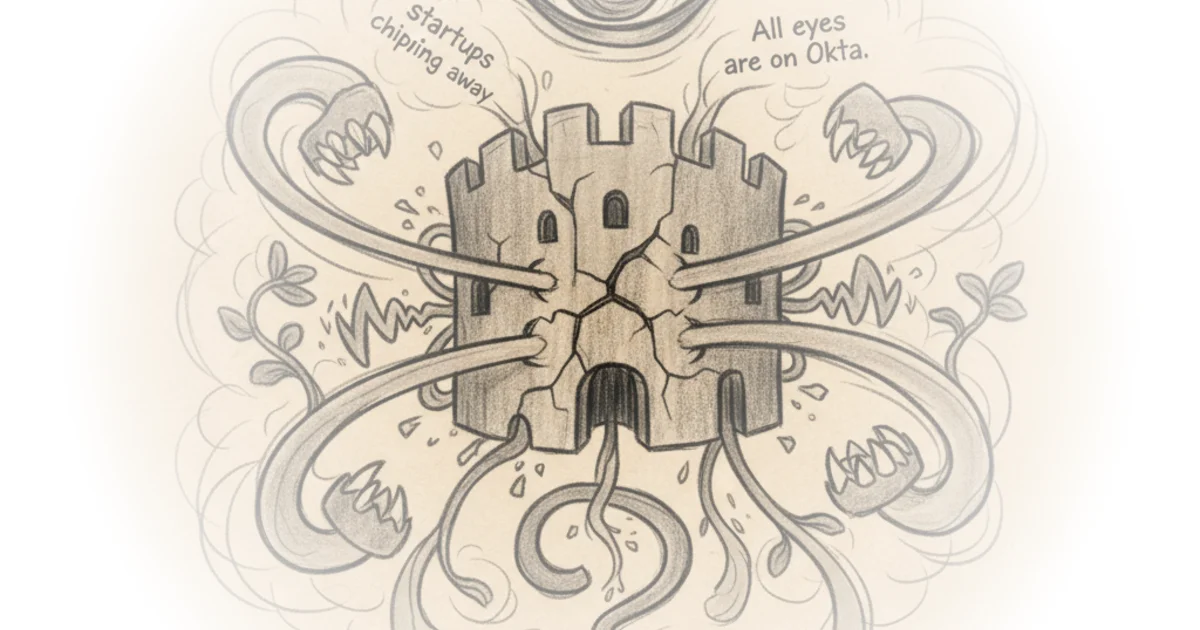
This distinction is crucial. If Okta were a true monolith, a competitor could carve out a piece and leave the rest intact. But because Okta is already a patchwork, the pressure isn't coming from one side; it is being "squeezed from all sides." The author suggests that customers are now questioning whether to buy the platform wholesale or pick and choose features, a hesitation that directly undermines the value proposition of a single-vendor solution.
Okta is basically a bunch of startups in a trenchcoat pretending to be a unified platform.
This vivid metaphor captures the core of the argument: the lack of organic integration. Haleliuk traces this back to Okta's history, noting that since its founding, the company has made at least ten acquisitions to enter new markets like identity governance and privileged access management. The result is a product suite where features feel "bolted-on rather than integrated." When a customer can easily swap out a specific module because it doesn't feel like part of the whole, the platform loses its stickiness.
Critics might argue that in the fast-moving security sector, buying innovation is a valid strategy, but Haleliuk counters that this approach has left Okta struggling to innovate outside its comfort zone. The evidence is stark: Okta entered the identity governance market in 2021, decades after competitors like SailPoint had already established dominance. This suggests a reliance on M&A that may have masked an inability to build organically.
The Pricing Trap and the Acquisition Spree
The commentary takes a sharp turn into the financial mechanics of this structural weakness. Haleliuk highlights how Okta's previous pricing model inadvertently accelerated its own fragmentation. By listing every feature as a separate line item—"Would you like MFA with that? That's extra. Lifecycle management? Another add-on"—the company made it incredibly easy for competitors to undercut them on single capabilities.
The author argues that this "à la carte" approach was a strategic blunder. It created confusion for buyers and, more damagingly, removed any monetary incentive to stay within the ecosystem. "Every unbundled feature became an opportunity for a startup to undercut them on that specific capability," Haleliuk writes. This pricing strategy essentially handed startups a roadmap for how to displace Okta's secondary products.
Instead of paying $2 for SSO, $3 for MFA, $2 for Universal Directory, and $4 for either Lifecycle Management or Workflows — ringing in at $11 (at list price) — you get all of them in the Starter plan for $6.
Haleliuk notes that Okta has since updated its pricing to bundle these features, a move that aligns better with buyer maturity and restores some platform value. However, the damage to the brand's cohesion remains. The author maps Okta's acquisition history to its product gaps, showing how capabilities in Identity Threat Detection and Response (ITDR) and Privileged Access Management (PAM) were almost entirely purchased rather than built. This reliance on external innovation means Okta is competing in markets where it is often the late entrant, facing giants like CyberArk and Zscaler.
The Real Competition and the Squeeze
The most compelling part of Haleliuk's analysis is the identification of who is actually doing the squeezing. It isn't a swarm of tiny startups stealing Okta's lunch money. Instead, the pressure comes from massive, well-established players who dominate specific niches. The author points out that while startups are targeting Okta's secondary markets, the real competition comes from "massive, well-established players: Duo for MFA... SailPoint for IGA... CyberArk for PAM... and Zscaler for zero trust access."
These competitors are not trying to replace Okta's core identity management; they are dominating the adjacent layers where Okta is weakest. Haleliuk observes that these larger players "typically focus upmarket, and integrate with Microsoft AD — they just serve a different customer profile." Okta, by contrast, has carved out a segment that is "more open to change and experimentation," which ironically makes it the perfect target for disruption.
What's really interesting is that these larger players haven't made serious moves to go after Okta's core IAM territory.
This dynamic creates a unique vulnerability. Okta is trapped between the giants who own the enterprise legacy markets and the agile startups that can offer a better, more focused experience for the specific features Okta acquired. The author concludes that Okta is not being unbundled in the classic sense; it is being outflanked. The platform is so fragmented that it cannot defend its perimeter against specialists who do one thing better.
When customers can easily swap out your IGA solution for a competitor because it doesn't feel like part of your platform anyway, you've lost the core value proposition of being a platform in the first place.
Bottom Line
Ross Haleliuk delivers a devastating diagnosis: Okta's greatest weakness is not a lack of features, but a lack of cohesion born from an acquisition strategy that prioritized speed over integration. The strongest part of this argument is the reframing of the threat from "unbundling" to "squeezing," which accurately reflects the multi-front pressure from both legacy giants and agile startups. The biggest vulnerability in the piece is its assumption that the new pricing model can fully repair the brand's fractured perception; while bundling helps, it cannot easily undo the technical debt of a "trenchcoat" platform. Leaders should watch whether Okta can successfully integrate its acquisitions before the market decides the sum is less than its parts.