Erik Hoel dismantles the myth of the lone genius, arguing that the legendary status of John von Neumann is less a testament to genetic superiority and more a product of a unique, aristocratic educational ecosystem in early 20th-century Budapest. For a culture increasingly obsessed with innate talent as the sole driver of success, Hoel's forensic debunking of von Neumann's "superpowers" offers a necessary corrective: genius is often just the right environment meeting the right moment.
The Myth of the Lightning Arse
Hoel opens by comparing the modern folklore surrounding von Neumann to the exaggerated tales of William Wallace in Braveheart. He writes, "First that he killed '50 men,' and then no, '100 men!' and was 'seven feet tall;' he even, as Gibson jokes, shoots 'fireballs from his eyes' and 'bolts of lightning from his arse.'" This vivid imagery sets the stage for a rigorous fact-check of the "pop-hereditarian" narrative that has co-opted von Neumann as proof of genetic determinism. Hoel argues that these legends are not just harmless fun; they are the foundation of a dangerous ideology that dismisses the power of education and environment.
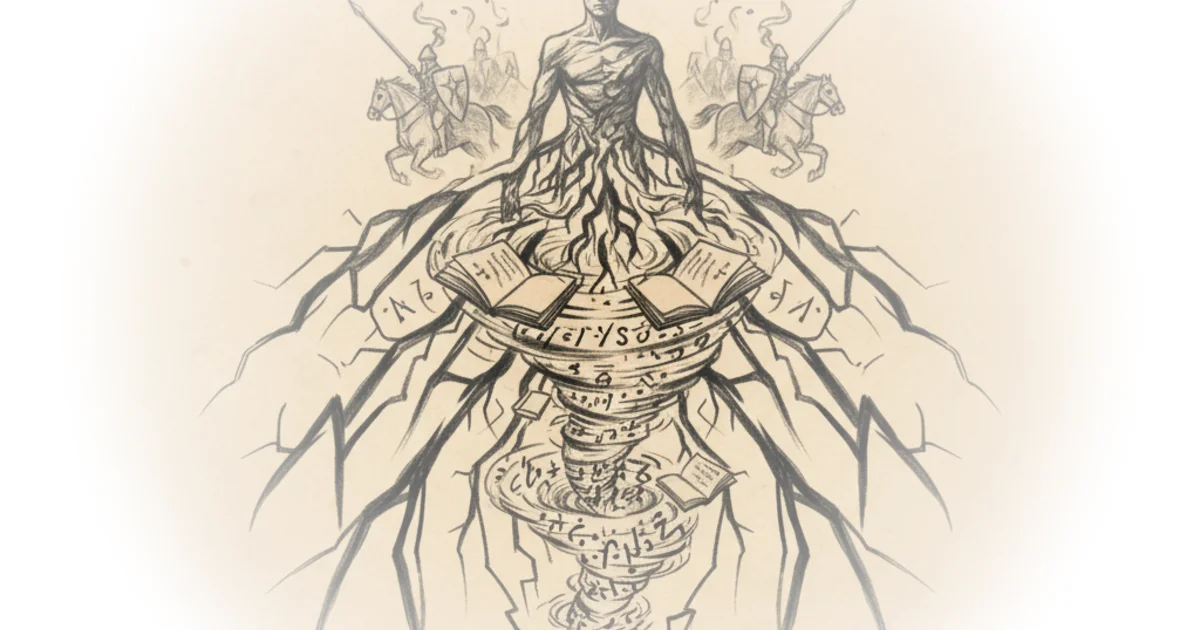
The author identifies a troubling shift in the nature versus nurture debate. He notes that while proponents of the "Blank Slate" theory once argued for a non-zero role of environment, the new wave of hereditarians has swung to the opposite extreme. "Pop-hereditarians scoff at the very idea that Nurture's contribution might be non-zero," Hoel observes, "fanatically dismissing that even the best education—gasp—could have an effect." This selective credulity, he argues, is the hallmark of bad science. It involves holding rigorous meta-analyses of education to impossible standards while accepting flawed, decades-old twin studies as gospel.
"When it comes to the Nature vs. Nurture debate, the truth is in the middle. It will always be in the middle. Yet middles are unsatisfying."
Hoel's critique here is sharp and timely. He suggests that the online desire for simple, symbolic heroes like von Neumann overrides the messy reality of human development. The author points out that von Neumann himself would likely reject the hereditarian interpretation of his life, given his own emphasis on the importance of cultural milieu and parenting.
The Budapest Reservoir
The core of Hoel's argument rests on a detailed reconstruction of von Neumann's upbringing, drawing heavily on Norman Macrae's biography. He describes a childhood defined by extreme privilege and a unique educational infrastructure that no longer exists. "Johnny had exactly the right parental upbringing and went through the early twentieth-century Hungarian education system that (this book will argue) was the most brilliant the world has seen," Hoel writes.
This was not a democracy but an aristocracy transitioning to a plutocracy, a system that allowed for an intensely focused, elite education for a small group of talented boys. Hoel details how von Neumann was tutored from infancy by a rotating cast of university professors, including luminaries like Gábor Szegő and Leopold Fejér. The author notes that von Neumann's first math paper was co-authored with his tutor at age 17, and he earned his PhD under Fejér, a family friend. This level of access was not accidental; it was the result of a society that valued intellectual achievement above almost all else.
The piece also contextualizes this phenomenon within the broader group known as "The Martians," a cohort of Hungarian-Jewish scientists who shaped the 20th century, including Edward Teller and Eugene Wigner. Hoel argues that their brilliance was not a genetic anomaly but a historical convergence. He cites Wigner's own memoirs, where the Nobel laureate explicitly rejected genetic superiority: "Let me begin by making it clear it was not a matter of genetic superiority. Let us leave such ideas to Adolf Hitler." Instead, Wigner credited the "superb high schools in Budapest" and the "forced emigration" that scattered these minds to the world's leading institutions.
Hoel draws a parallel to modern demographics, noting that the overrepresentation of certain groups in elite institutions today often stems from similar cultural and educational pressures rather than innate biological differences. "Budapest operated like a reservoir-release model," he explains, "drawing in via immigration a bunch of talent, educating it incredibly well due to rare historic and economic circumstances, and then exploding in a forced diaspora via antisemitic persecution and world war." This framing effectively shifts the focus from the individual to the systemic, challenging the reader to consider how much of what we call "genius" is actually the result of specific, replicable conditions.
The Architecture of Borrowing
Perhaps the most controversial claim in the piece is Hoel's assertion that von Neumann did not invent the "von Neumann architecture" for computers. He argues that von Neumann's true genius lay not in originality, but in synthesis and formalization. "Johnny borrowed (we must not say plagiarize) anything from anybody, with great courtesy and aplomb," Hoel writes. "His mind was not as original as Leibniz's or Newton's or Einstein's, but he sees other people's original, though fluffy, ideas and quickly changed them in expanded detail into a form where they could be useful for scholarship and for mankind."
Hoel details how von Neumann visited the ENIAC team, understood their work on the EDVAC, and then wrote a report that formalized their ideas with his own mathematical rigor. The result was a document that became the blueprint for modern computing, yet the core concepts belonged to John Mauchly and J. Presper Eckert. This is a crucial distinction for Hoel's argument: if von Neumann's greatest contribution was refining the work of others, then his success is a testament to his ability to leverage the environment and the people around him, not just his internal hardware.
Critics might note that in the history of science, the person who formalizes and popularizes a concept often deserves as much credit as the originator, especially when that formalization makes the concept usable. However, Hoel's point stands: the myth of the solitary genius obscures the collaborative reality of scientific progress. By stripping away the "lightning from his arse" mythology, Hoel reveals a more human, and perhaps more inspiring, story of how knowledge actually advances.
"You just need to do a little research yourself, and accept that places and eras can be just as exceptional as brains."
Bottom Line
Erik Hoel's piece is a masterclass in dismantling the cult of personality that often surrounds historical figures, replacing it with a nuanced analysis of the environmental factors that enable greatness. Its strongest asset is the rigorous use of historical context to debunk the genetic determinism that has found a new home in online discourse. The argument's vulnerability lies in its potential to be read as diminishing von Neumann's actual contributions, though Hoel works hard to maintain that he was still a titan of intellect, just not a magical one. For readers seeking to understand the true drivers of human achievement, this is an essential correction to the current cultural narrative.