Scandal as Symptom
Fabio Vighi opens with a structural observation that sets the tone for the entire essay: the staggered release of the Epstein files was not a failure of transparency but a feature of it. By the December 2025 deadline, barely one percent of the documents had surfaced. Vighi sees this drip-feed as something more than bureaucratic caution. He argues it reveals
"a system that sustains itself also through managed scandal, prolonging the spectacle of corruption as a substitute for structural renewal."
The claim is bold. Rather than treating the Epstein case as an isolated criminal matter, Vighi frames it as a diagnostic lens on late capitalism itself. The files, in his reading, are not simply evidence of crimes but artifacts of a civilization in decline.
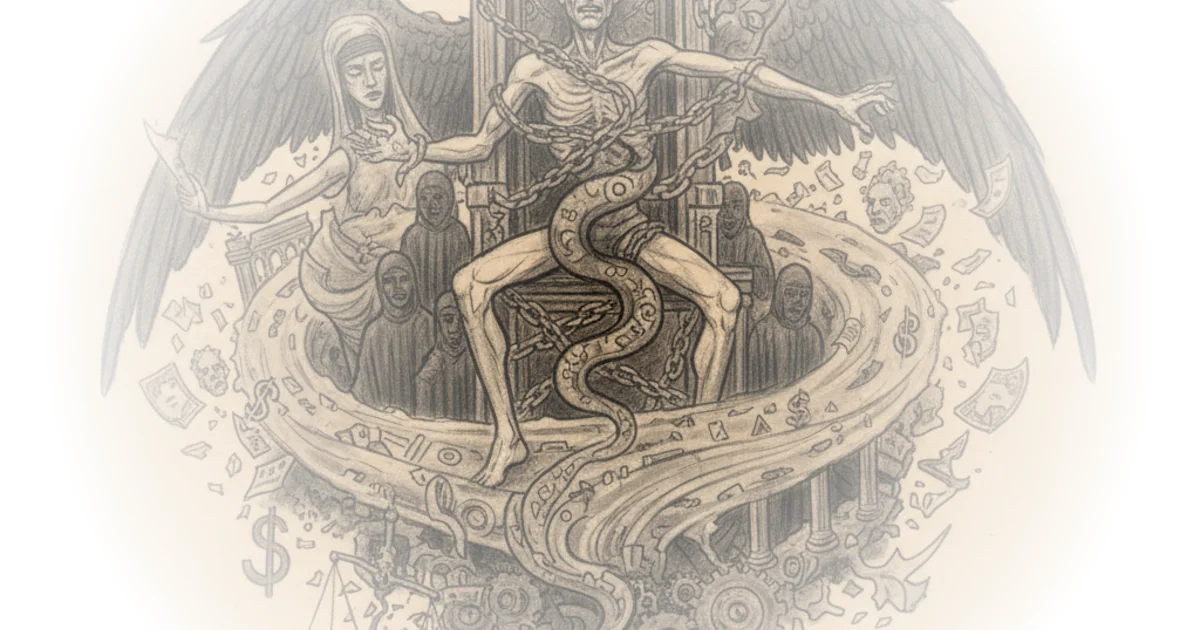
Capitalism and Predation
The essay's most provocative move is to draw a direct line between economic and sexual exploitation. Vighi contends that the traits rewarded by capitalist accumulation are
"disturbingly adjacent to those that enable rape, paedophilia, and genocidal violence."He goes further, insisting that
"capitalism does not simply tolerate predatory personalities; it breeds them."
This is where readers will reasonably push back. The argument risks collapsing important distinctions. Many people operate within capitalist systems without becoming predators. The structural critique has force, but the rhetorical leap from market incentives to sexual violence skips several intermediate steps that deserve scrutiny rather than elision. Still, the core insight -- that Epstein's network was not an aberration but a concentrated expression of systemic logics -- is harder to dismiss than it first appears.
Sade as Theoretical Ancestor
Vighi threads the essay through an intellectual genealogy running from the Marquis de Sade through Adorno, Horkheimer, and Lacan. The detail that Epstein kept a copy of Sade's Justine on his desk lends the comparison a certain grim literalism. But the philosophical point is more interesting than the biographical footnote.
Drawing on the Frankfurt School, Vighi argues that Sade did not stand outside the Enlightenment but exposed its shadow:
"reason reduced to calculation, and calculation hardened into organised brutality."Epstein, in this framework, represents the next iteration -- what Vighi calls
"a financialised degeneration of Sade's universe: the merging of libidinal coercion and economic leverage in seedy networks where bodies, secrets, and capital circulate through the same closed circuits of power."
The theoretical apparatus is heavy. Readers less steeped in Continental philosophy may find the Lacanian vocabulary -- jouissance, the superego injunction -- more obscuring than illuminating. But the underlying argument is accessible enough: systems of power do not merely commit violence; they organize enjoyment around it.
The Spectacle Machine
The essay's strongest section concerns how scandal functions as social management. Vighi identifies three stabilizing roles that spectacle plays under what he calls "emergency capitalism": it manages attention by providing emotionally legible narratives that displace structural analysis; it manages legitimacy by performing accountability without delivering it; and it manages fear by converting systemic anxiety into targeted moral panic.
There is a sharp irony embedded here. The very outrage the Epstein files provoke may itself be a mechanism of containment. As Vighi puts it,
"proliferating wiki-style archives convert court documents into consumable outrage: by indexing names, flights, photos, and degenerate acts, they transform systemic depravity into endlessly scrollable scandal."
One might counter that public outrage has historically been a precondition for reform, not merely a substitute for it. The essay's cynicism about collective moral response -- treating it almost entirely as a system-stabilizing function -- leaves little room for the possibility that exposure sometimes does lead to structural change. Abolitionist movements, labor organizing, and civil rights campaigns all drew energy from moral outrage directed at specific, visible injustices.
Desire in a Desexualized Age
Vighi ventures into more speculative territory when he argues that the hypersexualized predator serves as an ideal symbolic object for a society that has evacuated actual desire from daily life. The smartphone, he claims,
"functions as the ultimate libido-killer. What it evacuates returns as compulsive outrage directed at curated images of elite obscenity."
This is a genuinely interesting provocation, though it sits uneasily alongside the essay's earlier insistence on material analysis. The claim that modern life is "radically desexualized" is debatable -- it may be more accurate to say that desire has been reorganized rather than eliminated. But the broader point about displaced intensity resonates: a culture that outsources intimacy to screens may indeed find its most potent emotional experiences in the consumption of scandal.
Bottom Line
Vighi delivers a dense, theoretically ambitious essay that reads the Epstein files not as revelation but as symptom. The strongest contribution is the analysis of how managed scandal stabilizes the systems it appears to threaten. The weakest is the tendency to treat every form of public engagement with the case as mere libidinal capture, leaving no space for genuine accountability. The essay's final warning -- that
"the real danger is a civilization that learns how to fade while believing it is still doing fine"-- lands with force, even if the path to get there occasionally substitutes theoretical density for argumentative precision.