Freddie deBoer delivers a jarring revelation: the most progressive voices in sports media are inadvertently acting as the chief apologists for one of the most exploitative labor systems in modern history. While fans are conditioned to cheer for "smart" roster management, deBoer argues that this very praise is a euphemism for suppressing wages and stripping workers of their leverage. This is not a story about bad actors, but about a system so deeply embedded in the culture that even those who claim to support workers end up defending the bosses.
The Myth of Neutral Analytics
The core of deBoer's argument is that modern NFL analysis has been hijacked by ownership interests, disguised as objective data. He observes that analysts are not necessarily hostile to players, yet their reliance on specific metrics forces them into an anti-player stance. "Modern NFL analytics primarily serves ownership interests by optimizing cost efficiency at the expense of players," deBoer writes. This is a crucial distinction; the bias isn't personal, it's structural. The industry has adopted a "meta" of team-building that treats human beings as line items to be minimized.
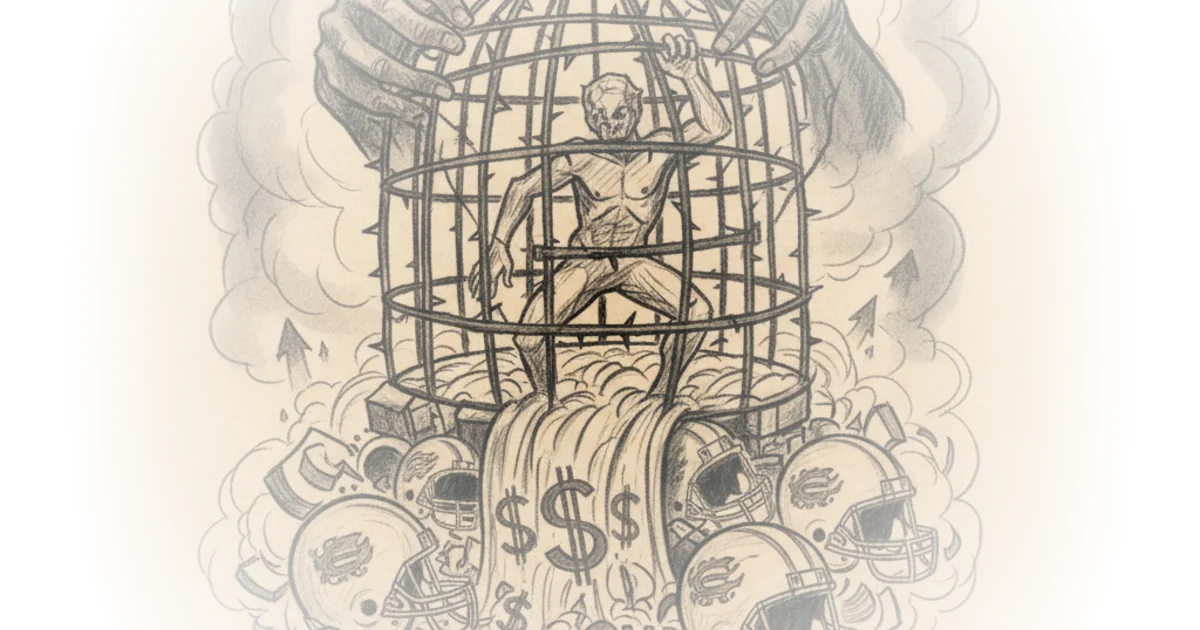
The author points to prominent figures like Ben Solak and Seth Walder, who use data to justify reprimanding teams for paying players even a dollar more than the absolute minimum. "Analysts like Solak and Walder exemplify the mainstream NFL media's uncritical adoption of franchise-friendly analytics by routinely praising teams for 'smart' roster construction that means cutting veterans, devaluing running backs... and maximizing cheap rookie production." This framing is effective because it exposes how language has shifted; what was once called exploitation is now celebrated as "discipline."
The result is industry-wide wage suppression dressed up as objective analysis.
Critics might argue that teams operate under a hard salary cap and must be financially responsible to remain competitive. However, deBoer counters that the cap itself is a tool of the monopoly, not a neutral market force. He notes that when the cap constrains owners, it mysteriously becomes flexible, but when it suppresses player pay, it is rigidly enforced. The system is designed to prevent the kind of bidding wars that would naturally occur in a free market.
The Mechanics of Suppression
DeBoer dissects the specific mechanisms that keep players underpaid, starting with the draft and the rookie wage scale. He highlights the absurdity of the current system where the most talented incoming players are forced to accept a fraction of their market value. "The NFL rookie pay scale exists to ensure that incoming players - including some of the very best players in the world, the ones selected at the top of the draft - earn a fraction of their market value for the first four years of their careers." This is a stark reality check for fans who view the draft as a meritocratic celebration. It is, in fact, a legal mechanism to lock in cheap labor.
The author uses the hypothetical case of a top quarterback prospect to illustrate the scale of this suppression. In a free market, a player with that potential could command $40 million annually. Instead, the system forces them into a four-year deal worth roughly $55 million total. This dynamic echoes the 2011 lockout, where the league and the players' union negotiated a new collective bargaining agreement that significantly increased the share of revenue going to owners and reduced the rookie scale, cementing the power imbalance that deBoer describes.
The franchise tag is another pillar of this exploitation. "Rather than rewarding excellence with a long-term contract, teams can tag a player, locking him into a single-year salary that, while large in absolute terms, is almost always well below what a true open market would bear." DeBoer argues that this system creates a "one-year hammer" that prevents players from ever reaching their full financial potential. The risk of career-ending injury looms over every tagged player, yet the media often praises the team for "managing the cap" rather than condemning the lack of security for the worker.
The Progressive Paradox
Perhaps the most biting part of deBoer's commentary is his observation of the political disconnect among NFL journalists. He notes that the vast majority of these analysts are politically progressive, believing in workers' rights and collective bargaining in the real world. "And yet the moment the conversation turns to NFL roster construction they become the most enthusiastic advocates for a system of labor suppression that would make a Gilded Age railroad baron blush." This cognitive dissonance is the piece's most striking insight. These commentators are not evil; they have simply accepted the league's financial logic as the default lens through which to view the sport.
The author illustrates this with the case of Russell Gage, a player who climbed from a sixth-round pick to a decent contract, only to be mocked by analysts for being "overpaid." "Russell Gage made $29 million playing professional football, so he did just fine," deBoer quotes an analyst as saying. He dismantles this logic by pointing out that in a truly free market, Gage would have likely earned far more. The media's dismissal of Gage's earnings reveals a deep-seated belief that players are lucky to be paid anything at all, ignoring the fact that they generate billions in revenue.
Professional football is an industry where workers are at an immense disadvantage relative to management, and yet generally progressive people relentlessly push strategies that benefit the bosses rather than the laborers.
The author also touches on the tragic aftermath of this system. Many players walk away with broken bodies and chronic pain, yet a "mind-boggling share of former NFL players end up in serious financial difficulty within years of retirement." The short career window, combined with the suppression of earnings during their prime, leaves them vulnerable. The media's focus on "value" and "efficiency" obscures this human cost, treating players as disposable assets rather than people.
Bottom Line
DeBoer's strongest argument is his exposure of how "smart" team-building is a euphemism for labor suppression, a framing that forces even progressive analysts to defend anti-worker policies. The piece's vulnerability lies in its assumption that a truly free market is the only solution, without fully addressing the complexities of maintaining competitive balance in a league with such extreme talent variance. Readers should watch for how the next collective bargaining agreement will be framed by this same media ecosystem, which will likely continue to praise cost-cutting as strategic genius while ignoring the human toll. The real story isn't just about football; it's about how we normalize exploitation when it's wrapped in the language of efficiency.