In a landscape often saturated with isolated academic musings, Mona Mona's October 31 roundup stands out by refusing to treat philosophy as a relic of the past. Instead, the piece functions as a diagnostic tool for a world increasingly defined by algorithmic enclosure and the erosion of human agency. The most striking claim here is not a single theory, but the curated realization that the "compute-industrial complex" is not merely a technological shift, but a new model of infrastructural enclosure that demands immediate philosophical resistance.
The Architecture of Control
Mona Mona frames the current moment as one where the stakes of humanism have never been higher. The coverage highlights a critical tension between rapid technological acceleration and the slow, necessary work of ethical grounding. As Mona Mona notes regarding the "compute-industrial complex," we are witnessing "coalitions turning America's AI boom into a new model of infrastructural enclosure, deregulation, and state-capital coordination." This is not a neutral observation; it is a warning that the very infrastructure of our future is being privatized and stripped of public oversight.
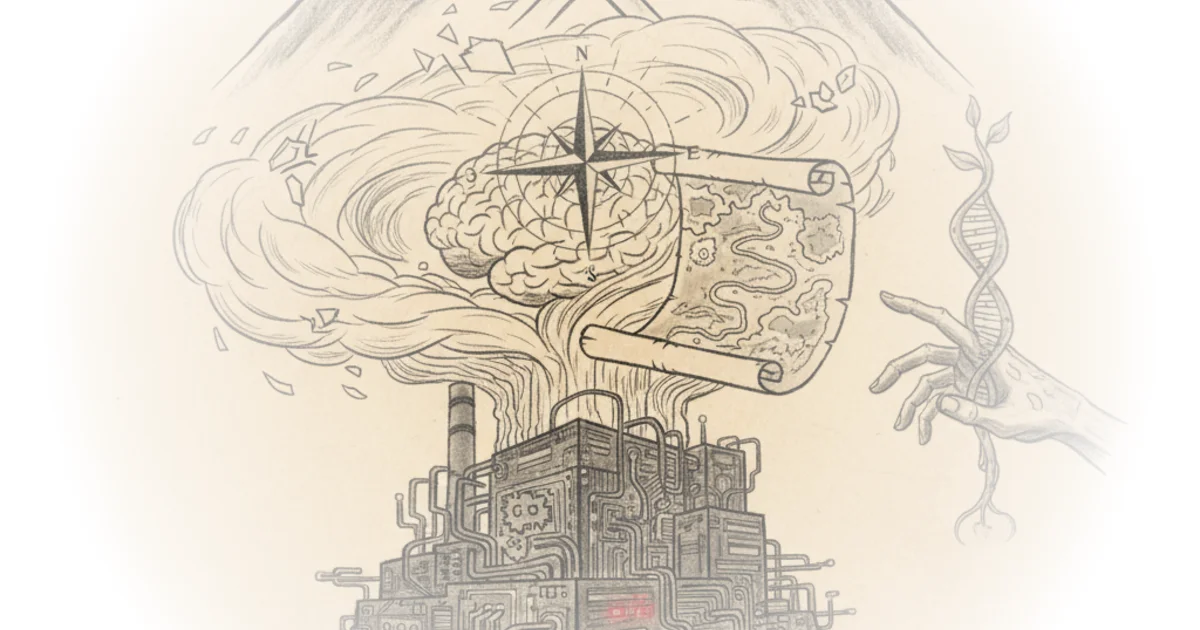
The author effectively bridges the gap between abstract theory and material reality. By juxtaposing Kant's concept of the sublime with the modern "slop in, slop out" phenomenon of AI generation, Mona Mona suggests that the digital age has created a new kind of barrier to human experience. The argument is that when machines generate our culture, the human capacity for genuine surprise and the "sublime" is flattened into predictable data patterns. This framing is particularly effective because it moves beyond the usual fear of "robots taking over" to a more nuanced critique of how our cognitive environment is being homogenized.
"Slop in, slop out" is not just a technical failure; it is a moral one that erodes the very possibility of shared truth.
Critics might argue that focusing on the "compute-industrial complex" overlooks the genuine utility AI brings to healthcare and scientific discovery. However, the piece wisely avoids a Luddite stance, instead urging a re-evaluation of who controls these tools and for what purpose. The emphasis remains on the structural dynamics of power rather than the technology itself.
The Human Cost of Abstract Violence
The roundup shifts with gravity to the human consequences of political and ideological extremism. Mona Mona does not shy away from the visceral reality of conflict, particularly in the selection of Samar Al-Bulushi's work on the policing of Muslims in Kenya. The coverage treats the "War on Terror" not as a distant geopolitical strategy, but as a localized engine of suffering that reshapes entire societies.
Mona Mona writes, "War-Making as Worldmaking: Kenya, United States and the War on Terror" reveals how state violence is not an anomaly, but a deliberate method of constructing a specific political order. This is a crucial distinction. The commentary suggests that the administration's foreign policy choices are not merely tactical errors but are foundational to a worldview that prioritizes security over human dignity. The inclusion of this text forces the reader to confront the reality that "civil society" is often the first casualty of such policies.
The piece also touches on the personal toll of these macro-forces through the lens of existential love and mortality. By pairing a guide to love with Dr. Shoshana Ungerleider's reflections on loss, Mona Mona creates a narrative arc that moves from the systemic to the intimate. The argument here is that in times of peril, the "ideal of self-governance" must begin with the individual's capacity to face their own mortality and the fragility of their relationships.
"Death is universal, but our choices are personal" serves as a reminder that even in the face of overwhelming systemic forces, human agency remains the final frontier.
A counterargument worth considering is whether this focus on individual existentialism risks depoliticizing the structural causes of suffering. If the solution to war and AI enclosure is simply "loving better" or "facing death," does it let the architects of these systems off the hook? Mona Mona balances this by ensuring the structural critiques remain front and center, using the personal only to illustrate the stakes of the political.
The Future of Human Cognition
Finally, the roundup addresses the question of human continuity in the face of potential extinction. The selection of the piece asking, "If humans went extinct, could we re-evolve?" is a bold move. It forces a confrontation with the possibility that our current trajectory is not just unsustainable, but terminal. Mona Mona paraphrases the core of this argument: "Maybe — just don't expect a carbon copy." This is a sobering admission that the specific conditions that allowed for human consciousness may never recur.
This section of the coverage serves as a check against the hubris of the "accelerationist" thinkers mentioned elsewhere in the list. While some argue for speeding up technological change to reach a post-human future, the inclusion of the extinction question suggests that the cost of such acceleration might be the total erasure of the human subject. The commentary implies that the "compute-industrial complex" is not a path to evolution, but a potential dead end.
Bottom Line
Mona Mona's roundup is a masterclass in connecting high theory to urgent reality, proving that philosophy is not a luxury but a survival skill. The strongest element is the seamless integration of the "compute-industrial complex" critique with the human cost of global conflict, creating a cohesive argument for the necessity of human-centered governance. The biggest vulnerability lies in the sheer breadth of the topics, which risks leaving the reader with a sense of overwhelm rather than a clear path forward. However, by grounding these abstract fears in the concrete reality of "migration and self-mutilation as protest" and the policing of marginalized communities, the piece ultimately succeeds in making the philosophical feel undeniably personal.