Matt O'Dowd proposes a startling resolution to the Fermi Paradox: the silence of the universe isn't due to a lack of planets, but because the transition from simple bacteria to complex life is a statistical impossibility that almost never happens. By weaving together recent genomic studies with the history of Earth's oxygen crisis, he argues that we may be the galaxy's only survivors of a brutal evolutionary bottleneck.
The Great Filter in Our Past
The piece begins by dismantling the comforting assumption that life is common. O'Dowd notes that while simple life appeared on Earth quickly, complex life took billions of years to emerge. "This crude statistical calculus is the heart of the Fermi paradox articulated by Enrico Fermi with his 'where is everybody' and that was in 1950 long before we knew about the 10 billion plus earth analogues in the Milky Way alone." The author suggests that the "Great Filter"—a barrier preventing life from becoming a galactic civilization—is likely behind us, not ahead of us. This is a crucial reframing; it implies humanity has already survived the most dangerous phase of evolution.
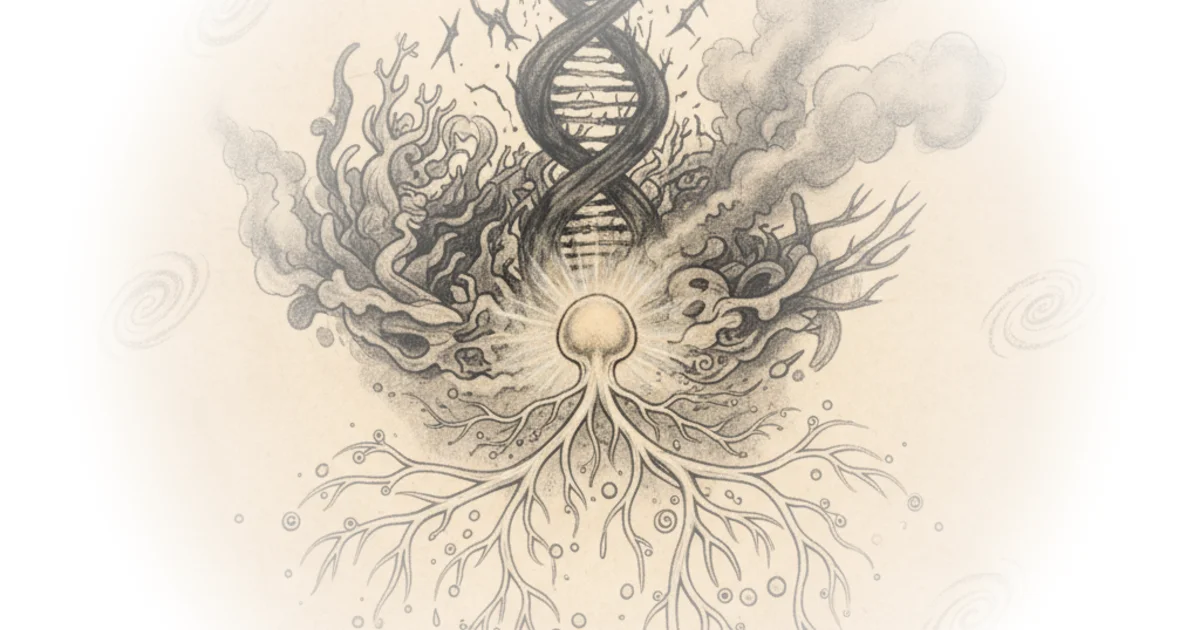
O'Dowd zeroes in on a specific biological event as the likely filter: the birth of the eukaryotic cell. He describes a moment two billion years ago when Earth was nearly sterilized by its own atmosphere. "The evolution of photosynthesis in cyanobacteria led to this green slime covering the planet... This great oxidation event killed nearly everything, which in turn may have precipitated the next cataclysms, a glaciation event exceeding any later ice age leading to a snowball earth epoch." The argument here is that the environment became so hostile that only a freak accident could save life.
"It's the formation of the first eukaryote cell. It was this event that enabled a massive increase in complexity of life including the transition to multicellularity."
The author explains that a single-celled organism, an archaeon, accidentally engulfed a bacterium that became the mitochondria. This wasn't just a merger; it was an energy revolution. Without this symbiosis, cells would hit a physical wall where their energy needs outpace their ability to generate power. O'Dowd writes, "As cell size increases to enable more complexity, the energy requirement increases with the cube of the radius, but energy production only with the square of the radius." This geometric constraint means that without mitochondria, complex life simply cannot exist.
Critics might argue that convergent evolution suggests complex life should arise independently on other worlds, yet the fossil record shows this merger happened only once on Earth. O'Dowd leans into this rarity, calling it a "colossal fluke" that allowed life to survive the oxygen poisoning and subsequent ice ages.
An Algorithmic Phase Transition
The commentary deepens by introducing a recent study by Enrique Muro and collaborators, which adds a computational layer to the biological argument. O'Dowd explains that before eukaryotes, evolution was limited by how fast it could find useful proteins. As proteins got longer, the number of possible shapes grew exponentially, making it computationally impossible for evolution to find new, functional ones within a reasonable timeframe.
"But as evolutionary time went on, a phase transition seems to have occurred. genes continued to grow, but protein lengths capped out at around 500 amino acids and didn't get much longer." The author describes this as an "algorithmic phase transition" where life found a new operating system. Instead of relying solely on protein length for complexity, organisms began using non-coding DNA to regulate gene expression more efficiently.
"In essence, life found a new way to regulate protein transcription and general gene expression that did not depend on the proteins themselves. If DNA is a sort of computer, then life just found a much more efficient operating system."
This dual breakthrough—solving the energy crisis with mitochondria and the computational crisis with non-coding DNA—created the conditions for the "evolutionary big bang" that followed. O'Dowd notes that biologist Nick Lane calls this the "black hole at the heart of biology" because we still don't fully understand the steps between the three great branches of life. The implication for the Fermi Paradox is stark: if both an energy revolution and a genetic software upgrade were required simultaneously, the odds of it happening elsewhere are vanishingly small.
Bottom Line
O'Dowd's strongest move is synthesizing the energetic and computational limits of early life into a single, plausible Great Filter, shifting the narrative from "aliens are hiding" to "aliens never got past bacteria." The argument's vulnerability lies in its reliance on Earth as the only data point; we cannot yet prove that this specific sequence of events is the only path to complexity. However, until we find evidence of extraterrestrial life, the silence suggests we are the lucky outliers who survived a cosmic gauntlet.
"Maybe an early abiogenesis is necessary, even if abiogenesis itself is a low probability event."
The piece leaves the reader with a sobering yet hopeful conclusion: the universe is likely silent not because life is impossible, but because the leap to intelligence is a miracle that almost never occurs.