Brian Merchant dismantles the prevailing narrative that the current administration is merely "deregulating" artificial intelligence. Instead, he presents a startling thesis: the White House is actively constructing a massive, state-directed apparatus to concentrate power, using AI as the ultimate tool for imperial dominance. This isn't about freeing markets; it's about the government taking the wheel, buying equity in private giants, and bypassing local democracy to force a singular vision of technological supremacy.
The Illusion of Deregulation
The piece begins by exposing the visual language of the administration's AI strategy. Merchant notes that the executive branch has embraced a style of AI-generated propaganda he terms "slopaganda." He writes, "Given that it's voluminous and cheap, fundamentally unconcerned with conveying truth or accuracy, free of nuance, and generally adhering to a gaudy, homogenous aesthetic, it's fitting that AI imagery has become an ideal vessel for state expression." This observation is crucial; it suggests that the administration values the projection of power over the accuracy of policy, using synthetic media to visualize conquests that haven't happened, such as the acquisition of Greenland.
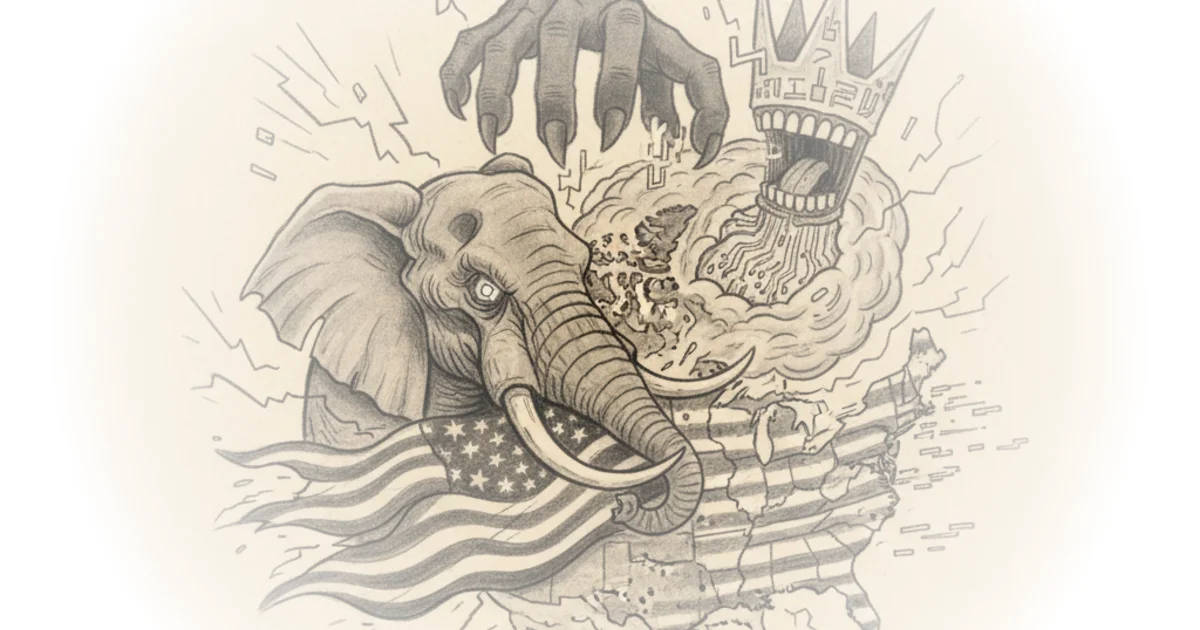
Merchant argues that this aesthetic choice mirrors the policy reality. The administration's push for a federal preemption of state AI laws is often sold as a way to help companies innovate faster. However, the author reframes this as a power grab. "Framed as relief from regulatory burden, preemption represents an aggressive assertion of federal authority that forecloses democratic experimentation at the state level," Merchant writes, citing policy expert Alondra Nelson. This is a sharp pivot in the conversation. It moves the debate from "red tape" to "centralization," suggesting that the goal isn't a free market, but a monopoly on rule-making held by the federal executive.
Critics might argue that a unified national standard is necessary for a technology that operates globally, and that state-level fragmentation could indeed stifle growth. Yet, Merchant's evidence suggests the motivation is less about efficiency and more about insulating policy from local accountability.
The Trump administration is not removing government from AI regulation; it is concentrating governmental power at the federal level while deploying it through mechanisms—investment, ownership, research funding, immigration controls, and preemption—not typically classified as "regulation."
The Big AI State
Moving beyond rhetoric, Merchant details the tangible mechanisms of this "Big AI State." He points to direct financial entanglements that blur the line between public and private sectors. The administration took a 10% stake in Intel and holds equity in eight other private tech firms. Furthermore, a deal with Nvidia allowed the sale of high-tech chips to China in exchange for a 25% revenue share. "That's a huge federal finger now firmly on the scale of the operations of the single most valuable company... on the planet," Merchant observes. This level of direct ownership transforms the government from a regulator into a shareholder with a vested interest in the success of specific corporations.
The author also highlights how the executive branch is clearing the path for massive infrastructure projects. By issuing executive orders to bypass environmental reviews and leasing public lands for data centers, the state is effectively subsidizing the build-out of the AI industry. Merchant cites Brian J. Chen's research, noting that the government is "derisking domestic infrastructure investments" while simultaneously "leveraging commercial diplomacy to open new markets for foreign data centers." This creates a feedback loop where the state funds the infrastructure, the private sector builds the tech, and the government secures geopolitical influence through the export of that technology stack.
The convergence of these interests raises a critical question about the future of the industry. If the state is so deeply invested, what happens if the market falters? Merchant suggests that a "semi-nationalized OpenAI is entirely thinkable" if investors pull back. This possibility challenges the core tenet of Silicon Valley's self-image as a purely private, market-driven ecosystem.
The Imperial Ambition
Ultimately, Merchant argues that the driving force behind this statist approach is a desire for dominance. The administration views AI not just as a tool, but as a lever for control. "To secure US dominance of AI, the federal government is organizing the AI industry in three ways," Merchant summarizes Chen's findings, listing derisking, diplomacy, and equity investment. The goal is to ensure that whoever controls the energy, the chips, and the data centers holds the world's attention.
The author posits that this alignment serves the administration's transactional nature. By controlling the infrastructure and the regulatory environment, the executive branch holds the industry hostage, ensuring that the world's richest men and largest companies remain dependent on federal largesse. "It thus offers the federal executive a huge amount of leverage over anyone who wishes to build that technology," Merchant writes. This transforms the relationship between Washington and Silicon Valley from a partnership into a hierarchy, with the state firmly at the top.
The Trump administration is regulating the AI industry to achieve both a specific vision of imperial and expansionist American power, and to suit its executive's own whims as a gangster capitalist.
Bottom Line
Brian Merchant's most compelling contribution is his ability to reframe "deregulation" as a sophisticated form of state capture, where the government becomes the primary investor and enforcer of a specific technological destiny. The argument's greatest strength lies in its synthesis of policy papers and financial data to reveal a coherent, albeit authoritarian, strategy. However, the piece leans heavily on the assumption that this centralization will inevitably lead to imperial overreach, potentially underestimating the resilience of market forces or the internal friction within the administration's own tech elite. Readers should watch closely for how the government's equity stakes in private firms evolve, as this will be the true litmus test for whether AI remains a private enterprise or becomes a state asset.