In a culture that often polishes parenthood into a series of curated, floral moments, Wayfare offers a jarringly honest counter-narrative: the most profound love is not found in perfection, but in the gritty, messy work of loving broken people. This piece reframes a beloved children's hymn not as a saccharine ode to idealized motherhood, but as a radical act of grace extended to a mother who was, in reality, "a shattered and unknowable non-personity." For busy listeners navigating the exhaustion of modern family life, this is not just a Mother's Day reflection; it is a necessary permission slip to stop apologizing for the inevitable failures of the home.
The Myth of the Angel Mother
Wayfare begins by dissecting the lyrics of "I Often Go Walking," a song written by illustrator Phyllis Kay Luch for the Church of Jesus Christ of Latter-day Saints children's songbook. The piece notes that while the lyrics paint a picture of "meadows of clover" and "blossoms of blue," the reality of parenting is often far less picturesque. The editors argue that the song's true power lies in its author's personal history, which contradicts the idyllic imagery. Wayfare reports, "I often feel real cognitive dissonance between the work of motherhood in daily life and the sincere praises of mothers featuring images of flowers and fragrances and meadows."
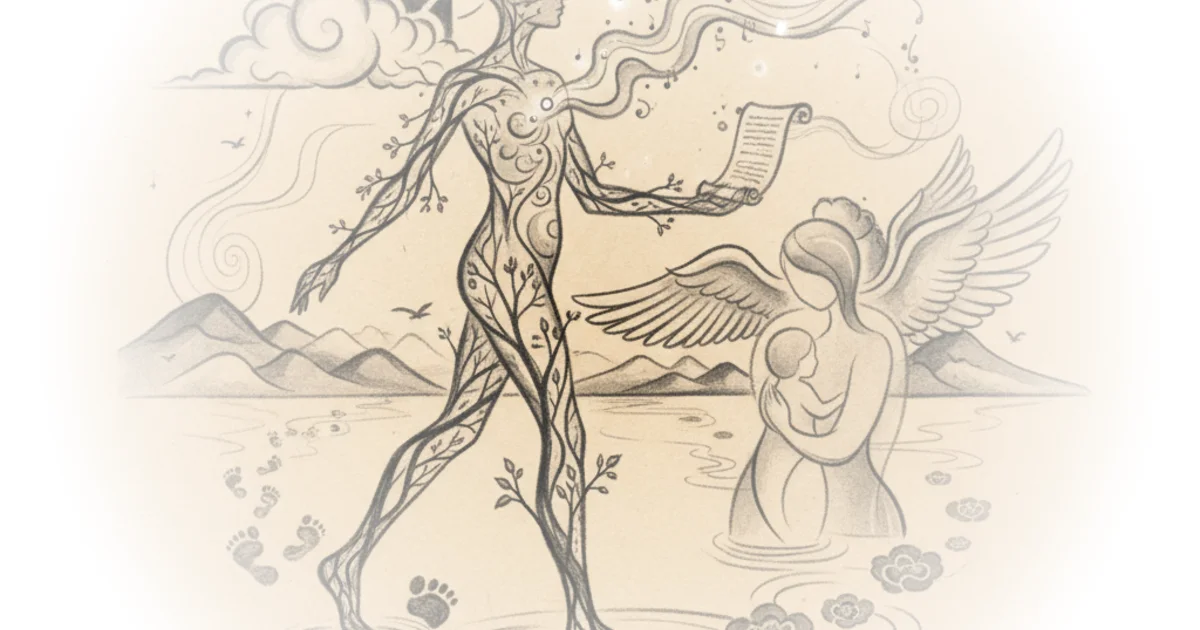
This dissonance is the piece's central tension. It acknowledges that for many, parenting is "without a doubt, the ugliest work I do," involving sleep deprivation, emotional labor, and moments where one must "sit by myself in a corner for a few minutes to avoid shouting." The commentary here is effective because it validates the hidden struggles of parents who feel they are failing at the very institutions they care about most. It challenges the notion that spiritual or familial success is measured by a lack of conflict.
"No other success can compensate for failure in the home."
The piece invokes a famous quote from church leader David O. McKay to highlight the high stakes of family life, yet immediately pivots to the reality that no family is perfect. Wayfare argues that the search for a flawless family unit is futile, noting that "the history of humanity has been a record of thoroughly imperfect families." From biblical figures like Cain and Abel to the author's own great-grandmother, who kept a planner of grievances, the text suggests that brokenness is the default human condition, not an anomaly. Critics might argue that this focus on failure could induce guilt rather than relief, but the piece counters this by framing imperfection as a shared legacy rather than a personal defect.
The Mulch of Brokenness
The narrative deepens as Wayfare explores the specific, harrowing context of Phyllis Kay Luch's life. The author reveals that Luch, the song's creator, did not have an "angel mother" but rather a mother suffering from severe schizophrenia, describing a childhood filled with "hallucinations, crazy gestures, violent and vulgar behaviors." Despite this, Luch wrote a hymn expressing love and gratitude. Wayfare posits that the song is not a lie about a perfect past, but a "peace offering, a clenched fistful of flowers, an exercise in gritty love extended to a mother in full view of her failures."
This reframing is the article's most compelling contribution. It suggests that the act of loving a difficult parent is not about ignoring their flaws, but about transforming them. The piece draws a powerful parallel to the author's own experience of being accused of child abuse and investigated by the state, a trauma that forced her to confront her own vulnerability and the judgment of others. Wayfare notes, "The intense, painful, and public scrutiny of my parental weaknesses was a lesson in turning my heart to my foremothers and forefathers."
The argument here is that shared brokenness creates a unique capacity for empathy. By acknowledging their own failures, parents can extend "frank honesty and healing compassion" to their own families. The piece suggests that we do not turn our hearts to our parents because they were easy to love, but because the effort itself is redemptive. As Wayfare paraphrases Luch's philosophy: "We can use our failures, hurts, bad circumstances, etc. as dirt to cover ourselves with or as mulch to grow a violet or a sunflower or a giant redwood."
"We cannot promise you safety... But we commit our love to you. And you are being rescued now, by love."
This perspective aligns with the broader theme of "Good enough parent" found in related Wayfare deep dives, suggesting that the goal of parenting is not to create a sterile, safe environment, but to provide a steadfast love that persists even when safety cannot be guaranteed. The author shares a blessing given to her son during a period of custody uncertainty, emphasizing that love can "forge, save, guide, become" a child even in the absence of stability.
The Legacy of Gritty Love
The piece concludes by expanding the definition of family legacy. It moves away from the idea of inheriting only "godliness" or success, and instead embraces a "terribly complex legacy of profoundly flawed matriarchs and patriarchs." Wayfare argues that this inheritance includes both "glories and failures," and that the work of family is to "take part in the often ugly work of loving."
The editors suggest that this "laboring love" is what ultimately saves us. It is a love that "must withstand tantrums and shouting, generational hurts and broken hearts" and is capable of being "knocked down over and over again and keep returning." This is a stark contrast to the commercialized, frictionless version of family life often presented in media. The piece asserts that the true miracle of family is not the absence of pain, but the persistence of care in the face of it.
Critics might note that this narrative places a heavy emotional burden on individuals to forgive and love those who have caused them deep harm, potentially minimizing the need for boundaries or justice in cases of abuse. However, the piece carefully distinguishes between toxic behavior and the human condition, emphasizing that the "mulch" of failure is meant to be transformed, not endured passively. The focus is on the transformative power of the love offered, rather than the merit of the recipient.
Bottom Line
Wayfare's most powerful argument is its reclamation of the "ugly work" of parenting as a sacred, redemptive act rather than a source of shame. By grounding its emotional appeal in the specific, painful history of Phyllis Kay Luch, the piece avoids the trap of generic sentimentality. Its greatest vulnerability lies in the immense emotional labor required to practice this kind of love, a burden that may feel insurmountable for those currently in crisis. Ultimately, the piece offers a vital reminder: the goal of family is not to be a garden of perfect flowers, but a place where broken soil can still grow something beautiful.