In a legal landscape where climate litigation is rapidly shifting from emissions targets to accusations of corporate deception, a new amicus brief filed for the Supreme Court case Suncor Energy v. Boulder County argues that local governments are overstepping constitutional boundaries. The piece, published by Reason, contends that these lawsuits effectively criminalize scientific debate, turning the courtroom into a venue for punishing unpopular speech rather than adjudicating damages. This is not merely a procedural dispute; it is a high-stakes test of whether the First Amendment protects the right of corporations to participate in public policy debates without fear of ruinous liability.
The Shift from Emissions to Speech
The core of the argument rests on a strategic pivot by plaintiffs. Reason reports that "trying to avoid federal preemption, plaintiffs in this and other climate-change cases have shifted from claims targeting emissions to claims alleging supposed 'deception.'" By framing the issue as one of marketing fraud rather than environmental harm, local governments attempt to bypass the federal government's exclusive authority over interstate commerce. However, the piece argues this maneuver fails because the underlying injury is still tied to emissions, which are inherently national in scope.
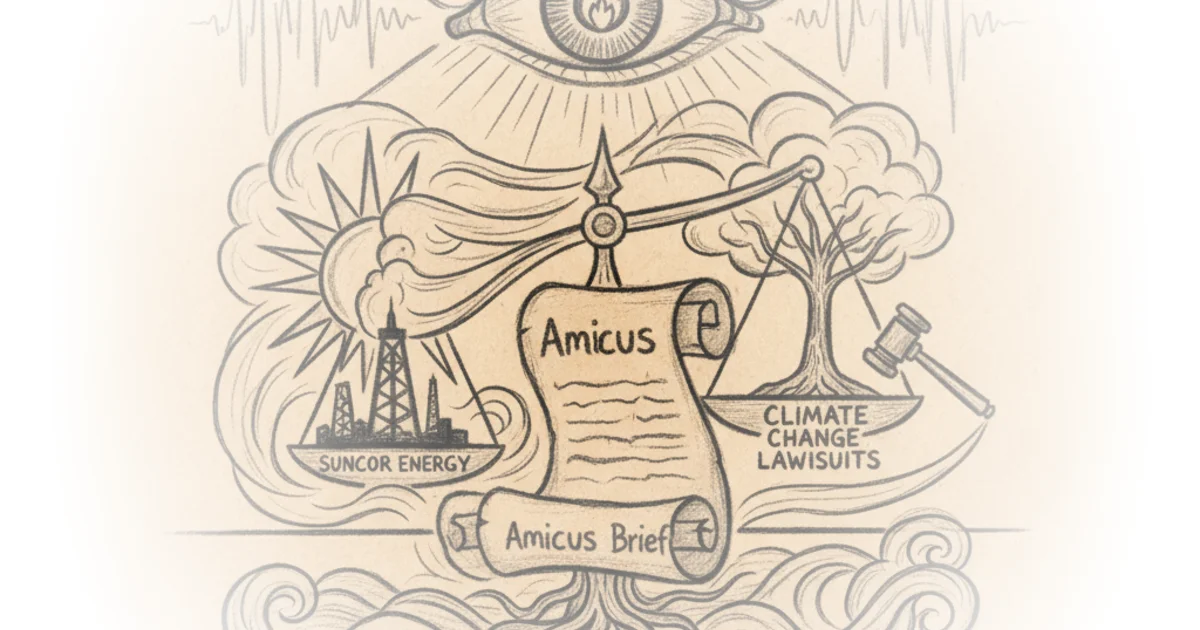
The brief warns that this approach creates a dangerous precedent where local jurisdictions become arbiters of scientific truth. "The danger to First Amendment rights is another reason favoring uniform national regulation of these issues as opposed to opportunistic state and local overreach that seeks to punish and suppress speech and debate on this controversial topic," the editors note. This framing is particularly sharp because it highlights the fragmentation risk: if every county can define what constitutes "truthful" climate science, the result is a patchwork of conflicting regulations that chills national discourse.
Critics might argue that corporations have historically used litigation to silence valid public health concerns, and that allowing unfettered speech on environmental risks could delay necessary policy action. Yet, the brief counters that the solution to bad science is more speech, not state-enforced silence.
The Peril of State-Enforced Truth
The piece leans heavily on Supreme Court precedent to dismantle the idea that the government can penalize "false" speech on matters of public concern. It cites United States v. Alvarez, where the Court recognized that "there are broad areas in which any attempt by the state to penalize purportedly false speech would present a grave and unacceptable danger of suppressing truthful speech." The argument extends this logic to climate science, noting that "it is perilous to permit the state to be the arbiter of truth."
This is a powerful invocation of judicial restraint. The brief suggests that when juries in ideologically homogeneous communities decide what is "true" about climate science, they are essentially acting as censors. As Reason points out, "Jurors may take the same view [that the science is settled]... Especially in relatively ideologically homogeneous communities, such jurors may well form the required supermajority for imposing massive liability on those with whom they disagree."
It is perilous to permit the state to be the arbiter of truth.
The argument draws a parallel to historical shifts in scientific consensus, reminding readers that challenging conventional wisdom is often the foundation of progress. The piece notes that resolving policy implications of scientific debates is left "to the people, their elected representatives, and the democratic process," not to local juries deciding liability. This echoes the spirit of the 2002 term per curiam opinions, where the Court often emphasized the limits of local authority when it conflicts with broader constitutional principles, much like the Commerce Clause debates that have long defined the balance between state and federal power.
Corporate Speech and the Public Square
Perhaps the most contentious part of the brief is its defense of corporate speech. Reason argues that while commercial advertising receives less protection, "a company has the full panoply of protections available to its direct comments on public issues." The piece distinguishes between selling a product and participating in a public debate about the product's impact.
Citing Consolidated Edison Co. v. Public Service Commission, the editors note that an energy company promoting a controversial energy source was engaging in protected speech. "The First Amendment's protections of speech and press were 'fashioned to assure unfettered interchange of ideas for the bringing about of political and social changes,'" the brief quotes from a dissent in Nike, Inc. v. Kasky. This reasoning is crucial: it asserts that listeners need to hear from both sides of the debate, even if one side has a financial stake in the outcome.
The piece warns against a double standard where critics of fossil fuels can speak freely, but defenders face liability. "The government 'has no ... authority to license one side of a debate to fight freestyle, while requiring the other to follow Marquis of Queensberry rules,'" it argues. This analogy effectively frames the issue as one of fairness and free exchange rather than corporate privilege.
However, a counterargument worth considering is whether the sheer scale of corporate resources creates an imbalance that distorts the "marketplace of ideas," potentially drowning out genuine public concern. The brief assumes a level playing field that may not exist in practice, where the volume of corporate messaging can overwhelm community voices.
Bottom Line
The brief's strongest asset is its rigorous application of First Amendment doctrine to a modern, high-stakes policy debate, effectively arguing that local courts are ill-equipped to adjudicate complex scientific questions without infringing on free speech. Its biggest vulnerability lies in the assumption that the "marketplace of ideas" functions equally for all speakers, potentially underestimating the real-world impact of corporate dominance in public discourse. As this case heads to the Supreme Court, the decision will likely define the boundaries of corporate speech and the limits of local climate litigation for decades to come.