This piece cuts through the noise of daily headlines to expose a terrifying reality: the world's most advanced air defense systems are being stretched to a breaking point, creating a global vacuum that threatens to collapse the security architecture of Europe and the Pacific simultaneously. Mick Ryan doesn't just report on missile counts; he connects the dots between a refinery fire in Russia, a power outage in Crimea, and a strategic gamble in Taiwan, revealing how a single shortage of interceptors is reshaping the calculus of war for three continents.
The Interceptor Dilemma
Ryan opens with a stark admission from President Zelenskyy regarding the desperate scarcity of protection against ballistic missiles: "In 2026, there are fewer of these missiles. Monthly deliveries were higher in 2025." This reversal of fortune is the central tension of the article. Ryan argues that the United States, as the primary manufacturer of the Patriot system, is facing a "doom loop" where commitments to the Middle East directly cannibalize supplies for Ukraine. He notes that every Patriot interceptor consumed in the Gulf is one that cannot be provided to Kyiv, a trade-off that has left Ukraine with "fewer missiles being shot down" despite a sustained barrage.
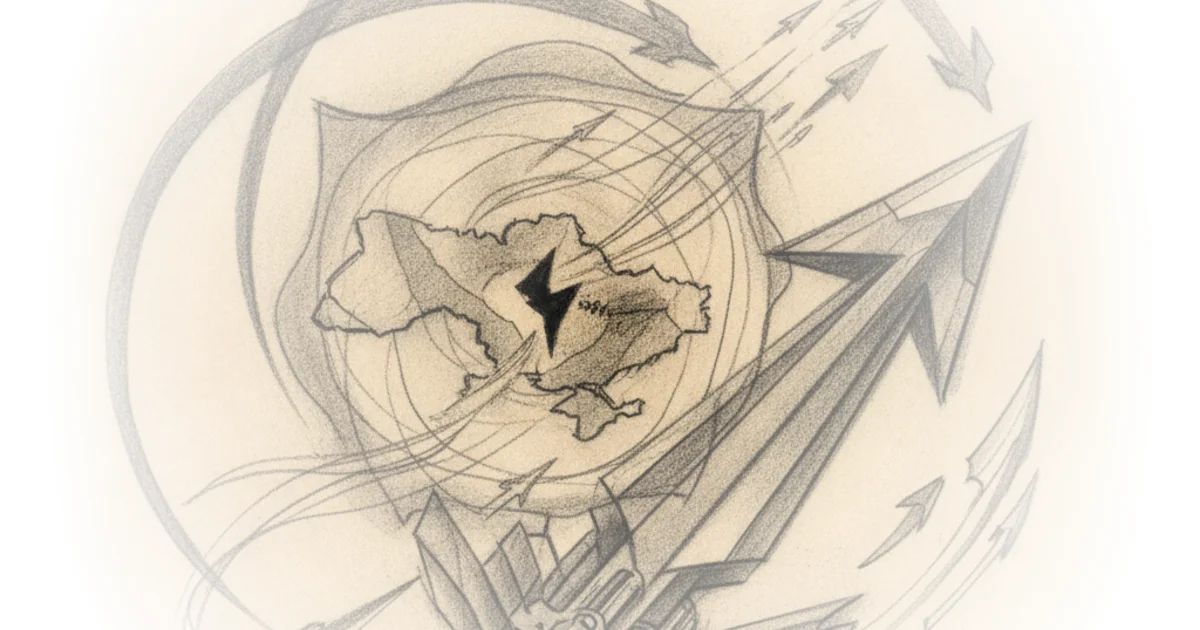
The author leans on data from the Center for Strategic and International Studies (CSIS) to illustrate the severity of the depletion, estimating that Washington has burned through more than half its PAC-3 MSE stock and nearly half its THAAD inventory. Ryan writes, "Patriot holdings have fallen from 2,300 rounds in February to around 800 or 900 today." This is not merely a logistics problem; it is a strategic crisis. While production is ramping up, Ryan points out the grim timeline: "The expanded production will not be complete until at least 2030." For the civilians in Ukraine facing nightly blitzes, a three-year gap in production is an eternity.
Critics might argue that focusing solely on the Patriot shortage ignores the effectiveness of Ukraine's own asymmetric warfare, but Ryan's data on interception rates suggests the defensive gap is widening dangerously. He highlights that in July, only 29 of 195 Russian ballistic missiles were intercepted, and on August 5, Ukraine failed to bring down a single one.
"The way that America manages its protracted crisis with Iran, including its strategic decision-making, munitions stockpiles and alliance relations, is being studied closely in Beijing."
This observation is the article's most chilling insight. Ryan suggests that the current strain on US defense stocks is not just a tactical issue for the Middle East or Europe, but a strategic signal for China. Planners in Beijing are watching how the executive branch handles the "contradictory signals" of the Iran negotiations to gauge American endurance before any potential confrontation over Taiwan.
The Asymmetric Response
With traditional air defense failing, Ryan details Ukraine's pivot to a "forty-day campaign" designed to coerce Russia by striking its military-industrial base and energy exports. The author describes this as an effort aimed at the "systematic destruction of military aviation and air defence," a strategy that has moved beyond the frontline to hit targets deep inside Russia. Ryan notes that Ukraine has now hit 21 of Russia's 38 large refineries, a campaign that has directly contributed to a fall in Russian refining capacity from roughly 5.2 million barrels a day to 3.8 million.
However, Ryan does not shy away from the human cost or the asymmetry of this exchange. While Ukraine strikes refineries, he reports that "more than eighty percent of Ukraine's power generation capacity has been destroyed or damaged by Russian strikes." This creates a brutal paradox: Ukraine is successfully degrading Russia's economy while its own cities are being plunged into darkness. The author frames this not as a victory, but as a grinding contest where the "underlying strategy of Russia's war against Ukraine is so poor" that even leadership changes, like the recent reshuffle of Russia's senior military, are unlikely to alter the outcome.
Ryan also touches on the complex role of technology, noting that the campaign is complicated by the refusal of private entities to support certain targeting efforts. He writes, "This will be complicated by the fact that Elon Musk has apparently refused to allow the use of Starlink in targeting Russian missile production and launch facilities." This highlights a new frontier in modern warfare where private corporate policy can directly constrain military operations, a dynamic that is rarely discussed in official briefings.
The Pacific Shadow
The article's scope expands to the Pacific, where Ryan draws a direct line between the Middle East's instability and the drills occurring in Taiwan. He describes Taiwan's "Han Kuang" exercise as a rehearsal for war, noting that "President Lai Ching-te was moved by armoured personnel carrier from the Presidential Office to a fortified command centre in a rehearsal of continuity of government." Ryan connects this to the broader theme of decapitation strikes, noting that "the recent decapitation strikes against Iran's leadership, and Russia's attempts to murder the Ukrainian president, add relevance to Taiwan's preparations."
This section is particularly potent because it moves the reader from the immediate tragedy in Ukraine to the looming threat in the Indo-Pacific. Ryan points out that Taiwan's defense spending is projected to exceed one trillion New Taiwan dollars, a clear signal of preparation. He writes, "This is a pointed message from the Taiwanese government about its willingness to defend territory where any Chinese move short of full invasion is most likely to begin."
The historical context here is vital. Just as the MIM-104 Patriot system was developed in the 1980s to counter Soviet ballistic missiles, today's systems are being tested against a different kind of saturation attack. The article suggests that the lessons learned from the "constant search for protection against ballistic missiles" in Ukraine are being applied in real-time to the defense of Taiwan.
The Human Calculus
Ultimately, Ryan's framing centers on the "brutal calculus" of modern conflict. He argues that Russia is now facing a strategic dilemma where it must choose between defending its heartland or holding onto occupied Crimea. "Crimea is now drawing more air defence and naval assets at exactly the same time as Ukraine's long-range strikes into the Russian heartland... are demanding those same assets to the north," Ryan writes. This creates a situation where "Russia cannot adequately defend both without accepting greater risk somewhere else."
The author concludes that the reshuffle of Russian military leadership is a reaction to this impossible geometry. "Putin will have to make tough strategic decisions about the apportionment of military forces and effort," Ryan asserts. But the cost of these decisions is measured in human lives. The article reminds us that behind the statistics of intercepted missiles and destroyed refineries are civilians losing their homes, their power, and their safety.
"Crimea and the Russian interior are no longer separate problems for Russian planners to solve sequentially. They are a single, unified target set for the Ukrainians."
This unification of the target set is the core of Ryan's argument: the war has evolved from a territorial dispute into a systemic war of attrition against the entire Russian state. The "switching off" of Crimea is not just a tactical victory; it is a strategic signal that the occupation is becoming unsustainable.
Bottom Line
Mick Ryan's strongest argument is the seamless connection between the depletion of US missile stocks and the strategic anxiety in Beijing, a link that transforms a regional conflict into a global security crisis. The piece's greatest vulnerability lies in its reliance on the assumption that Ukraine's asymmetric strikes will force a strategic collapse in Moscow, a outcome that remains uncertain despite the data on refinery damage. Readers should watch closely for the next phase of the "Forty-Day Campaign" and whether the US can ramp up production fast enough to prevent a total collapse of Ukraine's air defense before 2030.