Laura Rozen cuts through the noise of recent elections to deliver a stark diagnosis: the administration's political vulnerability stems not from culture wars, but from a profound disconnect between lavish executive displays and the crushing reality of household budgets. While other commentators chase polling fluctuations, Rozen anchors her analysis in the visceral contrast between a $300 million ballroom project and the sudden cutoff of food assistance for millions, arguing that this dissonance is what actually flipped the electorate. This is not just a story about who won; it is a case study in how the executive branch's priorities can alienate its own base when the cost of living becomes the only metric that matters.
The Architecture of Disconnection
Rozen's central thesis rests on the idea that the administration's focus on aesthetic grandeur has backfired spectacularly. She writes, "Trump has shown himself to be particularly tone deaf and out of touch with the struggles of most Americans, showing off more (and more) gold filigree and tchotchkes adorning the Oval Office while levelling the White House East Wing to build a $200-$300 million, 90,000 square foot ballroom." This framing is potent because it moves beyond abstract policy disagreements to concrete, visual symbols of excess during a time of scarcity. The argument gains traction when Rozen juxtaposes these renovations with the timing of the government shutdown and the suspension of Supplemental Nutrition Assistance Program (SNAP) benefits. She notes the administration's decision to host a lavish "Great Gatsby"-themed party "the day before SNAP food benefits were cut off for over 40 million Americans last week."
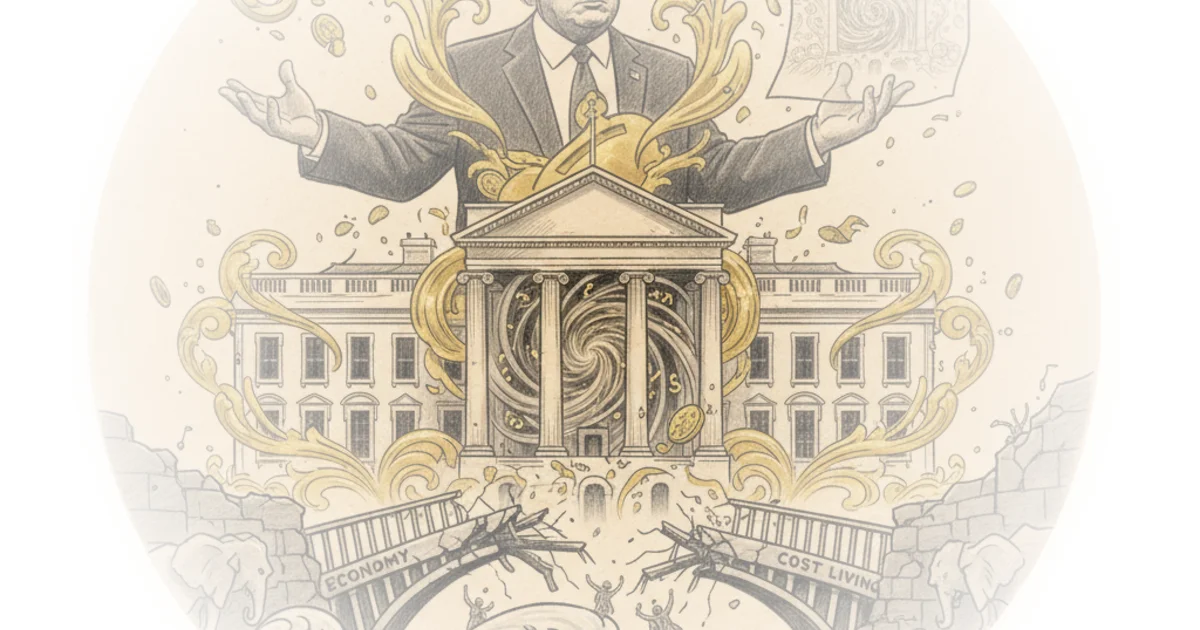
This specific sequencing is the piece's most damaging evidence. It suggests that the administration is not merely ignoring economic pain, but actively signaling that it is irrelevant to the executive's vision. Critics might argue that political campaigns often exaggerate the impact of single events, yet the sheer scale of the disconnect Rozen highlights makes the counterargument difficult to sustain. The visual of a ballroom rising while families face hunger creates a narrative of misplaced priority that polling data seems to confirm.
"The Democrats' sweeping victory on Tuesday may have made an impression on Trump and his GOP allies … But his party's political fate may hinge instead on pocketbook issues like the cost of groceries, gas and health insurance."
The Numbers Behind the Narrative
Rozen leans heavily on polling data to substantiate the claim that the administration has lost the economic argument. She cites an NBC News survey showing that "only 34% of registered voters believe the Trump administration has lived up to expectations on the economy, while 63% say it has fallen short." This statistic is not just a number; it represents a fundamental erosion of the administration's core competency claim. Rozen points out that the administration's response has been reactive and sparse, noting that while the President recently posted that "'affordability is our goal,'" this was "only the fourth time he'd done so in a post since he returned to office last January."
The scarcity of this rhetoric in the face of overwhelming public concern underscores the administration's lack of a coherent economic narrative. Rozen argues that the administration's meandering focus has given Democrats ample ammunition. She writes, "Trump's own meandering focus on the economy has given plenty of fodder to Democrats," specifically citing the demolition of the Rose Garden and the remodeling of the Lincoln bathroom as distractions that failed to resonate with voters worried about inflation. The data supports this: only 27% of voters in a CNN poll believed the administration's policies had improved economic conditions. This is a damning indictment of an administration that has spent significant time on foreign policy and domestic aesthetics while domestic economic indicators have stalled.
The Coalition Shift
Perhaps the most significant insight Rozen offers is that the administration is losing not just independent voters, but its own supporters. She highlights that Democratic candidates in Virginia and New Jersey "flipped 7% of Trump voters," a statistic that Rozen explains is "twice as significant as turning out a new voter" because it represents a net swing of two votes. This shift is not limited to traditional swing voters; Rozen notes that the administration is "hemorrhaging Hispanic support," with exit polls showing a dramatic reversal in New Jersey where a Democratic candidate won Hispanic voters by 37 points.
This erosion of the base is critical. Rozen writes, "It's not just Democratic voters who are blaming Trump for the poor economy." The argument here is that the administration's failure to address the cost of living has fractured the coalition that brought it to power. The focus on dismantling parts of the federal government, which was a campaign promise, is now being viewed by these voters as a direct threat to their economic stability. Abigail Spanberger's victory in Virginia, for instance, was driven by highlighting the "fallout for the state's economy from Trump's efforts to dismantle parts of the federal government." This suggests that the administration's strategy of reducing government capacity is backfiring, as voters perceive it as a reduction in support services rather than a liberation from bureaucracy.
"Voters are unhappy about the economy and are starting to blame Republicans instead of Democrats."
Bottom Line
Rozen's commentary is a masterclass in connecting specific, tangible actions of the executive branch to broad electoral consequences, proving that the administration's obsession with image is actively costing it the economy it claims to manage. The piece's greatest strength is its refusal to treat the election results as a generic political shift, instead pinpointing the exact moments of disconnect—like the ballroom construction and the SNAP cutoff—that drove voters away. The biggest vulnerability in this analysis is its reliance on the assumption that the administration will learn from these losses; history suggests the executive branch often doubles down on its aesthetic and ideological priorities rather than pivoting to the pragmatic concerns of the electorate.