Here's why you should care about Albert Camus: he wrote one of the most devastating critiques of capital punishment in modern philosophy—and he did it while living in a society that still used the guillotine.
Stephen West makes this clear in his analysis of The Rebel, the 1951 essay where Camus builds his case for justice not as an abstract system of laws, but as something embodied in human experience. This isn't academic theory—this is a philosopher asking what it means to say "no" to oppression and mean it.
The Slave Who Says No
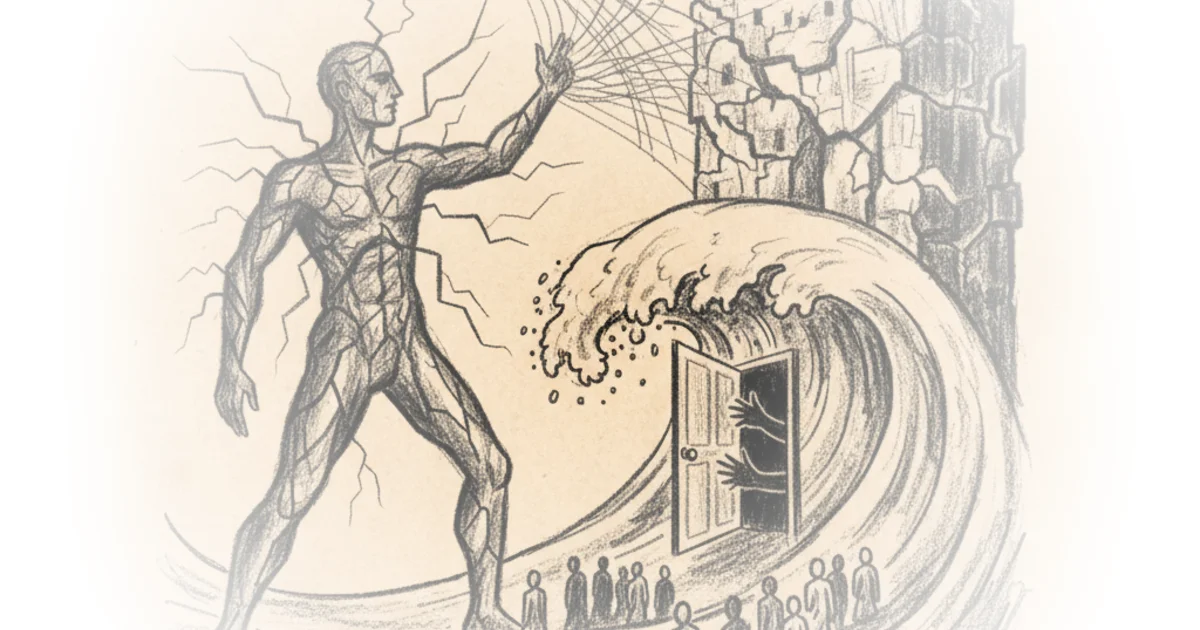
Camus opens The Rebel with a striking image: imagine a slave who has spent their entire life taking orders, then suddenly refuses to obey a new command. What are they saying when they say no?
They're drawing a line. This far, but no farther. The slave is affirming that there are things which cannot be done to them—boundaries in their own experience that matter. And crucially, by affirming their own line, they're simultaneously affirming that others have lines too. Every act of rebellion invokes a value: the preservation of limits where human dignity cannot be violated.
This leads Camus to his famous reformulation of Descartes: instead of "I think, therefore I am," he offers "I rebel, therefore we exist."
Solidarity Meets Justice
This is how solidarity connects to justice in Camus's thinking. Justice isn't a theoretical system or an external set of norms—it's a metaphysical posture toward the world. It's descriptive rather than normative. It's something embodied, not abstract.
When rebellion genuinely aims at human dignity within real limits, it remains true rebellion. But when it starts making exceptions for itself—when it decides certain people no longer have rights—it transforms into something else entirely.
The Premeditated Crime of Capital Punishment
Camus's critique of the death penalty is perhaps his most controversial position. He understands where people are coming from when they support it: find the most horrific crime, and it's easy to justify wanting someone dead.
But Camus points out the contradiction. In the name of protecting the sanctity of life, society kills this person against their will. This is exactly what extremist ideologies do—they trample on people's rights in the name of a cause. They become the oppressors they claim to try to stop.
He writes: "We are living in the era of premeditation and the perfect crime." A criminal might have an excuse—passion, anger, poor judgment. But the legal system that hands out death sentences has planned, justified, and rationalized murder with far more premeditation than any individual act of violence.
In Camus's view, this is human sacrifice dressed up in legal procedures.
How Rebellion Becomes Extremism
The French Revolution started with a genuine attempt to secure liberty, equality, and fraternity. But the moment it decided it was justified in killing Louis XVI and his ministers, it transformed into the Reign of Terror.
Communism began with philosophy rooted in preserving individual liberty. The moment that movement decided it was justified in killing oppressors in the name of a better society, it enabled labor camps, propaganda barriers, and the reduction of people to rational cogs in an abstract system.
This pattern appears throughout history: movements start as genuine attempts to protect human dignity, then transform into something else when they remove limitations on who deserves protection.
Critics might note that Camus's position on the death penalty assumes a universal concept of human dignity that not everyone shares. Some philosophical traditions argue that dignity itself is culturally constructed rather than grounded in any universal nature—a counterargument worth considering given how differently various societies have defined what counts as dignified treatment.
"I rebel, therefore we exist." This is Camus's reformulation of Descartes—and it's the foundation for his entire philosophy of justice.
Bottom Line
Camus's core argument remains powerful: justice isn't an abstract system but something lived and embodied. His biggest vulnerability is practical—moving from philosophical critique to political action requires concrete alternatives, which he doesn't fully provide. But his analysis of how movements fail when they start making exceptions for themselves? That's the part worth taking seriously. Watch for it in any movement that claims to preserve dignity while deciding some people have forfeited their rights.