Richard Hanania delivers a counterintuitive diagnosis for our fractured age: while the public square has descended into chaos, the highest tier of intellectual discourse is simultaneously becoming more rigorous. He argues that the internet has not merely amplified noise, but has also enabled a "great human capital divergence" where sophisticated thinkers can now bypass traditional gatekeepers to collaborate with unprecedented speed. This is not a story of decline, but of a widening gap between the masses and the elite, a dynamic that reshapes how we understand polling, scientific consensus, and voter behavior.
The Great Divergence in Public Thought
Hanania begins by acknowledging the obvious rot in our political culture. "Ten years ago, anti-vaxxers did not have any role in national politics. Now they're running HHS," he notes, highlighting the collapse of traditional filters. He contrasts the relatively contained conspiracy theories of the Obama era—such as the false claims about the president's birthplace—with the surreal, personalized delusions dominating current right-wing circles, like the belief that a prominent activist was monitored as a child. The removal of curators like TV producers and magazine editors has allowed "crude prejudice, quack health beliefs, conspiracy theories, and primitive tribalism" to flourish.
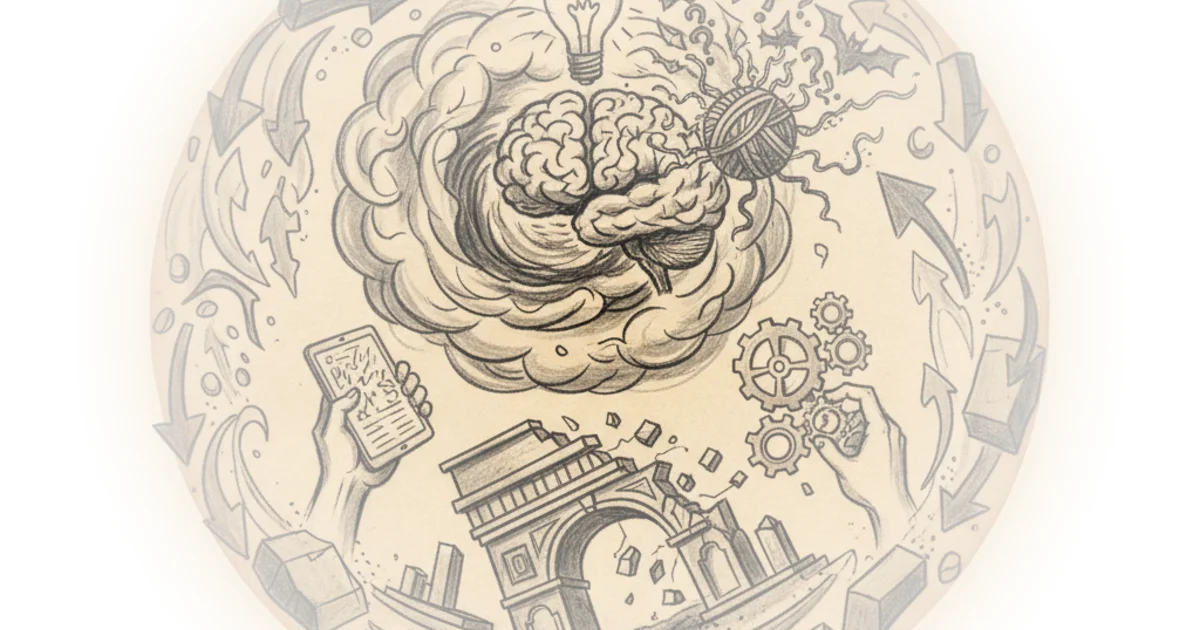
Yet, Hanania refuses to accept a purely pessimistic narrative. He posits that the same technology that democratizes misinformation also empowers truth-seekers. "Fools can now find one another much more easily and reinforce each other's views. But the same is true for smart people with good epistemological standards," he writes. This dual reality means that while the median quality of discourse may have dropped, the ceiling has been raised. We are seeing a bifurcation where the most capable minds are accessing faster, more copious information and forming tight-knit collaboration networks on platforms like Substack and X.
"Dumb beliefs have always been prevalent, but political debates were previously curated by people like academics, TV producers at major channels, and newspaper and magazine editors. With that gone, the discourse surrounding politics increasingly resembles the broad spectrum of public opinions and attitudes."
Critics might argue that this "divergence" simply entrenches an intellectual elite, leaving the general public further behind and making democratic consensus even harder to achieve. However, Hanania's point is descriptive, not prescriptive: the tools for high-level analysis are now available to those willing to use them, regardless of institutional affiliation.
A New Maturity in Forecasting and Statistics
The article's most compelling evidence for this intellectual maturation comes from the world of election forecasting. Hanania revisits the 2016 election, where a sharp divide existed between Nate Silver's probabilistic models and the near-certainty expressed by outlets like the Princeton Election Consortium and the Huffington Post. The latter groups assumed that polling errors in different states were independent events, calculating Trump's odds of winning as a near-zero probability. Silver, however, correctly identified the possibility of "correlated errors"—the idea that if polls missed in one state due to a nationwide factor, they would likely miss in others.
"Silver was of course correct," Hanania states, noting that the real-world outcome forced a reckoning among the educated class. He highlights a pivotal moment of intellectual honesty: Ryan Grim of the Huffington Post publicly apologized to Silver, admitting, "Yes. You were right that there was far more uncertainty than we were accounting for. I apologize. Gonna stick to punditry." This concession marked a shift. Since then, as Hanania observes, "nobody serious was talking about [Biden] having anywhere close to a 99% chance of winning the election" in 2020. The discourse has moved from false certainty to a more nuanced understanding of statistical uncertainty.
This evolution mirrors the broader "replication crisis" in social science that began in the early 2010s. Hanania argues that the era of treating a single study as a definitive truth is over. He describes the old, flawed method where a researcher might test dozens of hypotheses until finding a statistically significant result by chance—a practice known as "p-hacking." "You can't put much stock in one or a handful of studies reporting a statistically significant effect, especially if the p-value isn't much below 0.05 and there was no preregistration," he warns. The rise of preregistration and a focus on consensus over individual papers has made the discourse more robust.
"Any individual paper should be seen as another brick added to a wall of knowledge, not as something that forms the building block of a whole new structure."
The shift is particularly notable in how experts handle the "studies say" culture. Hanania recalls a time when citing a single paper was enough to settle a legal or political argument, a practice that peaked during the pandemic. Now, sophisticated analysts understand the difference between trusting a specific study and trusting the consensus of a scientific field. This is a crucial distinction for busy readers navigating a world flooded with conflicting data.
Debunking the Myth of the Self-Interested Voter
Perhaps the most significant correction Hanania offers is in the realm of political psychology. For decades, the default assumption was that voters act primarily out of self-interest. "Old people should want more spending on retirement programs, women should be more likely to pro-choice, minorities should be more likely to support affirmative action, etc.," he lists, only to dismantle this logic. He points out that because a single vote rarely changes an election, individuals have no incentive to vote strictly for their economic benefit. Instead, they vote based on social attitudes and cultural vibes.
Hanania notes that even the political establishment struggled to accept this, initially trying to frame support for populist movements as a result of "working class anxiety" or economic hardship. "When I wrote a report in 2020 with George Hawley using survey data to take apart the idea that economic self-interest was behind support for [the populist movement]," he recalls, the findings challenged the prevailing wisdom. The data suggests that "sociotropic voting"—judging the economy as a whole—dominates "pocketbook voting," which focuses on personal finances.
This insight explains why leaders might prioritize stock market performance over social safety nets. "There is no first-principles logic that explains why cultural and sociotropic voting dominate over self-interested voting, but that is what the data says, and smart people understand this a lot better than they did a few decades ago," Hanania concludes. The intellectual elite have moved past the simplistic economic determinism that once dominated political analysis.
"The idea of 'economic anxiety' as a way to explain support for [populist leaders] has become a punchline."
The Bottom Line
Hanania's most powerful contribution is his refusal to succumb to the narrative of total collapse; instead, he identifies a parallel track of intellectual progress where the most rigorous thinkers are more effective than ever before. The argument's greatest strength lies in its concrete examples of statistical and methodological maturity, from election forecasting to the replication crisis. However, the piece leaves an unresolved tension: if the smartest people are getting smarter while the rest of the discourse gets dumber, the resulting polarization may make governance increasingly impossible, regardless of how accurate the elite's analysis becomes. The reader should watch for how this divergence plays out in policy formation, where high-level epistemological standards may increasingly clash with a public square driven by tribalism and simplified narratives.