Argentina's economic crisis is entering a dangerous new phase. In just seven trading sessions, the Treasury sold $1.8 billion to defend the peso and maintain an exchange rate that markets expect to collapse after the midterm elections. Interest rates on short-term debt surged past 87 percent this week, and the central bank is running low on ammunition.
The Crisis Comes to a Head
President Javier Milei insists the peso must hold until October 26th when half of Congress is up for grabs. But the more dollars the government throws at the problem, the more obvious it becomes that the current exchange rate is unsustainable.
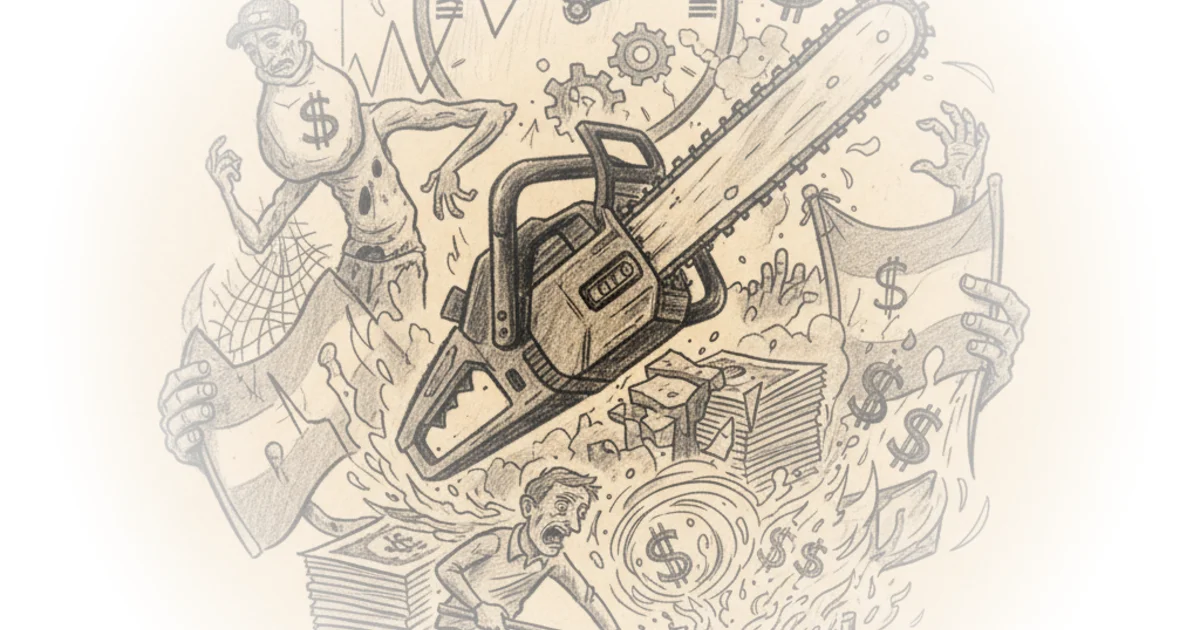
A US Treasury pledge of support last month managed to calm markets but didn't reverse the slump. Now the US has escalated its involvement. On Thursday, Treasury Secretary Scott Bessent announced that the US exchange stabilization fund—an emergency account run by the US Treasury—had directly purchased Argentine pesos. This is a very unusual move.
The ESF has only intervened directly like this four times in the last 30 years. Its most recent high-profile intervention was more than a decade ago and came as part of a G7 effort to control a spike in the yen after the Fukushima earthquake in Japan in 2011. The fund most famously lent $20 billion to support Mexico after its currency collapsed in 1994. Mexico drew down $12 billion of that amount and eventually repaid the US with a profit.
Bessent also finalized a $20 billion currency swap framework with Argentina's central bank, declaring Milei's reform program to be of systemic importance. The peso rebounded slightly on this announcement, and Argentina's dollar bonds rallied.
Political Fallout
But the intervention has sparked bipartisan backlash in Washington. Critics on both sides are asking whether this is in America's interests. Republicans question whether it aligns with President Trump's America First agenda. Democrats are probing whether hedge funds associated with Bessent played a role in the deal and whether taxpayer dollars should be used to support a foreign president whose policies may be hurting American farmers.
When Javier Milei took office in December 2023, he brought a chainsaw to the office—both literally and metaphorically. The self-described libertarian economist promised to cut through decades of Peronist interventionism and restore Argentina's economic credibility. His early moves were dramatic. He balanced the budget within a single quarter, cutting the deficit from 5 percent of GDP to zero. Inflation, which had been running at over 200 percent annually, began to fall sharply. By mid-2025, monthly inflation had dropped to around 2 percent and the IMF was publicly praising his fiscal discipline.
One of Milei's most tangible successes came in the housing market. In his first month in office, he repealed Argentina's rent control laws—regulations that had distorted the rental sector, driving landlords out of the market and leaving thousands of usable apartments vacant. The results were immediate. Listings on Argentina's real estate platforms surged by 180 percent. Inflation-adjusted rents fell and long-term leases returned.
High inflation in Argentina had also pretty much halted home sales because extreme inflation meant it made no sense to make any sort of long-term loan. Now that inflation has fallen, mortgages are back and houses are once again transacting.
Milei's economic philosophy—rooted in free market orthodoxy—stood in stark contrast to the popular statism of his predecessors. While his flamboyant style drew comparisons to Donald Trump, his policy agenda was more Milton Friedman than MAGA. He slashed tariffs, scrapped export taxes, and began privatizing state assets.
Political Scandal and Electoral Defeat
Milei's political footing has been growing increasingly precarious. Three major scandals have damaged his credibility: his involvement in a memecoin scheme; accusations against his sister and chief of staff for taking kickbacks related to pharmaceutical sales; and the resignation of his lead congressional candidate, José Luis Espriu, who admitted to receiving payments from a businessman now under investigation for drug trafficking.
The political fallout came to a head last month when Milei's coalition suffered a stinging defeat in Buenos Aires province—home to nearly 40 percent of Argentina's electorate. While the region leans left and his candidates were not expected to win, the scale of the loss was worse than anticipated. Analysts interpreted this loss as a sign that voters are tiring of austerity and that corruption concerns are gaining traction.
Milei's alliances with centrist opposition parties have frayed too. Argentina's Congress has already overturned one of his vetos on a spending bill and is preparing to challenge three more. A new bill passed in the lower house would limit his ability to govern by decree, further constraining his capacity to push through reforms.
With midterm elections approaching later this month, Milei faces a critical test. Even a modest gain in congressional seats could help him block hostile legislation and shore up his reform agenda. But if the vote goes poorly, his ability to govern and the durability of his economic program could be in jeopardy.
Geopolitical Stakes
Treasury Secretary Bessent says the United States stands ready to do what is needed to support Argentina. That announcement alone helped calm markets, but it also raised eyebrows in Washington. Behind the scenes, the bailout may be about more than Argentina.
Washington's support for Milei coincides with growing concern over China's influence in South America. Argentina has an $18 billion swap line with the People's Bank of China and Beijing has been deepening its trade ties across the region. Bessent said that Milei is committed to getting China out of Argentina.
The Trump administration has reportedly asked Argentina to reinstate export taxes on farm products—a move that would benefit US agricultural interests but undermine Milei's free market agenda and make it more difficult for Argentina to get the foreign exchange it needs to pay bondholders.
Critics point out that it's unreasonable to blame countries like Argentina and Brazil for selling agricultural produce to China, replacing US producers, as it was the US that started a trade war with its farm sector's best customer.
Bessent told Fox News late on Thursday that this is not a bailout and that he thinks the peso is undervalued. Most economists disagree, saying the currency is too strong and hurting Argentina's competitiveness.
The evidence of overvaluation is in plain sight. Thousands of Argentinians are making trips to shopping malls across the border in Chile—like Black Friday at Best Buy—stuffing their cars with TVs, laptops, and clothes thanks to the peso's new purchasing power. If your currency makes foreign electronics cheaper than buying rice at home, something may be off.
Historical Parallels
Argentina's currency troubles are by no means unique. History offers a long list of failed attempts to support an artificially high exchange rate.
The European monetary system famously unraveled in 1992 when the UK was forced to exit the ERM under speculative pressure. Thailand's fixed exchange rate against the US dollar faced speculative attacks in 1997 and the attempt to defend it depleted their foreign reserves. The government officially abandoned the fixed exchange rate on July 2nd, 1997, triggering a major financial crisis. Mexico's peso crisis in 1994 led to a $50 billion bailout coordinated by the US and the IMF.
Each case followed a familiar pattern: a currency held artificially strong, reserves depleted, defending it, and a sudden devaluation that shocked markets and citizens alike.
Argentina has lived this cycle repeatedly. It has defaulted nine times since gaining independence in 1816 and is now the largest borrower from the IMF, accounting for more than a third of its global lending portfolio. The IMF's current program with Argentina includes a $20 billion extended fund facility with $12 billion already dispersed, but the targets for reserve accumulation have already been missed and the peso remains overvalued.
The US bailout via the ESF appears to lack the conditionality that helped Mexico recover in 1994. Unconditional bailouts incentivize bad policy. Without a shift towards greater exchange rate flexibility and a sustainable path to rebuilding reserves, Argentina risks repeating the same mistakes.
The Bottom Line
The peso band may hold through the election, but history suggests it won't hold much longer. Argentina's economic history is littered with failed experiments—currency pegs, populist spending sprees, and reform programs that collapsed under political pressure.
Milei's early successes have given way to mounting risks: a currency under siege, reserves running dry, and a reform agenda facing resistance from Congress and the electorate. The IMF has already bent its own rules to keep the program alive. The US Treasury is now deploying nearly all of its liquid reserves to back a bailout that lacks enforceable conditions.
Defending an overvalued currency is not only economically unsound but politically dangerous too. Floating the peso would restore monetary autonomy, deter speculation, and signal confidence in Argentina's fiscal consolidation. It would also boost the country's ability to export and earn the foreign exchange needed to pay off its external debts.
Unfortunately, with elections looming, the temptation to delay adjustment may prove irresistible. If history is any guide, the cost of waiting could be steep. If Milei fails, the consequences will extend beyond Argentina—it'll be a setback for market-oriented reformers across the region and a cautionary tale for those who believe that ideology alone can stabilize an economy.