Jeff Rich's latest long read treats decolonization not as a finished chapter but as an ongoing force reshaping world order. He argues the process never ended in 1975 — it merely changed form, and we are living through its next phase.
The Scale of the Shift
Rich opens with Martin Thomas's assessment that decolonization signifies "the biggest reconfiguration of world politics ever seen." The numbers support the claim. In 1945, one-third of humanity lived under colonial rule. Today, fewer than two million remain in territories classified as non-self-governing. Eighty former colonies have joined the United Nations, swelling membership from 51 to 193 states.
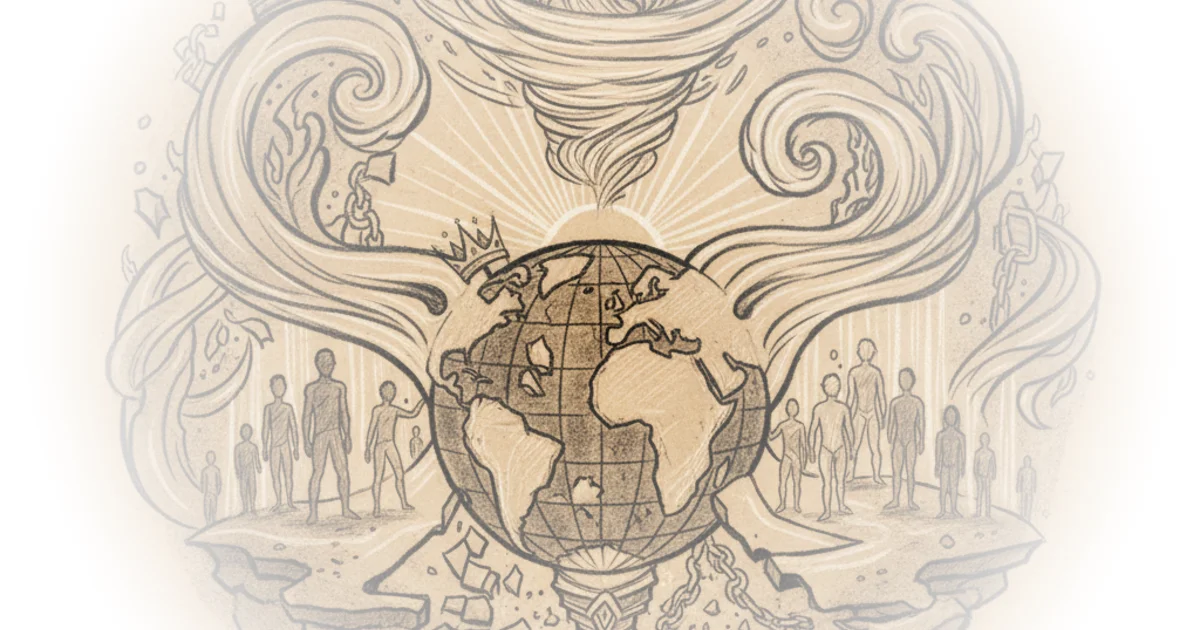
Jeff Rich writes, "All these states enjoy formal sovereign equality under the UN charter, and all these peoples attained the independence, in the words of the 1960 UN resolution to, 'for their own ends, freely dispose of their natural wealth and resources without prejudice to any obligations arising out of international economic cooperation, based upon the principle of mutual benefit, and international law.'"
But Rich immediately complicates this triumph. Formal sovereignty did not translate to real autonomy. New states found their resource decisions constrained. International law applied unevenly. Military integration locked them into architectures designed by former colonizers.
As Jeff Rich puts it, "The gap between formal jurisdictional equality and real independent power for post-colonial states remains."
The Unfinished Empire
Here Rich makes his sharpest move. He identifies the United States as both the champion of national independence and, paradoxically, one of the remaining colonial powers. Seventeen non-self-governing territories persist today, controlled by NATO allies — Britain, France, and the United States.
Jeff Rich writes, "Many assume, when they use the term 'vassal state', that even former European colonial powers — including Britain and France — have been re-colonised by the USA because they do as they are told by the White House."
"Reports of the death of colonialism are greatly exaggerated, and yet decolonization transformed the world. The changes were messy but undeniable."
The UN has rung the bell on colonialism's death repeatedly — a First Decade (1990-2000), a Second, a Third, and now the Fourth International Decade for the Eradication of Colonialism (2021-2030). A fifth seems inevitable. France retains New Caledonia. Britain holds Gibraltar. The United States plants military bases across every ocean and continent.
Critics might note that Rich's definition of colonialism stretches beyond legal categories into metaphor — military bases are not colonies in the administrative sense, and conflating them risks diluting the term's precision.
Multipolarity as Myth
Rich challenges the fashionable language of "multipolarity." He argues the world was always multipolar — distributed centers of power, influence, agency. Unipolarity existed only in "the fever dreams of NATO strategists who desired full-spectrum dominance."
Jeff Rich writes, "I do not define globalisation in opposition to the supposedly sacred nation state, nor as the package of ideas and institutions associated with its recent 'neo-liberal variant' of the Washington Consensus (1975-2005). I follow John Darwin in describing globalization as the process of exchange over long distances of people, resources, ideas and biota."
This reframing matters. If globalization is simply long-distance exchange, it has occurred for tens of thousands of years — the Mongol Exchange, the Columbian Exchange, steam-powered transformation, the post-1945 charter world. The neoliberal variant (1975-2005) was one form, not the definition.
As Jeff Rich puts it, "A 'neoliberal variant' of globalization took hold and 'reinforced economic inequalities and facilitated imperial forms of influence, making decolonization harder to complete.'"
That variant emerged partly in response to decolonization's challenge to Western dominance. The empires dismantled by Nehru, Fanon, Mao, Khrushchev, and Lumumba metamorphosed into pillars of the US-led international order.
Decolonization Without End
Rich detaches decolonization from its strict legal meaning — the UN process leading to nation-state independence. He proposes a broader view: "All history is the history of decolonization, because all of us get fed up, from time to time, with being controlled, dominated or, more benignly, 'influenced' by people who come from somewhere else."
This lens reveals decolonization running deeper than the post-1945 moment. Some trace it to 1776 in North America. Martin Thomas identifies waves from the early twentieth century. The seams of colonization and its undoing run longer than nationalist narratives allow.
Jeff Rich writes, "In the twentieth century, the world decolonised itself incompletely from European empires. In the twenty-first century the world will 'decolonise' itself imperfectly and unpredictably from the changeable North American empire that has ruled it indirectly since 1945."
He predicts this new wave will lead, over ten to fifty years, to the disintegration of the US empire — or even, like the Soviet Union between 1989 and 1991, a more rapid collapse.
Critics might note that Rich's timeline is speculative, and that the mechanisms of twenty-first century decolonization — economic fragmentation, digital sovereignty, currency diversification — differ fundamentally from the territorial independence movements of the twentieth century.
The Peripheral View
Rich positions himself as a "peripheral participant-observer and semi-citizen of a semi-sovereign state in a disintegrating empire." He argues the future is better perceived from the periphery than from the core. "From the deserts, the prophets come."
Jeff Rich writes, "Decolonisation looks very different when viewed from London, Washington or Moscow than it does when viewed from Seoul, Caracas, or, indeed, Melbourne, Australia."
His aim is not definitive history but "provocations from the periphery." Over nine weeks, he plans to share specific stories diagnosing how decolonization affects daily life and diplomatic halls alike.
Bottom Line
Rich's argument is ambitious and uncomfortable: decolonization never finished, and the next phase targets the indirect empire built by the United States since 1945. Whether that empire disintegrates slowly or collapses suddenly, Rich sees the process as fundamental to understanding the coming decades. The verdict: provocative, under-sourced, but impossible to ignore.