In an era where science is often wielded as the ultimate silencer of the spiritual, Alex O'Connor and David Bentley Hart engage in a rare dialogue that refuses to let the "mechanistic" view of the universe go unchallenged. This is not a standard debate about whether God exists, but a deeper excavation of how the very method of modern science—by design—banished the mind from nature, leaving us with a worldview that Hart argues is not just incomplete, but fundamentally incoherent. For the busy intellectual seeking to understand why materialism feels increasingly desperate, this conversation offers a startling historical and philosophical diagnosis.
The Great Banishment
The conversation begins by dismantling the modern assumption that the universe is a cold, dead machine. Hart, a philosopher whose work often challenges the intellectual status quo, suggests that the pre-modern view of a cosmos "full of gods" was actually closer to the truth than our current "mechanistic" model. He argues that the shift wasn't just about new data, but a deliberate methodological choice. "It began more humbly simply as an attempt obviously to create a working inductive method that didn't presume more than it could conclude from the evidence," Hart explains, noting that this method required stripping away formal and final causality.
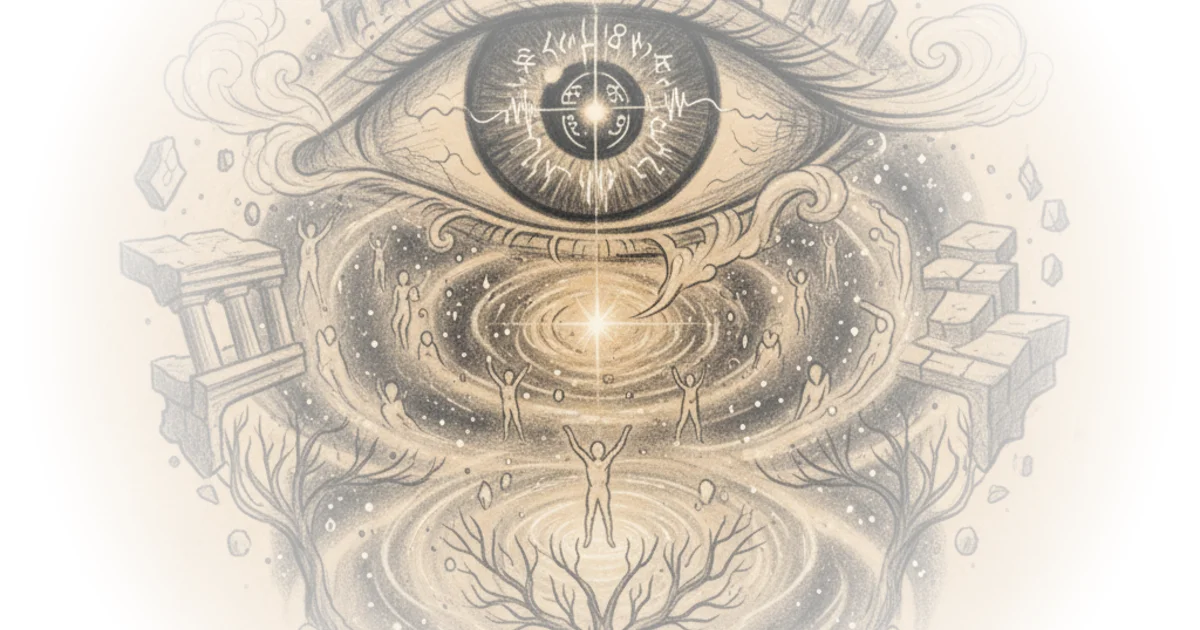
This historical framing is crucial. Hart posits that by excluding anything resembling mind or spirit from the picture of nature, early scientists created a dualism where the physical world became a "vast reservoir of resources to be exploited by the will." The consequence of this exclusion, Hart contends, is that modern science is now trying to explain the very thing it banished—consciousness—using a model that explicitly forbids it. "The problem is you have a model then that exists solely by virtue of the exclusion of mental phenomena from our picture of nature," Hart observes, "and then using that model, an attempt was being made to understand mental phenomena, which leads... invariably to the sort of diffuse materialist strategies we have now."
Critics might argue that the scientific method's success in predicting physical phenomena validates its mechanistic approach, regardless of how it handles consciousness. However, Hart's point is that the method's success in one domain has been illegitimately inflated into a metaphysical claim about the entirety of reality.
The Illusion of the Third Person
The dialogue then pivots to the epistemological heart of the matter: the "third person perspective." O'Connor introduces the common scientific ideal of removing subjective bias to see the world "as it really is." Hart, however, dismantles this as a philosophical fiction. He argues that the "view from nowhere" is not a neutral vantage point but a construction built entirely upon first-person experiences. "The third person perspective is itself a distillation of first person perspectives," Hart asserts, challenging the notion that we can ever truly step outside our own consciousness to observe the universe objectively.
Hart takes aim at prominent materialists like Daniel Dennett, who argue that intentionality is merely a stance we adopt. Hart finds this circular and absurd: "You're simply taking your subjective impression under the form of in the somewhat dissembling form of a perfectly disinterested and perfectly detached third person perspective." The analogy of the airplane dashboard is particularly potent here; just because a pilot navigates using instruments does not mean the world outside the cockpit is made of gauges and graphs. To mistake the map for the territory is, Hart suggests, the fatal error of modern materialism.
The third person perspective is itself a distillation of first person perspectives.
This argument resonates because it exposes the paradox of trying to explain the observer using only the observed. If consciousness is the precondition for any observation, then a theory that eliminates consciousness cannot be the final word on reality.
The Absurdity of Reductionism
As the conversation deepens, Hart characterizes the current state of materialist philosophy regarding the mind as "the most consistent and the most insane at the same time." He critiques various attempts to bridge the gap, such as emergentism or integrated information theory, suggesting they are desperate maneuvers to save a failing paradigm. The core issue remains the "user interface" of our perception. While we acknowledge that our senses simplify reality to help us navigate it, Hart warns against the error of thinking that this simplified interface is the only reality that exists.
Hart's critique is not that science is wrong, but that it has overstepped its bounds. "Method whenever... becomes your metaphysics or becomes your ontology," he warns, "it sooner or later you're going to end up in absurdity." This is a powerful reminder that the tools we use to measure the world are not the world itself. By clinging to a mechanistic ontology, modern philosophy risks becoming a self-fulfilling prophecy of meaninglessness, unable to account for the very minds doing the philosophizing.
Bottom Line
Alex O'Connor's interview with David Bentley Hart succeeds by refusing to treat the "hard problem" of consciousness as a mere glitch in the machine, but rather as evidence that the machine model itself is flawed. The argument's greatest strength lies in its historical clarity, showing how the exclusion of mind from nature was a choice, not a discovery. Its vulnerability, however, is that it relies heavily on the reader accepting that the "first person" is ontologically primary—a leap that materialists will find difficult to make without abandoning the very foundations of their worldview. For the reader, the takeaway is clear: if you want to understand the mind, you cannot start by assuming it doesn't exist.