This piece from Natural Selections offers a startling demographic reversal that defies conventional political wisdom: the rural, self-sufficient lifestyle once championed by the political left has become the primary draw for the right. It argues that the desire to escape industrial dependency has created a strange, new political alignment where environmental stewardship and skepticism of government regulation now walk hand-in-hand. For busy observers tracking the fracture lines of American culture, this shift from "tree huggers" to "homesteaders" at places like Polyface Farm is not just a curiosity—it is a symptom of a deeper crisis in how we derive self-worth.
The Great Political Flip
The article opens by describing Joel Salatin's Polyface Farm in Virginia as a place where the land itself "seems to breathe," a stark contrast to capital-intensive modern agriculture. But the real story isn't the farming; it's the people. Natural Selections reports that the political composition of the farm's visitors has undergone a complete inversion. "Back then, Salatin reports, about 80% of the visitors to Polyface Farm were on the left, politically—tree huggers and granola-eating hippies... These were people who reviled corporations, but trusted the government. Now, the ratio has flipped: about 80% of the visitors to Polyface Farm are on the right—homesteaders and homeschoolers and hunters... who are more likely to push the government away than invite its help."
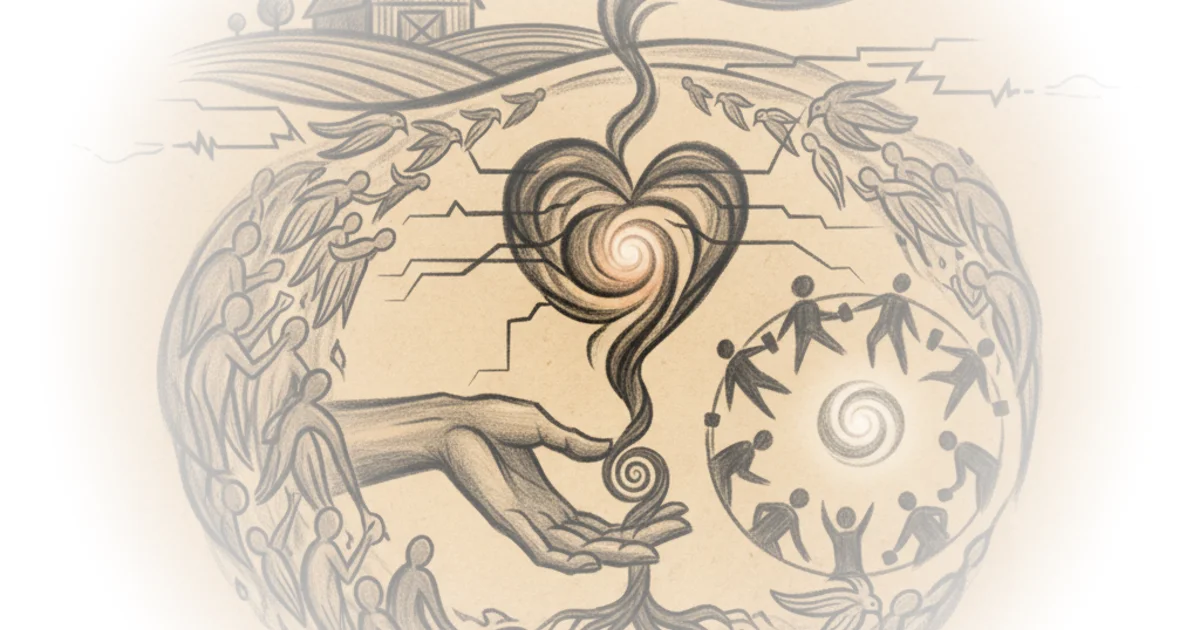
This observation is the piece's most compelling hook. It suggests that the ideological divide is no longer about the environment versus the economy, but rather about who holds the keys to survival. The argument posits that both groups share a "hunger to return to the land, our roots, our home," yet they diverge sharply on the role of the state. The piece asks a fundamental question: "When does a safety net become a security blanket, infantilizing in its comfort, preventing adulthood and self-worth from ever blooming?" This framing challenges the reader to consider whether modern reliance on government and corporate infrastructure is actually a form of dependency that erodes human agency.
Critics might note that this binary view oversimplifies the complex reasons people leave cities, ignoring economic necessity or the genuine failures of rural infrastructure that require public investment. However, the emotional resonance of the argument lies in its focus on personal responsibility rather than policy minutiae.
We generate self-worth by successfully accomplishing meaningful tasks.
The Virtue of Hard Work
The commentary then pivots to a personal anecdote about the author's father, a former farmer who insisted that his children build a fence rather than retreat to books. This story serves as the emotional core of the argument, illustrating a generational shift away from the "vaguely perfect" ease of suburban life. The piece argues that the modern tendency to outsource labor—whether it's cooking, cleaning, or even thinking—has severed our connection to reality. "Our thirst for convenience encourages us to outsource more—we've already outsourced the making of our clothes and our customer service to faceless people half a world away, why not ask machines to do our thinking for us."
This is a powerful critique of the technocratic mindset. The article suggests that by handing over our agency to experts and machines, we become "utterly dependent on those who still know how to do things." It frames the current moment as a choice between autonomy and convenience. The piece cites Jeffrey Tucker of the Brownstone Institute, who writes in his book Spirits of America that "Hard work is a virtue. There is no line between work and life; they are the same. To be inert is to be miserable."
The argument here is that the "lack of work ethic" often attributed to the young is actually a symptom of a system that has removed meaningful labor from their lives. By engaging in physical, problem-solving work, the author's sons found a sense of accomplishment that traditional internships could not provide. "There are no bullshit jobs on farms, no make-work," the piece notes, contrasting the tangible results of farming with the abstract nature of many modern careers.
The Search for a New Political Home
The final section of the article attempts to synthesize these observations into a new political identity. It suggests that many who once identified as liberals have become "politically homeless," drawn to conservative or libertarian views not because of social issues, but because of a shared distrust of centralized power and industrial food systems. "Just as many on the right have woken up to the problems of Big Ag and Big Food in light of what happened to us all during Covid, many who thought of ourselves as being on the left have woken up, too."
This convergence is described as a reaction to the fragility exposed during recent global crises. The piece argues that the desire for "real food" and a distance from "moneyed interests" has created a strange bedfellow situation between former adversaries. "We appreciate the 2nd Amendment more now, having seen some of what the government is capable of. And we are more wary of regulations, for the same reason. But we're still fundamentally interested in conserving the Earth, and its inhabitants—people included."
While the piece paints a hopeful picture of this realignment, it acknowledges the difficulty of the path forward. Sourcing real food and identifying true stakeholders in the food system has become a "devilishly hard game." The underlying tension remains: can a movement built on self-reliance and skepticism of institutions actually scale to address global challenges, or will it remain a niche lifestyle choice?
Ease is not the goal. Let us stop handing over our agency and worth to those who promise an easy life.
Bottom Line
The strongest part of this argument is its reframing of the political divide as a conflict over agency and the definition of meaningful work, rather than a simple clash of policy preferences. Its biggest vulnerability is the romanticization of farm labor, which may overlook the systemic barriers that make self-sufficiency impossible for many. Readers should watch for how this "politically homeless" demographic evolves, as their shared values around food and autonomy could reshape the American political landscape in unexpected ways.