In a world obsessed with digital archives and high-resolution scans, Dan Snow argues that the most profound connection to history isn't found in a museum glass case, but in the muddy, oxygen-free silence of the Thames foreshore. This piece stands out not for its archaeological rigor, but for its radical redefinition of value: it posits that a broken clay pipe is a more intimate portal to the past than a curated exhibition, transforming the act of scavenging into a meditative dialogue with 2,000 years of human life.
The Art of the Mudlark
Snow frames mudlarking not as a hobby, but as a disciplined practice of patience and observation. He introduces Annabel Zello, a veteran practitioner, to dismantle the myth that finding artifacts requires a magical eye. Instead, Snow highlights Zello's assertion that the skill is built on repetition and familiarity. "It's just about experience and practice and getting to know what to look for," Zello explains, a sentiment Snow embraces to suggest that history is accessible to anyone willing to invest the time. This approach is refreshing; it democratizes archaeology, removing the gatekeeping often associated with academic discovery.
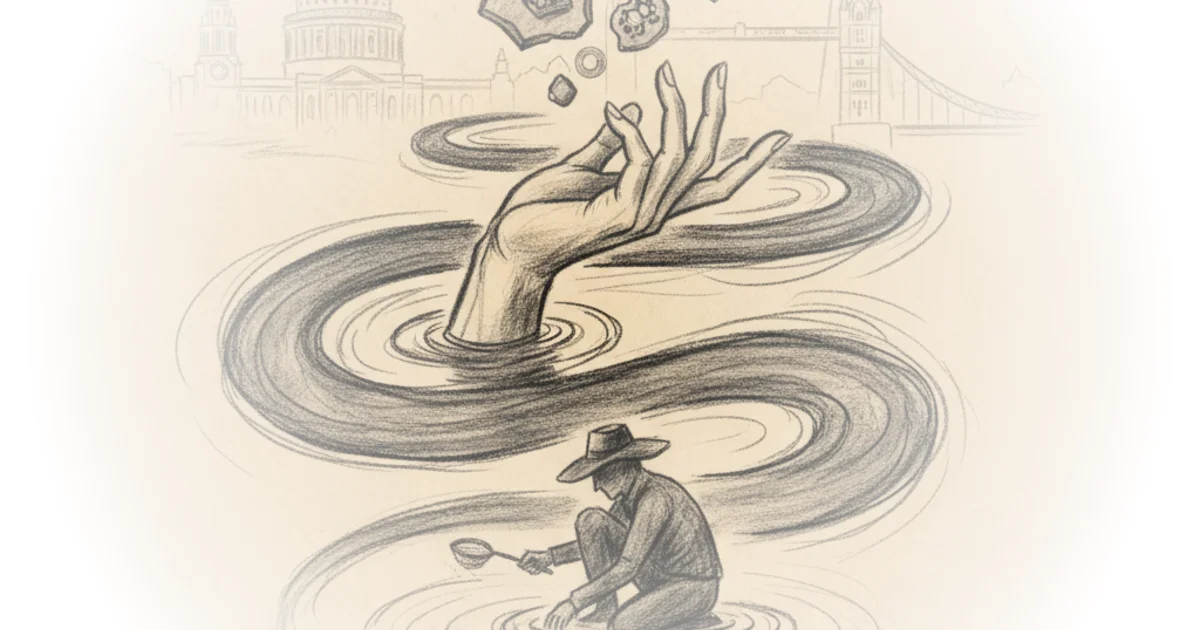
However, Snow is careful to distinguish modern mudlarking from its grim historical roots. He notes that in the 19th century, the term referred to desperate scavengers, often considered "semi criminal," who searched the riverbed for items to sell or use to survive. Today, as Zello points out, the activity has evolved into "amateur archaeology," governed by strict permits from the Port of London Authority to protect the river's integrity. This shift from survivalist desperation to curated preservation is a crucial narrative pivot. It allows the reader to engage with the thrill of the hunt without the moral ambiguity of the past, though one might argue that the romanticization of the riverbed still glosses over the harsh realities of the people who originally discarded these items.
"They're story prompts. That's how I like to think of them. And they're also like little portals to the past. You hold something like this and it lets you kick down a door and you enter somebody else's world."
The Weight of Small Things
The core of Snow's argument rests on the emotional resonance of mundane objects. He doesn't focus on gold or jewels, but on the "design classic" of a bone comb that hasn't changed in centuries, or the ubiquitous clay pipe. Snow uses Zello's collection to illustrate how the size of an object is inversely proportional to the weight of its history. A small pipe bowl, he explains, can tell a massive story about the transatlantic slave trade. "The reason the price of tobacco came down was because of the slave trade. So when you look at the pipe bubbles increasing, you're also looking like another representation of slavery across the seas," Zello notes. This is the piece's most powerful moment: using a tiny, broken fragment to force a confrontation with a global tragedy. It grounds abstract historical statistics in a tangible, physical reality that a reader can almost hold in their hand.
Snow also touches on the unique preservation qualities of the Thames mud. Because the riverbed is anaerobic, lacking oxygen, organic materials like wood, bone, and even leather survive for millennia. "Objects in the temps get preserved because they go into the mud and the mud is anorobic... often you find that things go in as beautifully come out as beautifully as they went in," Snow writes, paraphrasing Zello's explanation. This scientific detail adds a layer of wonder, suggesting that the river is not just a dumping ground, but a time capsule. Yet, this framing risks overlooking the environmental cost of the river's history; the very mud that preserves these treasures is also a repository of centuries of industrial pollution and waste.
From Detritus to Museum
The narrative concludes by exploring the fate of these found objects. Snow reveals that while modern mudlarks can keep their finds, anything over 300 years old must be reported to the Museum of London's Finds Liaison Officer. This system, part of the Portable Antiquities Scheme, ensures that even common items like Stafford slipware or oyster shells are recorded and added to the historical record. Zello describes her own home, where she has "redesigned my entire kitchen around my collection," creating a personal museum where she can "watch the sun fall on it and feel pleasure as I eat my banana." This domestication of history is a striking image. It suggests that the past is not something to be locked away in a vault, but something to be lived with, integrated into the daily rhythm of modern life.
Critics might note that the focus on personal enjoyment and the "joyful" nature of the hobby could trivialize the serious archaeological value of the site. If every amateur treats the foreshore as a treasure hunt, the potential for damaging undiscovered stratigraphy remains a concern, despite the permit system. Snow acknowledges the need for permits and safety, but the overwhelming tone is one of individual gratification rather than collective stewardship.
"I feel like I grabbed it back from oblivion."
Bottom Line
Dan Snow's piece succeeds by shifting the focus from the grand narrative of kings and wars to the intimate, tactile reality of everyday life, proving that history is often found in the broken things we discard. Its greatest strength is the ability to make the mundane feel miraculous, though it occasionally leans too heavily on the romantic allure of the river, potentially underplaying the rigorous scientific and ethical responsibilities of modern archaeology. For the busy reader, this is a reminder that the past is not a distant abstraction, but a physical layer waiting just beneath our feet, preserved in the mud and waiting to be told.