The Reformer's Trap
Between 1962 and 1991, every major attempt to reform a communist economy from within either stalled, reversed, or accelerated the system's collapse. Michael Hill, a policy researcher at Britain Remade, traces this pattern across the Soviet Union, China, Vietnam, and North Korea, arguing that the failures were not random but structural. The reformers understood the problems. They often had the ear of power. What they lacked was a viable path through the political minefield that surrounded any meaningful change.
Hill opens with a striking juxtaposition: two quotes from Kim Jong Un separated by just nine months.
We shouldn't put on colored glasses, and provoke people or find fault with them for allegedly supporting capitalist methods.
Those who dispute the Party line and its policies should not have their leaves trimmed, but be ripped out at their roots.
The whiplash is the point. In December 2011, the new North Korean leader signaled tolerance for economic debate. By September 2012, he was threatening to exterminate those who pushed too far. Hill uses this to illustrate the fundamental paradox: reform required free thinking, but free thinking threatened the regime's survival. The space between "acceptable comradely debate" and "counter-revolutionary sabotage" was, as Hill puts it, a matter of life and death.
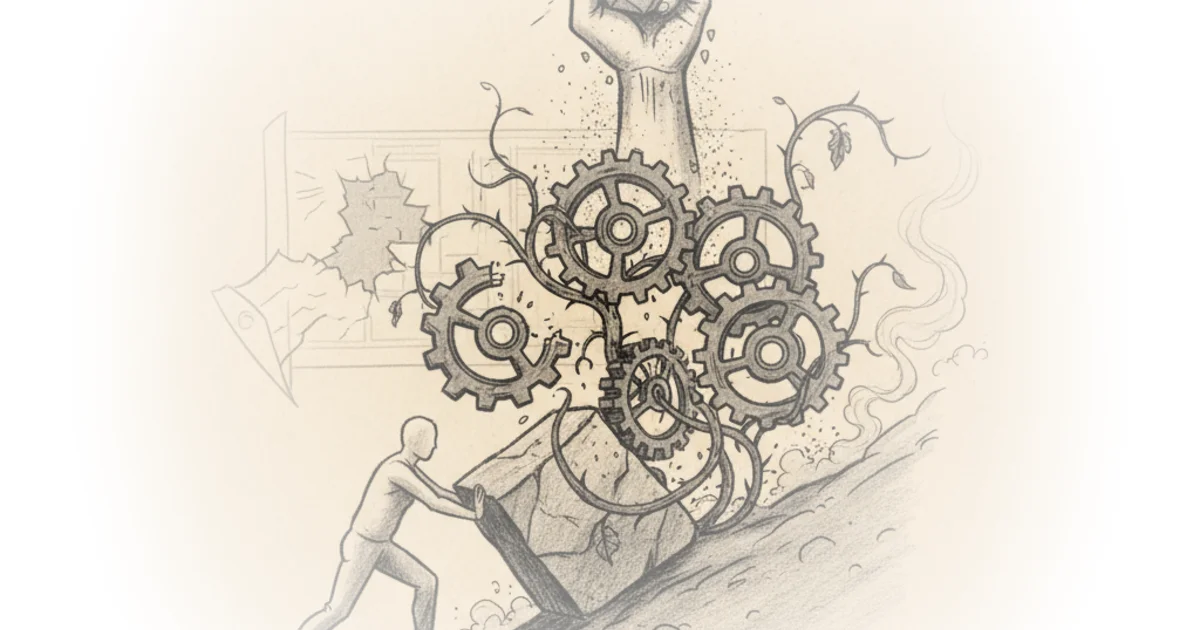
The Price Nobody Could Touch
The article's strongest thread concerns prices. Karl Marx's labor theory of value held that market prices were illusions concealing the true worth of goods, measured by the labor embedded in them. Communist planners were supposed to build their pricing systems on this foundation. In practice, no price in any communist country was ever set that way. Prices became political artifacts -- compromises between ideology, bureaucratic inertia, and expedience.
In practice, no price in the communist world was set this way. Prices were compromises between politics, economics, and inertia. The result was distortions everywhere: goods overproduced or scarce, resources misallocated, needs unmet.
Hill traces how price stability became existential for communist legitimacy. In China, hyperinflation had doomed the Nationalists. In the Soviet Union, Joseph Stalin launched annual price cuts from 1948 to 1954, turning falling prices into a propaganda triumph. Citizens internalized this. Cheap bread was not a policy choice; it was a right.
The consequences of touching prices were immediate and sometimes fatal. In 1962, Soviet planners raised meat and dairy prices while trimming wages. Workers in the city of Novocherkassk erupted in protest after a factory director told them to "eat cabbage." Nikita Khrushchev sent in troops. Dozens died. The massacre was kept secret for decades.
Academic economists would continue drawing up models of price reform until the USSR's collapse. Many were always confused about why their ideas were never acted upon. Many likely didn't hear of the Novocherkassk Massacre until after their country was gone.
That single passage captures the entire tragedy of communist reform economics: brilliant theorists drafting elegant solutions to problems whose true constraints were hidden from them by state violence and state secrecy.
Kosygin's Impossible Dilemma
Hill devotes substantial attention to Alexei Kosygin, the Soviet Premier who emerged from the bloodless coup against Khrushchev in 1964 determined to modernize the economy. Kosygin adopted the ideas of economist Evsei Liberman, who proposed a seemingly simple fix: judge enterprises by profitability rather than crude output targets. Give managers bonuses for hitting profit goals. Let efficiency, not tonnage, drive production.
The reform failed because it changed incentives without changing the information those incentives relied on. With prices still set by bureaucrats and customers guaranteed by the plan, profits measured political connections, not economic value.
Factory managers gamed the system. They invented 'new' products, almost identical to old ones, so that they could raise prices. They lobbied planners to let them charge more. Output shifted toward whatever goods produced the highest paper profits, unrelated to what people wanted.
Hill frames this as a sequencing problem. Kosygin correctly identified that managers needed better incentives and more autonomy. The logical first step was price reform, since profitability means nothing when prices are fiction. But after Novocherkassk, prices were untouchable. So Kosygin tried enterprise reform without price reform -- like rewiring a house while leaving the fuse box locked.
Critics might note that Hill presents sequencing as though there existed some correct order that would have worked. But the deeper problem may have been that no sequence was viable. Each reform depended on others that were politically impossible, creating not a sequencing puzzle but a genuine deadlock.
The Firewall Gorbachev Burned
The article's most revealing case study involves a financial mechanism most readers will never have heard of: Beznal. In the Soviet monetary system, enterprises maintained two separate accounts. Nal was paper cash, used for wages and consumer purchases. Beznal consisted of noncash rubles used exclusively for transactions between enterprises. The critical rule: enterprises could not convert Beznal into Nal without explicit state authorization.
This firewall mattered. It kept excess money trapped in enterprise accounts, preventing it from competing with citizens' wages for scarce consumer goods. Enterprises could not convert Beznal back into Nal without explicit authorization. In effect, the system stored inflation out of sight.
When Mikhail Gorbachev legalized private cooperatives in the late 1980s, he inadvertently gave them the ability to convert freely between the two currencies. Enterprises immediately exploited this loophole, funneling vast sums of hidden money into the consumer economy through sham transactions with cooperatives. The result was runaway inflation in uncontrolled sectors and catastrophic shortages in controlled ones.
Hill raises a damning question: did Gorbachev even understand the system he dismantled? The Soviet leader had been denied access to the state budget as recently as 1983, just two years before taking power. The secrecy that protected the regime also blinded its reformers.
Success Where Planning Never Took Root
Not every reform attempt failed. Hill draws a sharp distinction between countries where central planning had become entrenched and those where it never fully consolidated. China and Vietnam both launched successful market reforms, but from positions of weakness, not strength.
Vietnam's 'Doi Moi' reforms began in 1986, after decades of war and a single failed nationwide five-year plan. Most Vietnamese lived on less than a dollar a day. In China, the Great Leap Forward and Cultural Revolution had devastated both planning and the party elite.
The argument is counterintuitive: reform succeeded precisely where communism had been most chaotic and destructive. In China, stable central planning had existed for roughly ten of the twenty-seven years of Communist rule when Deng Xiaoping began his reforms. There were fewer vested interests to protect the old system because the old system had barely functioned.
The Soviet Union, by contrast, had built a functioning (if inefficient) planned economy over decades. Its military-industrial complex rivaled America's. Its citizens enjoyed middle-income living standards. Reform carried genuine risks for real people with real things to lose.
Where planning worked well enough, as in the USSR, it created vested interests that blocked reform. Where it failed to take root, as in China and Vietnam, there was little to lose and much to gain.
A counterargument is that this framing underweights the role of political leadership. Deng Xiaoping's willingness to move gradually, starting with agricultural decollectivization and special economic zones rather than wholesale price liberalization, reflected strategic discipline as much as favorable conditions. The Soviet Union's problem was not only entrenched interests but a leadership class that repeatedly chose bold, ill-sequenced reforms over patient, incremental ones.
Bottom Line
Hill's article is a well-constructed comparative history that identifies a genuine and underappreciated pattern: communist economic reformers failed not because they were wrong about the problems, but because they could not solve the political and sequencing challenges that reform demanded. The price stability argument is particularly strong -- the idea that citizens treated cheap goods as a social contract, and that breaking that contract carried existential risks for regimes, is both well-evidenced and applicable beyond communist systems.
The article's main vulnerability is its tendency to treat the failures as lessons for reformers everywhere, including in democratic market economies. The closing appeal to modern policy movements -- "we must understand the order of reform, the risks of backlash" -- stretches the analogy thin. Democratic reformers face opposition, but not the specific trap of a system where political power, economic allocation, and ideological legitimacy are fused into a single structure. The lessons about sequencing and coalition-building are real, but they operate under fundamentally different constraints in open societies where prices are free and dissent is legal.
Where the piece excels is in its use of specific, vivid episodes -- the Novocherkassk massacre, the Beznal collapse, Kim Jong Un's nine-month reversal -- to illustrate systemic dynamics. Hill avoids the common trap of treating communist economies as monolithic failures, instead showing how each country's reform trajectory was shaped by its particular history of planning, war, and political consolidation.