What if China's energy advantage is the thing that decides who wins artificial intelligence? That's the provocative case one expert makes, and it's more nuanced than it sounds.
Casey Hammer has spent years at NASA JPL, Caltech, and now running Terraform Industries. He argues that China currently dominates clean energy manufacturing—solar panels, batteries, transmission equipment—but that's not the whole story. The US can catch up if it commits to serious industrial mobilization. And there's a technology that could fundamentally level the playing field.
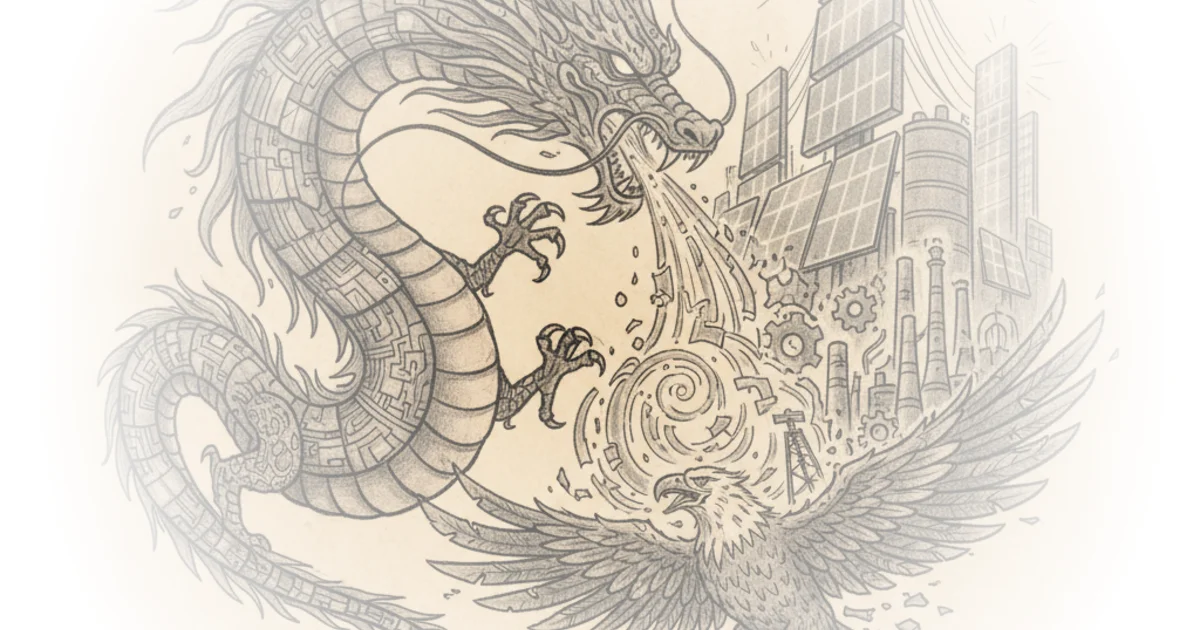
China's Energy Dominance
The numbers are staggering. China manufactures roughly twenty times more solar panels annually than the United States. They lead in battery production, transformer capacity, and grid infrastructure. The US has imposed export controls on advanced chips to slow China's AI capabilities—but China's energy sector keeps growing faster than any countermeasure.
Why the US Isn't Done For
The conventional wisdom says China wins by default because they're better at building solar farms and batteries. But this misses something crucial: the United States still has advantages the conversation overlooks.
Unlike China, the US is surrounded by oceans and friendly allies—geographically secure. The US has abundant natural gas, oil, and cheap energy inputs. Most importantly, America's automation capabilities and financial capital are world-leading. A fully automated solar manufacturing facility in the US could theoretically copy Chinese factories and ramp up production within two years if there was World War II-level urgency.
The real question isn't whether China beats us on clean energy. It's whether we can match that industrial capacity with our own resources.
The Synthetic Fuels Game-Changer
Hammer's company is working on something that could change the entire calculus: synthetic fuels technology. Currently, electricity only supplies about a third of final energy needs in modern economies—the rest requires gas, oil, and other fuels. But converting abundant clean electricity into synthetic fuels would allow China's energy advantage to power transportation, manufacturing, and heating.
This technology essentially levels the playing field. If China can convert their massive solar and nuclear capacity into synthetic fuels, they gain access to nearly 100% of energy needs—electricity becomes a complete replacement for fossil fuels across the entire economy.
The Real Bottleneck: Chips, Not Solar
Here's what's interesting. Companies like XAI (Elon's AI venture) aren't prioritizing solar panel factories as their critical bottleneck. They're focused on chips—specifically GPU manufacturing and automated mass production of compute capacity.
The hyperscalers building massive data centers—1 gigawatt, 2 gigawatt, even 5 gigawatt facilities—are choosing natural gas right now because it's available immediately and can be delivered through existing pipelines. The constraints they're hitting aren't solar supply; they're turbine manufacturing rates, transformer production speed, and grid capacity.
This suggests that for AI development specifically, chips are the limiting factor—not clean energy. Even with aggressive tariffs on Chinese solar, data centers would still function if they have access to gas turbines.
What Would Actually Happen
If the US committed to serious industrial mobilization—something like the Manhattan Project or WWII-level urgency—the country could scale domestic solar manufacturing in under two years. Most technology already exists. The bottleneck isn't invention; it's calling up manufacturers and writing checks.
But without that level of commitment, China's energy dominance continues compounding. They have more electricity, more manufacturing capacity, and now synthetic fuels technology to convert all of it into usable energy across every sector.
Counterpoints
Critics might note that assuming World War II mobilization is realistic underestimates how difficult industrial coordination actually is—the US struggled to match China's solar manufacturing even with existing technology. Others point out that the chip export controls are already squeezing China, and energy independence doesn't automatically follow from having more solar panels.
If you can convert electricity into synthetic fuels at scale, China's clean energy advantage becomes overwhelming—and it asymmically helps them far more than us.
Bottom Line
The most compelling part of this argument isn't that China will win AGC by default—it's that they might win because we've created an opening through export controls while they're busy building the energy infrastructure we ignored. The technology to convert clean electricity into complete energy supply already exists, and China is investing heavily in it. We need to be paying attention.