Casey Newton doesn't just report on Elon Musk restoring Alex Jones to X; he dissects the tragic erosion of digital accountability and asks a question that haunts the entire industry: when does a ban become permanent, and why? This piece is notable because it refuses to treat the return of a notorious conspiracy theorist as a mere policy tweak, instead framing it as the final nail in the coffin of X's viability as a public square, while simultaneously exposing the hollow nature of "free speech" absolutism when it protects those who have been legally found to cause real-world harm.
The Anatomy of a Deplatforming
Newton begins by grounding the reader in the sheer absurdity of the situation. He notes that the decision appeared to arrive "on a whim, after someone tagged him in a post asking him to consider the idea." This highlights the capricious nature of the platform's governance, where a single user's tag can overturn years of precedent. Newton reminds us that this move followed a poll where a "large majority of respondents appeared to vote in favor," a mechanism that reduces complex ethical decisions to a popularity contest among a skewed user base.
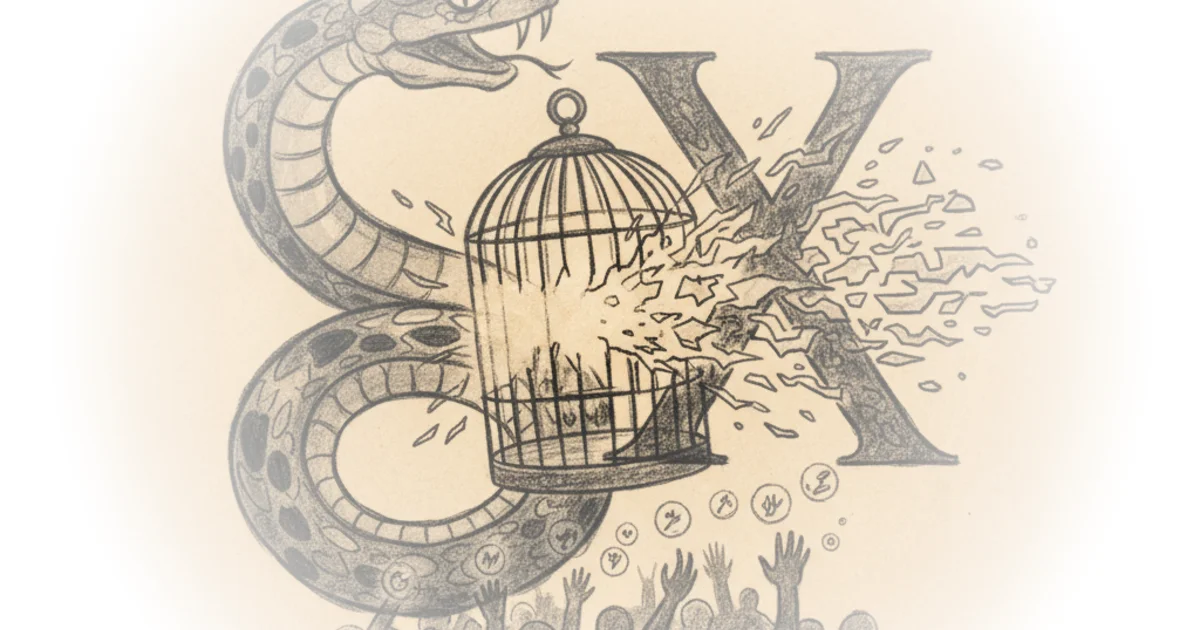
The author's most powerful move is reframing the 2018 deplatforming not as a reaction to Sandy Hook misinformation alone, but as a collective action against hate speech. Newton writes, "In all cases, the reason for deplatforming Jones was not 'he lied about Sandy Hook.' It was that he kept saying awful things about Muslims, transgender people, and other minorities." This distinction is crucial. It shifts the narrative from a debate about truth to a defense of human dignity. By detailing the specific violations—hate speech against Muslims, attacks on transgender people, and a video showing an adult pushing a child to the ground—Newton strips away the "free speech" defense that often shields such content.
"Jones' original deplatforming five years ago stands as one of the most consequential cases of collective action among tech platforms in modern history."
Newton acknowledges the counterargument raised by some readers: "What's the case for indefinite bans on social media?" He concedes that for most users, permanent bans are too harsh, noting that many are unaware of rule violations and could improve. However, he draws a hard line at Jones, arguing that the man has not changed. Despite a court ordering him to pay nearly $1.5 billion for defamation, and a bankruptcy filing that families called an "improper effort to avoid paying," Jones has offered only a "tepid apology" for the shootings while remaining silent on the hate speech that originally got him banned.
The Hollow Victory of Free Speech Absolutism
The commentary then pivots to the consequences for the platform itself. Newton argues that Musk's decision is a strategic error that accelerates the platform's decline. He writes, "At this point it appears that Musk would rather accept the pyrrhic victory of bankrupting his platform in the name of 'free speech' than taking even the minimum steps necessary to build a viable advertising business." This is a stark assessment of the trade-off between ideological purity and economic survival. The return of Jones, alongside figures like Andrew Tate, is not just a moral failing; it is a business suicide pact.
Newton points out that the media ecosystem has already moved on. Unlike in 2018, when X (then Twitter) served as a "collective assignment editor" for the national media, the platform now "rarely if ever serves as an assignment editor the way it did in the past." The threat Jones posed was his ability to amplify his ideas across multiple platforms simultaneously. Now, he is isolated. "The more relevant conversations are now elsewhere, and whatever Musk may be doing on X, Jones will not be a part of them," Newton concludes. This suggests that the real damage of the ban lift is not the resurgence of Jones, but the final confirmation that X is no longer a central node in the global information network.
Critics might argue that Newton underestimates the power of niche communities to radicalize, even without mainstream amplification. While Jones may not reach the general public, his return could still energize a dangerous fringe. However, Newton's evidence regarding the loss of advertisers and the exodus of journalists suggests that the infrastructure for mass radicalization has been dismantled, regardless of Jones's presence.
"It is difficult for me to look at this set of facts and conclude that Jones is a changed man, deserving of a second chance at harnessing platforms' recommendation algorithms to grow and monetize his following."
Bottom Line
Newton's strongest argument lies in his refusal to separate the legal and moral culpability of Alex Jones from the technical decision to reinstate him; he proves that a "second chance" is impossible when the first one resulted in a billion-dollar judgment for defamation and ongoing harassment of grieving families. The piece's biggest vulnerability is its reliance on the assumption that the media ecosystem has permanently abandoned X, a claim that may be tested if the platform manages to pivot its user base or if a major news event forces a return to the site. Readers should watch for whether the promised advertiser exodus accelerates, as that will be the true metric of whether Musk's "free speech" experiment has truly bankrupted the platform's future.