This piece cuts through the fog of official optimism to reveal a stark reality: the United States has effectively burned through its high-end arsenal in a six-month conflict, leaving the military dangerously exposed for the very war it was most prepared to fight. Jordan Schneider, moderating a conversation between defense experts Bryan Clark and Justin McIntosh, exposes the dangerous gap between the administration's public confidence and the actual state of the munitions supply chain. The coverage is notable not just for the data, but for its willingness to name the political cowardice that allowed this depletion to happen while the world watched.
The Illusion of Readiness
Schneider frames the central crisis around a terrifying statistic: in just the first couple of months of the conflict, the military fired 850 Tomahawk cruise missiles, depleting a stockpile specifically reserved for a potential conflict with China. The administration's response, as Schneider notes, is to dismiss critics as traitors rather than address the inventory hole. "We have plenty of munitions — but by the way, the people that are talking about this should be prosecuted," quotes Schneider from Hudson Institute fellow Bryan Clark, capturing the administration's aggressive deflection tactics.
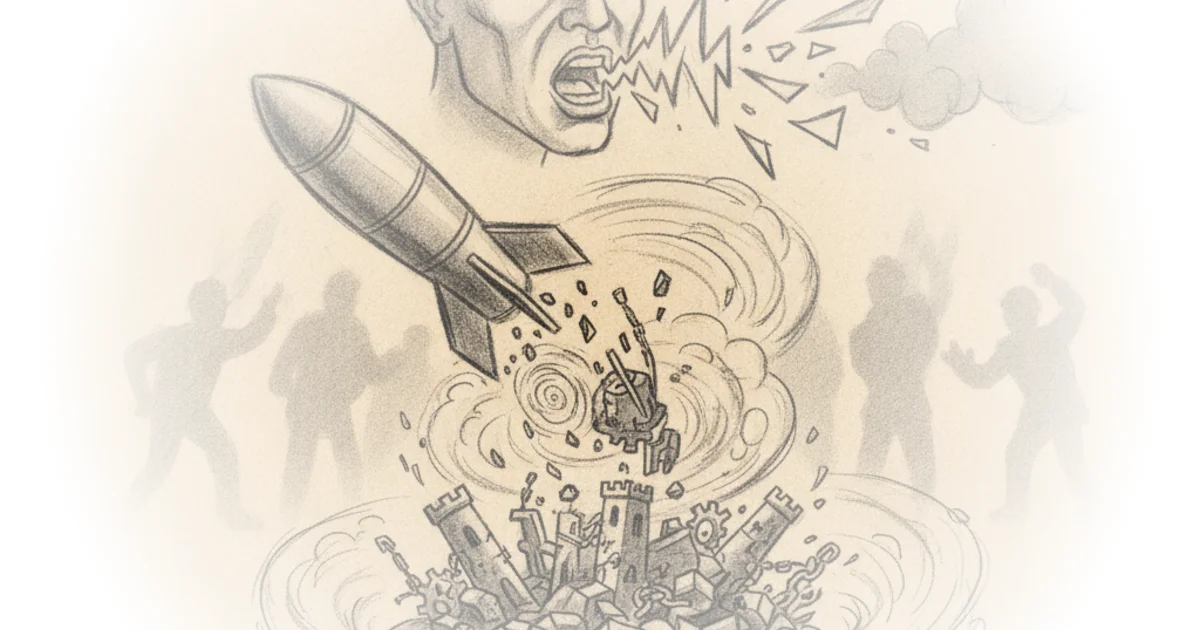
The argument here is that the military has been forced to use its most expensive, long-range standoff weapons—designed to keep American pilots safe from advanced air defenses—because the enemy has modernized. This strategy worked against a less capable foe, but it has drained the reserves needed for a peer competitor. As Clark explains, "Tomahawks... were designed to go after the Chinese threat, because we anticipated some big war with China in the future. And now we've expended almost all of them in Iran."
This framing is effective because it shifts the blame from a simple lack of foresight to a strategic miscalculation that prioritized immediate political goals over long-term security. Critics might argue that the administration had no choice but to respond to the conflict as it unfolded, but the experts in the piece suggest the risk was known years ago. Justin McIntosh, a retired Green Beret, points out that the warning signs were ignored when the military first used Tomahawks against the Houthis, noting, "People were saying, 'What is INDOPACOM thinking? Because you're throwing them away against people who have no air defenses.'"
Every fight is going to require some kind of standoff munition — which means we need a different portfolio. A bunch of cheap standoff munitions, as opposed to only having the exquisite ones and then the cheap gravity bombs.
The human cost of this depletion is implicit but heavy. By running out of precision weapons, the military is forced to consider options that put pilots at greater risk or rely on less accurate gravity bombs, increasing the likelihood of collateral damage and civilian casualties in a conflict that has already claimed thousands of lives. The "lethality" the administration boasts of is, as Schneider dryly observes, becoming a "testosterone prescription instead of an ammunition line item."
The Political Cover-Up
The commentary then pivots to the political fallout, specifically the hunt for leakers at Camp David. Schneider highlights the absurdity of the administration's reaction to the news of the shortage. The narrative from the White House is that the shortage is a fabrication, and anyone revealing it is committing treason. "The president asserted overnight that the United States had massive amounts of munitions, and that the leakers of these treasonous statements are being hunted down," Schneider writes, quoting a Washington Post report.
Schneider uses the experts to dismantle this narrative. The "leakers" are likely senior officers who are desperate to signal the truth to the public because the chain of command is broken. McIntosh argues, "What they call leaks has become so overused it doesn't actually mean anything... I'd argue this is general officers and flag officers — admirals — expressing their concern in the only manner they have." The piece suggests that the administration is more concerned with controlling the narrative than fixing the supply chain, a dynamic that McIntosh compares to the buck-passing culture of the Pentagon: "The buck stops anywhere but here."
This section is particularly sharp in its critique of the administration's refusal to take responsibility. The experts note that while Deputy Secretary Steve Feinberg is trying to fix the supply chain, the timeline is years, not weeks. "There's no way you fix that quickly," Clark says, highlighting the disconnect between political demands for immediate results and the reality of industrial production. The administration's focus on hunting leakers distracts from the fact that the depletion was predictable and preventable.
The Strategic Pivot
Finally, Schneider and the experts discuss the long-term strategic implications. With the Middle East basing network compromised and the high-end munitions gone, the US is being forced to retreat from the region. "At the end of this we will have lost most of our basing in the region. And based on people I talk to in the department, we're not going back," Clark predicts. This forced pivot to Asia is not a strategic choice but a consequence of exhaustion.
The piece draws a parallel to the LRASM (Long-Range Anti-Ship Missile) and the Precision Strike Missile (PrSM) programs, which were meant to be the backbone of the Pacific strategy. Now, with those inventories depleted, the US is left with a "portfolio" that is ill-suited for modern warfare. "We don't have a cheap way of shooting down even crappy ballistic missiles, just because they're fast," Clark notes, pointing out the vulnerability of US forces to the very tactics Iran has adopted.
The commentary concludes that the administration's "lethality porn" has masked a fundamental weakness. The focus on "testosterone" and aggressive rhetoric has not translated into a sustainable military posture. As McIntosh puts it, "The only way the testosterone helps at this point is if it makes them more tolerant of risk and they're willing to put planes in harm's way because they get super aggro. But that's really it."
We don't have to look at Ukraine. Look at the Houthis versus Saudi Arabia. Watch how the Houthis systematically figured out where the overlapping fields of fire were on those Patriot batteries, then figured out how to get past them. And yet now it's 'we had no idea it was going to turn out this way.' Because you didn't ask anybody.
Bottom Line
Schneider's coverage succeeds in exposing the dangerous gap between the administration's bravado and the military's actual readiness, forcing a conversation about the human and strategic costs of depleting the arsenal meant for a peer conflict. The piece's greatest strength is its reliance on insider testimony to dismantle the official narrative, but it could go further in detailing the specific humanitarian consequences of the shift to less precise weaponry. Readers should watch for how the administration responds to the inevitable pressure to ramp up production, and whether the "pivot to Asia" becomes a reality or just another slogan. The real test is whether the US can rebuild its stockpiles before the next crisis hits.