Derek Muller has spent decades making the invisible visible — turning physics from a dry subject into something that feels like magic. His latest piece tackles three genuinely counterintuitive problems: why shaking carbonated drinks doesn't increase pressure, why ice melts faster in fresh water than salt water, and how to make a ring catch on a chain. These aren't just party tricks. They're gateway drugs for understanding how the world actually works.
The Carbonate Paradox
Muller begins with an experiment that seems to defy common sense: he shakes up a bottle and the pressure doesn't change. "No amount of shaking is going to change the pressure up here," he writes — and this is precisely where most people will get it wrong. The intuition that shaking creates more pressure is so deeply embedded in our experience that it's almost impossible to shake off.
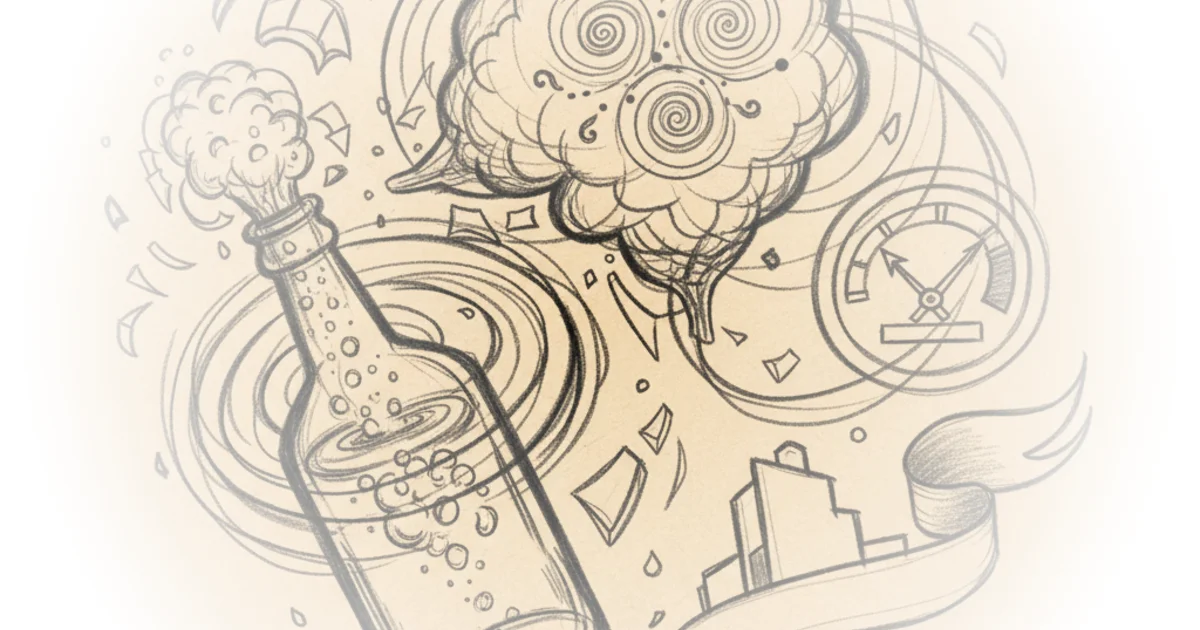
But Muller isn't just debunking a myth; he's revealing something far more interesting about how carbonated drinks actually work. When you pick up a bottle from the grocery store shelf, "the dissolved co2 in the liquid is at equilibrium with the gas up here in the head space." The system has been sitting for days. It's already at three atmospheres of pressure — balanced, stable, and thoroughly unremarkable.
What makes this worth watching is what happens next: Muller introduces nucleation sites — tiny air bubbles introduced by shaking — which act as catalysts for the CO2 coming out of solution. "When you go to open it those bubbles do two things," he explains. "First they expand due to the decrease in pressure and that pushes up the liquid above them and second they act as nucleation sites allowing the dissolved co2 to come out of solution much more rapidly."
This is the real explanation, and it's elegant: not pressure building up inside the bottle, but bubbles forming that release the fizz faster than physics would otherwise allow. Critics might note that Muller leans heavily on demonstration rather than rigorous derivation — but for a video about perplexing physics problems, this visual approach is exactly what makes it work.
The Ice Cube Mystery
The second problem shifts from drinks to water in a different state: identical ice cubes placed in fresh water versus salt water. Most viewers will assume the saltwater ice melts faster because we use salt to melt ice on roads. But Muller shows something counterintuitive: "the ice cube in the fresh water is melting faster than the ice cube in salt water."
The explanation comes down to density — a concept most people learned about in school but rarely connect to real-world phenomena. In fresh water, "the water coming off that ice cube is cold it's more dense than the surrounding fresh water and so it descends." This downward flow brings warmer water up to meet the ice cube, melting it faster.
In salt water, something different happens: "that fresh water is actually less dense than the salt water around it and so it stays that cold water that just melted off the ice cube stays around the ice cube in effect insulating it from the warmer salt water around it." The cold water insulates rather than circulates — it's the opposite of what most people would predict.
Muller uses food coloring to demonstrate these currents, then acknowledges a flaw: "maybe food coloring would just float on the surface of salt water anyway and sink in fresh water so not a good demonstration." He pivots to colored ice cubes as a better alternative. This self-correction is part of what makes his approach feel genuinely experimental rather than performatively authoritative.
The Chain Trick
The third problem — making a ring stick on a closed loop of chain — seems almost like stage magic. Muller shows the trick, then breaks down exactly how it works: "the key is to let it go on one side before the other side so I'm going to let it go with my thumb first and it'll just sort of slide off my finger." The ring rotates about 90 degrees and slides down the chain.
What makes this section effective isn't just the demonstration — it's Muller's willingness to show slow-motion footage and explain exactly what's happening. "These pieces slide up the sides and when you get to the bottom it's almost like this piece at the bottom gets sucked into the middle of the ring and then at the last minute gets pulled around and it snaps on." The physics is actually quite simple once you see how rotation matters.
Bottom Line
Muller's strongest move in this piece isn't any single explanation — it's the willingness to show his failures. The pressure gauge that doesn't change, the food coloring that floats wrong, the ice cubes that behave opposite to expectations: these aren't just demonstrations of correct answers; they're permission for viewers to think differently about everyday phenomena.
The biggest vulnerability here is one of depth. Muller explains density differences and nucleation sites with clear confidence, but he doesn't explore why these mechanisms work the way they do — what molecular properties drive water's behavior at different salinities? The piece is satisfying enough to watch, but leaves genuinely curious viewers wanting more.