The four words a paramedic spoke at a doorway in East Texas in May 2020 — "They won't let you in" — contain more indictment of pandemic policy than any op-ed. Natural Selections publishes this essay as a reckoning, one grief at a time.
The Distance Between the Ambulance and the Door
The piece opens not with policy but with a father. A newspaper editor who worked late, missed dinners, interviewed five presidents and a young Elvis Presley. A man who his daughter fought with bitterly through a rebellious adolescence, then slowly came to love as a fellow flawed human. That journey of reconciliation — from adversaries to the simple, hard-won place of holding hands on a sofa — is the emotional architecture on which everything else in the essay rests.
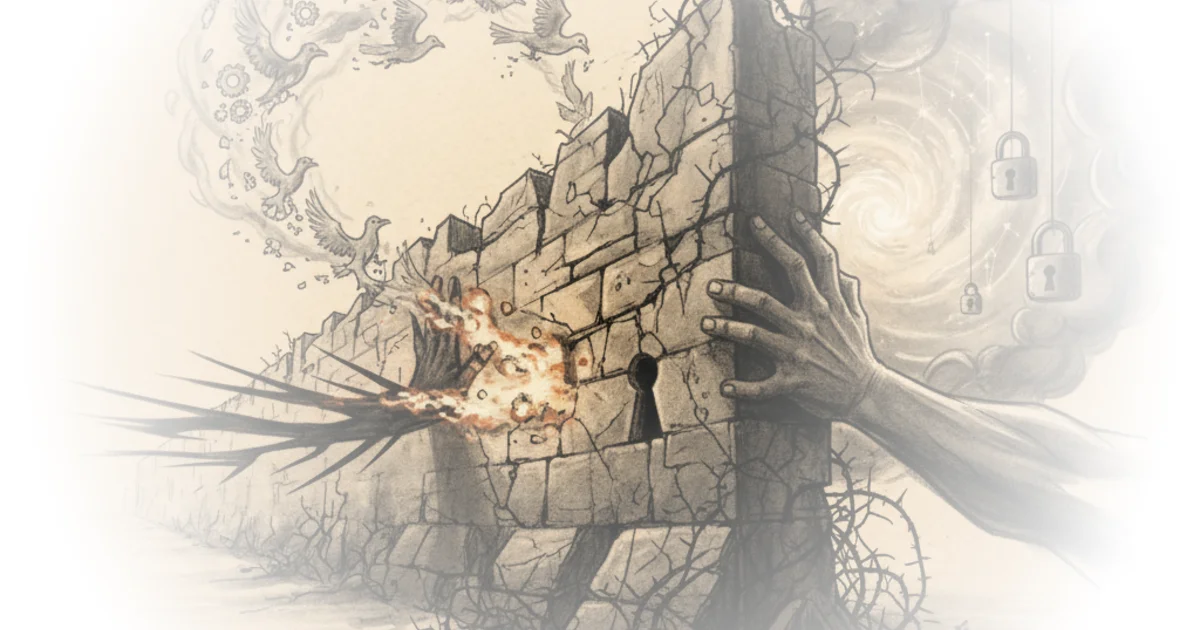
When the father's decline accelerates in late April 2020, the family is already living under the strange suspended logic of pandemic life. The narrator had driven to East Texas from Austin at her boyfriend's urging — "Things are getting weird," he said — and had been keeping her parents company through the monotony of lockdown. Neither parent feared the virus. Boredom, the essay notes, was their biggest concern. Then the father got sick. Not with a respiratory illness — he was weak, achy, prone to dehydration. The family kept him home as long as they could, respecting his clear wish not to go to the hospital. What they did not understand, because it had not fully registered, was what a hospital visit in May 2020 would actually mean.
When the moment finally came — the father too weak to stand, his cat already retreating to hide under a spare bed in what the narrator reads as a feline farewell — an ambulance was called. The paramedics came. They lifted the father gently onto a gurney. His wife called out that they would be right behind. And then one paramedic turned back with sadness in his face and delivered the sentence that titles this essay.
"They won't let you in."
The narrator writes that she only continued to stare stupidly at the sympathetic face that had just told her the incomprehensible. The ambulance drove away slowly, with no sirens and no lights. Mother and daughter walked back inside in silence.
The Hospital as Black Box
What follows in the essay is a portrait of grief conducted at a remove — through phone calls, through intermediaries, through the glass wall of institutional protocol. The family drove to the hospital with the father's glasses and a few personal items. Not even his wife was allowed inside.
The medical interactions that came next did not improve matters. A doctor seemed focused less on the father's condition than on his classification. Both COVID tests she administered came back negative, but she remained undeterred. Natural Selections recounts the exchange in terms that are pointed: when the narrator's mother cited the test results over the phone, the doctor replied, "Oh, he's got it. I can just look at him and I know." The mother's response — that the government should hire her to travel the country diagnosing people by sight — is delivered by the essay as dark comedy, the absurdist rejoinder to institutional overconfidence. Someone else was eventually assigned to the father's care.
The counterpoint to this institutional coldness arrives in the form of a nurse who, off the clock, returned to the father's room on the family's wedding anniversary and held the phone to his ear so the parents could speak. It is one of the essay's most precisely rendered moments. The mother told an old story — about the Triumph convertible, about driving through New Mexico as a young couple, about a sunset so beautiful they simply kept driving all night. "Tell him about when y'all were young and had the Triumph convertible," the narrator urged, "and how you were driving through New Mexico and the sunset was so beautiful and you felt so free that you decided to just keep driving and drove all night long." The father, in his morphine haze, confirmed he knew the voice on the phone: "That's my wife," he said.
The phone was passed around. The eldest sister, more composed than her younger sibling throughout her life, spoke briefly — and then suddenly, fearfully, cried out "Daddy!" before her voice broke entirely. The father died of heart failure two days later, alone in a hospital bed.
"Death is the one certainty we have in this life, and yet fear of death makes us try to deny it. If life really is a journey we should be holding someone's hand as they take those final steps."
Two Griefs, Two Lenses
The essay's most intellectually charged section arrives near its end, when the narrator receives a Christmas card from an old friend she hasn't spoken to in years. The friend describes her own pandemic loss: her mother in an assisted living facility, visits reduced to standing on the other side of a plate glass window, mouthing greetings while her mother looked confused. Facetime failed because the mother couldn't understand tablets or iPhones. Dementia accelerated. She too died alone.
The narrator, reading this, believed she had found someone who understood. She wrote back with fury — "railed against the dystopian, crazy and inhuman policies that had treated our parents so cruelly" — only to reread the original letter later and discover she had projected her own anger onto it entirely. Her friend had not been angry. She had accepted the plate glass, the silence, even the dementia as part of an honorable role in a national crisis. She questioned nothing. She accused no one. She never wrote back.
Natural Selections lets this irony stand without over-explaining it. The two women suffered nearly identical losses under nearly identical circumstances and arrived at opposite conclusions about what had happened to them. The narrator cannot understand her former friend's acceptance; the former friend, presumably, cannot understand the narrator's rage. The essay does not declare a winner. It simply notes the unbridgeable distance that opened between them — a smaller version of the larger social rupture the piece describes, where the pandemic sorted the population into those who repeated the rules eagerly and those who hesitated, and the two groups increasingly looked at each other as strangers.
The Yoga Teacher's "Oh Good"
One of the essay's sharpest moments is also one of its briefest. Back in Austin after her father's death, the narrator returns to her yoga studio when it reopens. A teacher asks what she did during the closure. She explains that her father died. "From Covid?" the teacher asks, looking stricken. "No," the narrator says. "Heart failure." "Oh, good," the teacher replies, smiling with obvious relief.
The narrator wonders whether she should ask if the teacher genuinely believed the grief would have been worse had it been a COVID death. She does not ask. She simply notes, with compressed fury, what she was seeing: how fear had replaced reason, how the taxonomy of acceptable grief had been quietly reorganized, even in a city that had allowed in-person yoga and mask-free restaurants.
Critics might reasonably note that the hospital visitation policies the piece condemns were not arbitrary cruelty — they were implemented at a moment of genuine medical catastrophe, when hospitals were overwhelmed and the transmission vectors of a novel virus were still poorly understood. Protective isolation of the dying was, in many places, an attempt to protect the living, including healthcare workers with inadequate personal protective equipment. The nurse who held the phone on her own time was working within a system doing its imperfect best under conditions no one had prepared for.
Critics might also observe that the piece's framing of COVID policies as propaganda and fear-replacing-reason sits within a specific political interpretive tradition — one that the essay itself acknowledges, noting that the narrator's Texas life was "far less restricted" than that of people in "bluer states." The essay doesn't argue that all lockdowns were equivalent; it argues that whatever the rules were, the no-visitors policy was indefensible. That is a narrower claim than it sometimes appears, and a more defensible one.
A third counterpoint worth naming: the narrator never definitively learns what her father died of. The doctor's insistence on a COVID classification despite two negative tests, and the family's certainty that it was heart failure, is presented as the family's account. The essay doesn't linger on this ambiguity — but it is there, embedded in a story whose grief would have been no less real regardless of what the death certificate ultimately said.
What the Essay Is Actually About
Strip away the COVID politics — or rather, hold them in suspension for a moment — and the essay is about something older and harder: the fact that Western modernity has arranged death so that the dying go behind institutional walls, and the living wait at home for a phone call. The pandemic accelerated and formalized this arrangement with legal force, but the arrangement itself predates 2020 by decades. Hospitals have always been places where families stand in hallways.
What the narrator mourns is not only the policy but the particular story interrupted by it: a father and daughter who had traveled from estrangement to reconciliation, who had arrived at the simple, hard place of holding hands, and who were then separated at the precise moment when the reconciliation most needed its physical expression. The essay's power comes from this specificity. It is not an argument about COVID policy in the abstract. It is the story of a man who loved wine and golf and gin rummy, who had driven through a New Mexican sunset in a Triumph convertible, who was in a morphine haze in a hospital room when his daughter was trying to apologize for the ugly years.
"I do remember my brain was screaming, 'Tell him you're sorry! Tell him you're sorry!'" Natural Selections records. The narrator hopes he believed her when she said he would come home soon. She does not know if he did.
The small memorial that eventually came — Hawaiian shirts on a golf course, a bottle of Chateauneuf du Pape, Dad stories — was the ceremony that should have come with witnesses, with his friends and colleagues, with the full social acknowledgment that a life had been lived and mattered. It came instead in private, among three women, because public funerals were not permitted. The father had spent his career making sure stories reached people. His own ending went largely unremarked.
Bottom Line
Natural Selections publishes here a grief essay that will outlast the policy debates surrounding it — because its real subject is not lockdowns but the long human practice of accompanying the dying, and what happens when institutions interrupt that practice in the name of safety. The piece is strongest not in its political observations but in its intimate ones: the cat retreating under the spare bed, the Triumph convertible story told over the phone, the sister's sudden cry of "Daddy" at the moment composure finally broke. Whatever one concludes about the policies of 2020, the cost of those policies was paid by real people, in real rooms, and this essay names one of them.