The oldest named person in history was a Sumerian accountant. His name was Kushim, and he lived approximately 5,000 years ago in what is now Iraq. His legacy isn't a kingdom or a military conquest — it's a small clay tablet recording 135,000 liters of barley delivered over 37 months. This isn't just an archaeological curiosity. It's the earliest known evidence of human beings using written numbers to track goods, and it represents something far more profound: a cognitive revolution that reshaped how humans think about power, wealth, and governance.
The Origins of Accounting
The tablets found in Mesopotamia aren't the beginning of this story. They're actually the continuation of something much older — tiny clay tokens that predate writing by several thousand years. These aren't impressive objects. They range from spheres to discs to cones, each shape possibly representing different goods: grain, livestock, or measured quantities of precious materials.
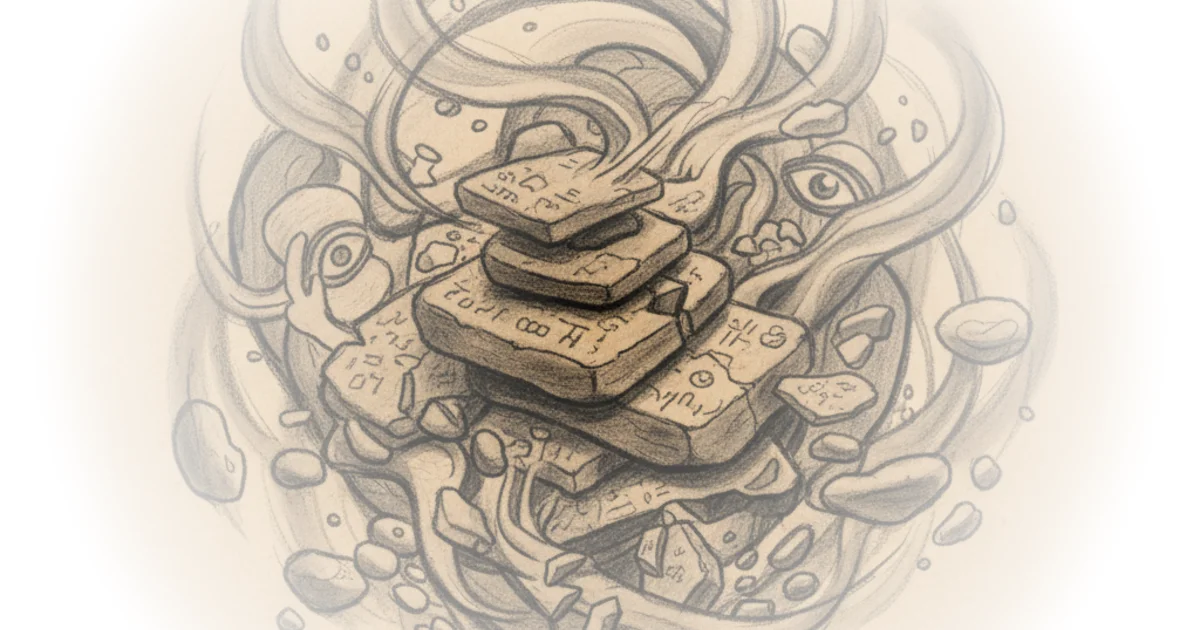
Archaeologists have found thousands of these tokens across Mesopotamia. The earliest examples may be as old as 11,000 years. They were discovered at a site called Tepe Gaura (also spelled Teepe Ga Ga), about 25 kilometers north of modern Mosul in Iraq. The site was first excavated by the University of Pennsylvania in the 1920s and 1930s.
Tepe Gaura isn't a natural hill. It's what archaeologists call a "tell" — a mound formed from thousands of years of stacked mud brick towns built directly on top of ruins below. It's like a human termite mound, layered so thick that when people dug foundations for new buildings, they often cut into the remains of older structures.
These tiny clay objects represent something far more profound than simple counting — they were the foundation upon which complex economies and governments would be built.
A Transitional Civilization
Dr. Brad Hafford, an expert in ancient Mesopotamian trade who runs his own archaeology YouTube channel, explains why Tepe Gaura matters so much to this story. The site was occupied for roughly 5,000 years, from about 6,500 BCE down to 1,500 BCE — spanning the emergence of writing around 3,400 BCE.
The location was strategically perfect for trade. Situated near the Tigris River and the foothills of the Zagros Mountains, Tepe Gaura had access to materials like wood, precious stones, and metals that were harder to find further south in Mesopotamia. The climate also allowed what archaeologists call "dry farming" — agriculture without elaborate irrigation systems.
This meant easier urban life could emerge. Generation after generation, settlements grew larger and more complex, creating bigger cities with economies that needed to keep track of goods.
The core problem was straightforward: how do you know how much food your community actually has? When farmers settled into agricultural towns, they needed to survive winters when nothing could grow. The solution involved pulling grain together into shared storage — but knowing exactly how much grain existed required a system of counting.
What the Tokens Represent
Archaeologists believe these different shaped tokens represented different goods. Cones might represent grain; round discs could represent flocks of animals. Some tokens were enclosed in clay envelopes, creating what appears to be an extremely ancient transaction receipt.
When Dr. Hafford measured these tokens, he wanted to know if they followed a system of weights — a standardized measurement system. They didn't. But the evidence strongly suggests they were used for accounting: tracking quantities, planning distributions, and managing grain stores.
Yet there's another possibility that makes these objects even more fascinating. The word "calculate" comes from the Latin calculus, meaning "little stone." Some tokens may have been gaming pieces — left behind by ancient board games. This creates a tantalizing question: are some of humanity's oldest mathematical tools also the ancestors of modern board games?
Evidence from Graves
When graves start showing more built-up chambers at Tepe Gaura (levels 10 and 11, corresponding to roughly 4,000 to 3,800 BCE), something else becomes obvious: luxury goods emerge. Beautiful golden artifacts, delicate jewelry — signs of class distinction emerging.
One grave stands out specifically. It's called Grave 181, found at what archaeologists call "the round house" — a huge building with very thick walls that was likely defensive in nature. The grave contains tokens, jewelry, and all the signs of wealth accompanying a wealthy administrator.
But here's what's remarkable: it's a child's grave.
This implies something crucial about how these societies functioned. Normally, status would be earned through demonstrated achievement. You couldn't gain prominence young — you needed time to do something great that would be rewarded. But this child was buried with symbols of profession or intended profession. The implication is inherited status: the ability to use tokens and administer grain was a skill passed down through families.
The First Rulers Were Accountants
It's not hard to imagine how people keeping track of grain at Tepe Gaura could become an elite. Even if they didn't have more grain than anyone else — which they probably did, since they were the ones keeping track — they held real power. They decided how grain got distributed. They knew exactly how much existed.
This changes everything about how we understand early urban societies. The first kings weren't necessarily the strongest warriors or the most ruthless leaders. They may have been simply the accountants, the bureaucrats. Knowledge of these clay balls and the mathematics behind them probably put them in positions of power.
These objects were so important that they appeared in graves — buried alongside people as symbols of their profession or intended profession. With this power came other desires: sharing your name, your title, your authority.
The tokens themselves are tiny — only about 3 centimeters across — but some bear little pictures: a sitting deer, geometric patterns, even what appears to be a seated woman. When these tokens show up in heavy use, archaeologists also find evidence of more complex administrative systems emerging.
Critics might note that interpreting these artifacts is notoriously difficult. Archaeology involves looking thousands of years into the past, and certainty is rare. The tokens could have been used for almost anything — gaming pieces, religious objects, simple measurement tools. We can't be sure 100% what they were being used for, though the context of grain storage buildings strongly suggests administrative purposes.
The first rulers weren't necessarily the strongest warriors or the most ruthless leaders — they may have been simply the accountants.
Bottom Line
The strongest part of this argument is its reframing of power. By suggesting that governance emerged from the ability to count and administer rather than from violence or conquest, it challenges how we understand civilizational foundations. The evidence at Tepe Gaura — tokens buried with administrators' children — suggests professional knowledge was inherited, creating the first class structures.
The biggest vulnerability is interpretive certainty. We can't prove these tokens were used for accounting, not gaming or religion. But the grain storage buildings and linguistic evidence make the strongest case. What comes next is even more intriguing: understanding that these tiny clay objects weren't just counting tools but represented a fundamental shift in how humans could plan, project numbers into the future, and organize complex societies. }