Then & Now reframes the universal struggle of addiction not as a failure of willpower, but as a fundamental error in measurement. While modern discourse often treats bad habits as moral failings or biological traps, this piece argues that the ancient Greek concept of akrasia—acting against one's better judgment—is actually a cognitive illusion where we misjudge the value of immediate pleasure against distant consequences.
The Chariot and the Single Soul
The commentary begins by invoking Plato's famous metaphor of the soul as a chariot pulled by two horses: one rational, the other unruly. Then & Now writes, "Socrates said that sometimes these internal guides are in accord, sometimes at variance, and one gains the Mastery now, the other." This duality suggests that when desire drags us irrationally toward pleasure, we are in a state of "wantonness," a chaotic existence where the soul loses its wings and cannot break through to the heavens. The author uses this imagery to illustrate the visceral feeling of being "pulled in two different directions," a sensation familiar to anyone battling nicotine, sugar, or other compulsions.
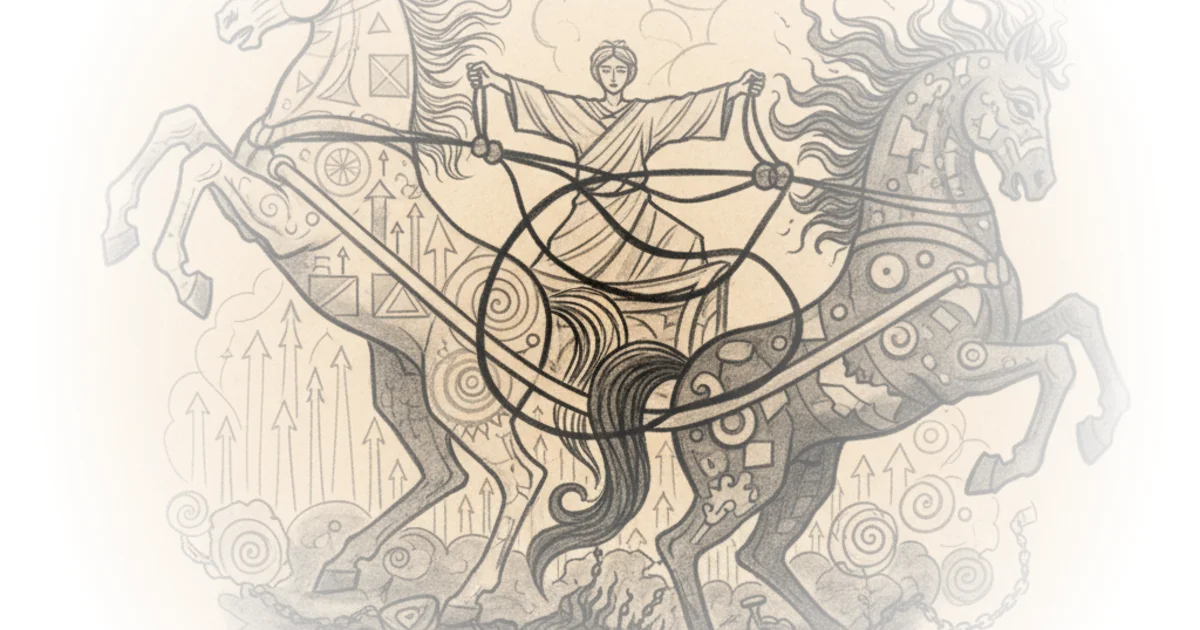
However, the piece quickly pivots to a more radical Socratic claim: the soul is not actually divided. Then & Now notes that Socrates posits the soul is "an organic whole," meaning we are not driven by two competing horses but act for a single reason. The core argument here is that what we perceive as weakness of will is actually a lack of knowledge. As the author explains, "when people make a wrong choice of pleasures and pains... the cause of their mistake is lack of knowledge." This reframing is powerful because it removes the shame of moral failure and replaces it with a solvable intellectual problem. If addiction is ignorance, then the cure is not brute force, but better data.
"No man voluntarily pursues evil or that which he thinks to be evil; to prefer evil to good is not in human nature."
This perspective challenges the modern reliance on willpower. The author points out that we often believe we know a cigarette is bad for our health, yet we smoke anyway. Then & Now argues that we don't actually have the right knowledge in that moment; rather, the "knowledge that it's going to be preferable in the present moment is stronger than the knowledge of the consequences in the long term." The piece suggests that our internal calculus is flawed not because we are weak, but because we are bad at measuring value across time.
The Art of Measurement
The commentary deepens by introducing the Socratic solution: the "art of measurement." Then & Now writes, "do not the same magnitudes appear larger to your sight when near and smaller when at a distance?" This observation is the crux of the piece's utility. We overvalue the immediate buzz of a drink or the relief of a cigarette because they are close, while the long-term damage appears small and distant. The author argues that "the art of measurement would do away with the effect of appearances and showing the truth would teach the Soul at last to find rest in the truth."
This is where the argument becomes most actionable. The piece draws on Baruch Spinoza to reinforce the idea that "an effect... cannot be taken away unless by an effect that is opposite to and stronger than the one that is to be restrained." Then & Now interprets this to mean that acquiring adequate knowledge of a choice will always beat a lesser impulse. The author concludes that the path to freedom is not fighting the unruly horse, but simply sharpening the measurement of the consequences. "Our goal should be to balance all of the consequences, all of the virtues, all of the pleasures and pains and bring them into proportion," the author states.
Critics might note that this intellectualist approach underestimates the physiological grip of addiction, where the brain's reward system is hijacked regardless of how well one can "measure" the outcome. For many, the chemical reality overrides the philosophical calculation. Yet, the piece's strength lies in its refusal to treat the addict as a slave to their biology, offering instead a framework where agency is restored through clarity.
Bottom Line
Then & Now's most compelling contribution is the shift from a moral battle against desire to an intellectual exercise in measurement. The argument's greatest vulnerability is its reliance on the assumption that human beings can always access and apply this "art of measurement" in the heat of a craving. However, the piece succeeds in offering a dignified, non-judgmental lens for understanding why we do things we know are bad for us, suggesting that wisdom, not willpower, is the true saving principle of human life.