In a political climate where efficiency is often mistaken for virtue, Yascha Mounk dismantles one of the most persistent myths of our time: that authoritarian regimes are simply better at getting things done. While many observers envy the apparent decisiveness of autocrats, Mounk brings a rigorous, data-driven counter-narrative showing that unchecked power rarely delivers on its promises and frequently leads to catastrophe. This piece is essential listening for anyone tired of the "strongman" fantasy, offering hard evidence that the messy process of democracy is not a bug in the system, but its most vital feature.
The Illusion of Decisiveness
Mounk opens by confronting the seductive idea that dictators can act without the friction of debate. He writes, "Where democratic leaders haggle, delay, and pander, the authoritarian ruler simply acts." It is a framing that resonates with anyone frustrated by legislative gridlock. However, Mounk quickly pivots to argue that this speed is often an illusion masking deep structural rot.
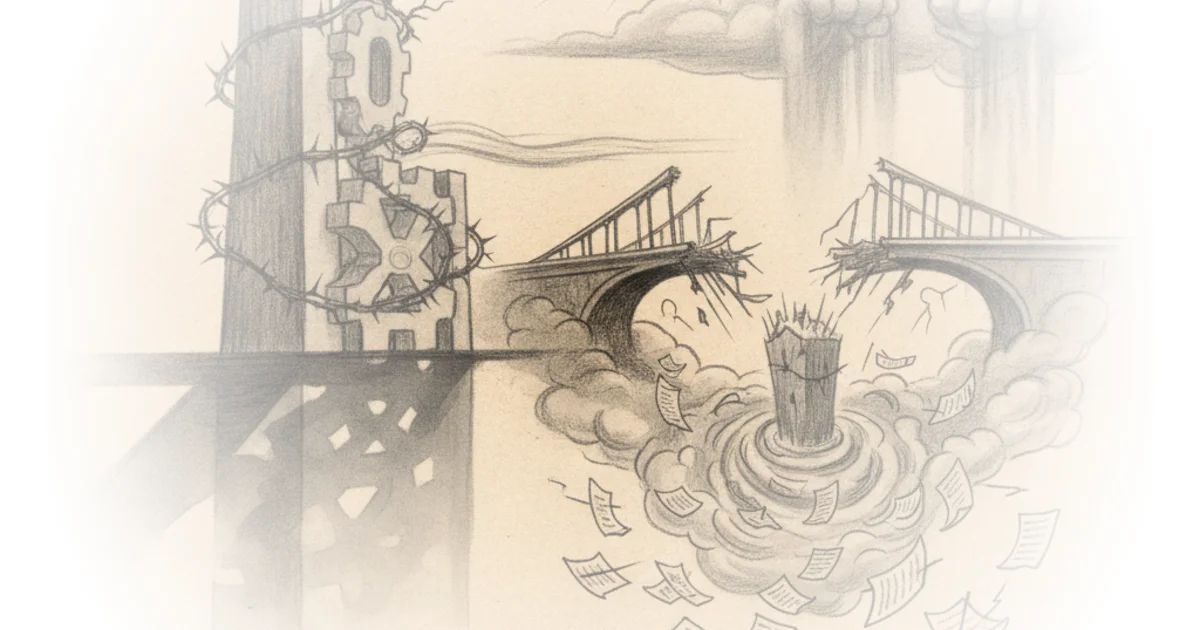
The author points out that while autocracies may move fast, they frequently move in the wrong direction because their leaders are cut off from reality. "An autocrat's epistemic isolation, it turns out, is not a strategic asset—it is a liability." This observation is crucial; it reframes the lack of dissent not as a sign of unity, but as a blind spot that leads to disastrous miscalculations. The recent conflict in Ukraine serves as a stark case study here. Mounk notes how Vladimir Putin bet on a fractured West and a weak Ukrainian society, only to find his military outmatched by citizen-soldiers fighting for their own survival.
The argument gains weight when Mounk looks at the long-term historical record of warfare, challenging the ancient notion that democracies are inherently weak. He cites a striking statistic: "Since 1815, democracies have won more than 80 percent of the wars they have fought." This is not just a matter of morale; it is about legitimacy. Democracies can ask citizens to make sacrifices because those citizens have a voice in the decision. As Mounk puts it, "They win not in spite of their openness but because of it."
Critics might argue that this historical data ignores the early 20th century, when authoritarian powers seemed to dominate democracies before the tide turned. Yet, Mounk's point remains robust: the long-term trajectory favors systems where power is checked and information flows freely.
An autocrat's episemic isolation, it turns out, is not a strategic asset—it is a liability.
The Economic Trap of Unchecked Power
The article then shifts to the economic realm, addressing the claim that authoritarian leaders can make long-term investments that democracies cannot because they are unencumbered by elections. Mounk acknowledges there is "something to this argument" but insists it is a dangerous oversimplification.
He argues that democratic accountability actually drives better outcomes in health, education, and infrastructure because citizens reward governments that deliver these goods. Furthermore, the open flow of ideas in free societies acts as an engine for innovation. Mounk writes, "The open circulation of ideas across universities, a free press, and competitive markets is not a distraction from growth but one of its primary engines." This challenges the narrative that state control fosters efficiency.
Perhaps most damning is the comparison of disaster frequency. While democracies may have slow moments, they rarely produce existential catastrophes. Mounk contrasts this with the "ideological fantasy insulated from the real world" that led to Mao's Great Leap Forward, which killed tens of millions. He notes, "Comparable disasters in democratic states are virtually unknown—not necessarily because democratic leaders are wiser or more virtuous, but because they face institutional constraints and public scrutiny that make disastrous policies impossible to sustain."
This section effectively uses the concept of selectorate theory—where autocrats must please a small elite rather than the general populace—to explain why these regimes often fail to transition to knowledge-based economies. While countries like China can achieve middle-income status through mobilization, Mounk argues that the final leap requires rule of law and intellectual freedom, which are systematically undermined by dictatorship.
The Climate Myth and the Chinese Case
The most timely application of Mounk's argument concerns climate change. Many environmentalists have flirted with "eco-authoritarianism," suggesting that only a dictator can impose the painful costs needed to save the planet. Mounk dismantles this by distinguishing between the capacity to decide and the likelihood of making good decisions.
"Authoritarian regimes can certainly move fast when they decide to," he writes, "But choosing to address climate change rather than subsidizing fossil fuels is precisely what they frequently fail to do." He points out that without a free press and independent scientists, regimes often lie about emissions and suppress the very movements needed to drive change. The argument here is that freedom of expression is not an obstacle to climate action; it is a prerequisite.
Mounk then turns his gaze to China, the primary exhibit for the authoritarian model. He acknowledges China's spectacular growth in lifting millions out of poverty but urges a closer look at the costs. "China's official growth figures are among the most manipulated of any major economy," he notes, citing satellite data that suggests the reality is less impressive than claimed.
The comparison with South Korea and Taiwan is particularly powerful. Starting from similar levels of poverty in 1949, these two democracies have surpassed China in per capita income and quality of life. Mounk writes, "South Korea and Taiwan are consolidated democracies with per capita incomes substantially higher than China's." He also highlights the human cost of China's internal security apparatus, noting that domestic security spending now exceeds military spending—a sign of a regime that fears its own people.
The handling of the pandemic further illustrates the danger of prioritizing control over truth. Mounk observes that while China's initial lockdowns were swift, they were preceded by the suppression of early warnings. "The government had optimized for control rather than for public health," he concludes, a choice that ultimately cost lives both domestically and globally.
Bottom Line
Yascha Mounk's strongest contribution is his refusal to compare real democracies against an idealized version of authoritarianism; instead, he pits the messy reality of free societies against the catastrophic failures of dictatorships. The argument's greatest vulnerability lies in its reliance on long-term averages, which may not satisfy those facing immediate crises who feel democracy is too slow to act now. However, Mounk leaves us with a profound truth from Machiavelli: "Fewer errors will be seen in the people than in the prince—and those lesser and having greater remedies." In an era of rising autocratic temptation, this reminder that systems capable of self-correction are superior is not just academic—it is essential for our survival.