A rocking chair won an Oscar, humbled the founders of Studio Ghibli, and quietly reshaped the course of world animation — and most people outside serious film circles have never heard of it. Animation Obsessive's deep dive into Frédéric Back's Crac (1981) makes the case that one of animation's most consequential works is also one of its least discussed.
The Shock of a Different Vision
In 1982, Isao Takahata and Hayao Miyazaki were in Los Angeles, grinding through frustrating negotiations with Hollywood over a proposed animated Little Nemo feature. The experience, by most accounts, was a professional low point. Then, almost by accident, Takahata stumbled into a screening where a Canadian short was playing as a double bill with a French live-action film. He didn't know it had already won the Academy Award for Animated Short Film that year. He just watched it.
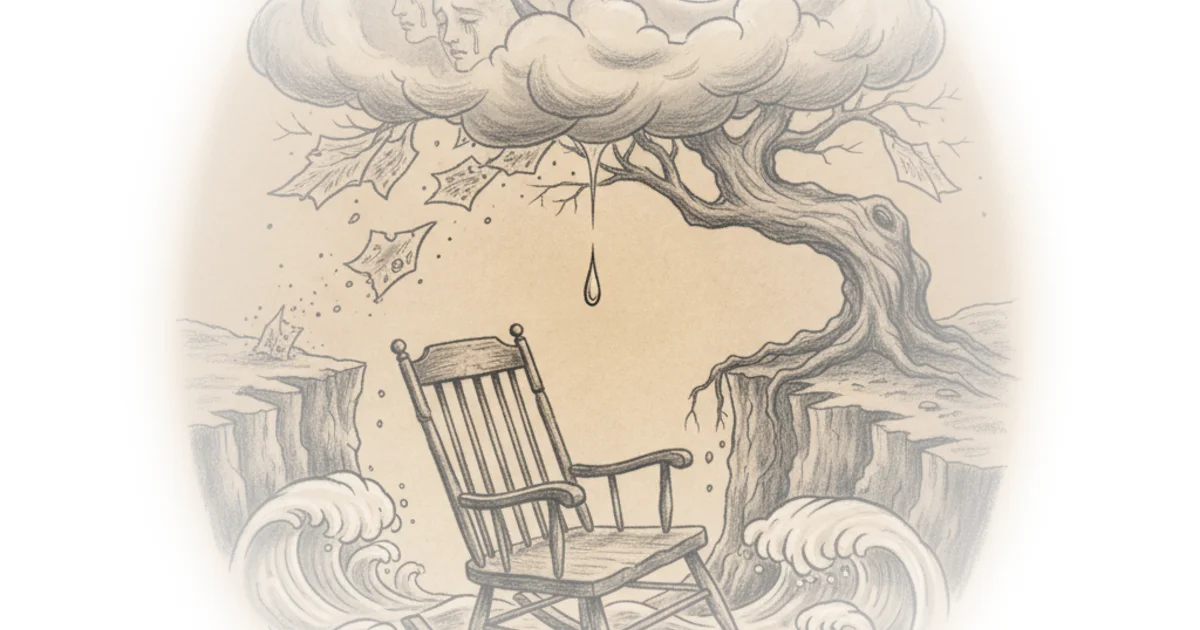
The film was Crac. Takahata watched it a second time, dragging colleagues in with him. Miyazaki, describing the walk home afterward, recalled the vertigo of encountering something genuinely better than what you yourself are making: "It was a shock to both of us. As we trudged home after the film, I remember saying to Takahata-san, 'So, I guess we're failures, aren't we…'"
That kind of creative reckoning — the honest confrontation with a master's work — is rarer than it sounds. Miyazaki is not given to false modesty, and neither was Takahata. The fact that both men were floored by the same twelve-minute film about a wooden chair says everything about what Back had achieved.
Animation Obsessive traces what specifically electrified them. Toshio Suzuki, then a magazine editor in Tokyo, heard the two men raving when they returned. He recalled their observation that in Crac, "the story, theme and presentation all matched" — that even the characters and backgrounds were fused into a single unified vision. This was something Japanese cel animation, at that time, simply did not do. Takahata later crystallized the insight: Back was a filmmaker whose "content and presentation are inseparably linked."
The Film Itself
The premise of Crac is deceptively simple. A man cuts down a tree and carves a rocking chair. The chair stays in his family for generations. Seasons change, children are born, marriages are celebrated, and the chair is there for all of it — painted over, broken, repaired, always present. Then modernity arrives. The rural Quebec landscape is razed, replaced by factories and identical apartment towers, and the chair is thrown out. It eventually ends up in a museum, surrounded by its memories.
The story Back was telling was personal. He had emigrated from Europe to Canada in the 1940s and developed a deep love for Quebec's rural life — a world, as he described it, when people "had the forests to live off and they lived well by the forest." His wife had known that older Canada firsthand. Crac was built from those combined memories, a tribute to something already gone by the time Back made the film.
What surprised Back was how far beyond Quebec the film's resonance reached. "I expected the film to please Quebeckers, especially. The big surprise was seeing that Americans found it amusing, and that the Japanese found it interesting, and then seeing it accepted around the world." Japan's postwar industrialization had tracked the same arc — rural displacement, the obliteration of old ways by new construction — even though Back had aimed at something entirely local. The specificity turned out to be universal.
A Technique Born from Accident
The visual style of Crac — those warm, textured colored-pencil drawings that make backgrounds and characters feel like sketches from the same hand — didn't originate with the film. It emerged during Back's previous project, All Nothing (1978), out of a technical failure. The original plan had been to draw on tracing paper, which didn't work. So Back tried something else: frosted cels, the kind used by architects and engineers rather than animators.
As Back explained the discovery: the frosted cels allowed him to use wax-based colored pencils — Prismacolor, readily available — which wouldn't have adhered to a standard transparent cel. The semi-transparency of the frosted surface gave images a particular texture and "great freedom of expression." More importantly, it collapsed the visual boundary between character and background. In most animation, characters are drawn on one layer and backgrounds painted on another; the two exist in different registers. Back's frosted-cel technique made them look like they came from the same artist's hand in the same moment.
Takahata read this as something larger: the transposition of sketching itself into animation. Not the polished, structured drawing of Disney — but the quick, personal line of an artist capturing exactly what they want to capture, nothing more. "Impression took over," the piece notes, and Crac was the fullest realization of that approach.
The film's sense of movement followed the same logic. It exaggerates and simplifies, but never tips into cartoon abstraction. Takahata described it as "the attraction of human movement as such" — the animation of ordinary, everyday activities in a way that hooks the viewer precisely because it feels true rather than performed. A child playing. A couple dancing. A chair being painted. These are not dramatic moments, but Back makes them feel irreplaceable.
The Man Behind the Work
Back came to animation late, starting around 1968 in his mid-forties, and was always an outsider to the industry's mainstream. He worked not at the prestigious National Film Board of Canada — home of Norman McLaren, from whom Back drew the auteur model of working largely alone — but at Radio-Canada, whose animation department was smaller, underfunded, and perpetually at risk of being shut down. He made his name there anyway.
The idea for Crac predated his arrival at the technique that would make it famous. He wrote his first proposal in 1973, inspired by a story his young daughter had written for school: Les lamentations d'une chaise berçante, or "The Lamentations of a Rocking Chair." Her version was an old handcrafted chair's tirade against humanity for abandoning it in favor of mass-produced furniture with "no personality." The story's humor and its implicit critique appealed to Back's sensibility. He was an environmentalist, an animal-welfare advocate, and an activist who had spent his life acting on those convictions — by his own account, he had gotten into fights with people who mistreated horses. His films were an extension of that same impulse.
Animation Obsessive quotes Back reflecting on his sense of mission: "I always felt weak in relation to the dimension of injustice. … One must counterbalance violence. One must react. We can't accept it. When someone is getting a beating in front of you, the worst thing is cowardice. Intervention is necessary." Crac is not an angry film, on the surface. But Back understood it as part of the same work.
"My films are my gift. I put the very best of myself, of what I believe very deeply, into my work. … filmmaking is not just an occupation for me."
The Cost of Making It
The colored-pencil technique that defined Crac's look required a fixative applied to each cel. Just before All Nothing competed at the Oscars in early 1981, while Crac was in production, that fixative got into Back's right eye. It was late at night. The drug stores were closed. He washed the eye with water and kept working.
Surgeries followed. Doctors told him the eye could be saved if he rested. He kept animating. He lost the eye.
"I should have stopped working for several months," he said later. "But I continued."
There is something in that admission that Animation Obsessive handles with admirable restraint — it presents the fact without turning it into hagiography. Back's workaholism was driven by his sense of mission, but it was also a choice with permanent consequences. His colleagues remembered him as "sort of the night watchman" at Radio-Canada, always the last to leave. The film was finished. It won the Oscar. Back went onstage in a borrowed tuxedo that was too large and accepted the award — and then told his producer offstage that he wished All Nothing had won instead, because its message was more direct.
The self-effacement is characteristic. Crac's statement is quieter than his earlier work's, wrapped in beauty rather than delivered as argument. Back seemed to have thought that made it lesser. He was wrong.
The Ghibli Inheritance
The influence of Crac on Takahata and Miyazaki is traceable and documented, but Animation Obsessive makes a subtler point: it's also ambient in ways that outrun direct citation. Disney veterans like Glen Keane fell in love with the film. Festival animators like Koji Yamamura traced their own roots to it. The piece argues that you can read even My Neighbor Totoro as an answer to Crac — the same celebration of rural life, the same elegy for a simpler relationship with the natural world, the same conviction that ordinary moments deserve the full weight of an artist's attention.
More strikingly, Animation Obsessive contends that Back's approach to staging and transitions shows up "in the work of people who've never watched Crac" — that the film's DNA has dispersed through animation broadly, transmitted indirectly through the work it inspired. This is the mark of a genuinely foundational piece: influence that outlasts attribution.
Critics might note that the Ghibli connection, however real, risks flattening Back's achievement into an origin story for more famous filmmakers. Miyazaki's and Takahata's testimony is genuine, but Crac deserves to be understood on its own terms — not primarily as the film that influenced the people who made Grave of the Fireflies and Princess Mononoke. Animation Obsessive is aware of this tension, but the Ghibli frame is also how most of its readers will first come to care about the film, which is a reasonable editorial trade-off.
One might also push back on the piece's treatment of Back's message as self-evidently correct. His nostalgia for rural Quebec is sincere and beautifully rendered, but nostalgia for pre-industrial life is also a sentiment with a complicated history — often more available to artists than to the people actually living that life. The film doesn't grapple with this, and the piece doesn't press on it. The romanticization of a vanished rural world is part of what makes Crac emotionally effective; it's also worth naming as a romantic construction.
Additionally, the piece leaves composer Normand Roger somewhat in the shadows despite Back himself giving Roger much of the credit for the film's success. Roger's approach — working with traditional musicians who "could not read music, but had the real style … they learned by ear very fast" — is described briefly, but the folk score's role in shaping the emotional arc of Crac arguably deserves more than a paragraph.
Bottom Line
Animation Obsessive's account of Crac is the kind of deep-focus historical journalism that the medium rarely gets — rigorous, specific, and genuinely illuminating about why a twelve-minute film about a rocking chair changed what animation could be. Frédéric Back made the work at enormous personal cost, aimed at a small audience, and hit something universal; the fact that his name is not as widely known as those he influenced is the article's real subject, and its quiet argument. Seek out the film before reading another word about it.