Most legal defenses exist to protect the vulnerable from the powerful, yet Canada's Criminal Code contains a rare exception that legally sanctions the powerful to inflict pain on the most vulnerable. Ailsa M. Watkinson of The Walrus exposes this glaring contradiction, arguing that Section 43 is not a relic of the past but an active, state-sanctioned entitlement for adults to assault children. This piece is essential listening because it dismantles the comforting myth that "reasonable" corporal punishment is harmless, revealing instead a legal framework that prioritizes parental authority over a child's right to bodily integrity.
The Legal Anomaly
Watkinson anchors her argument in a disturbing 1994 case where a father was charged with assault for spanking his daughter in a restaurant parking lot. The Walrus writes, "David was successful in using section 43 as his defence. The Ontario court ruled that the physical punishment he meted out upon his five-year-old daughter was 'reasonable under the circumstances,' and thus the assault charge against David was dismissed." This case illustrates the core absurdity of the law: the same act that would be prosecuted as a violent crime if committed by a stranger is legally protected when committed by a parent.
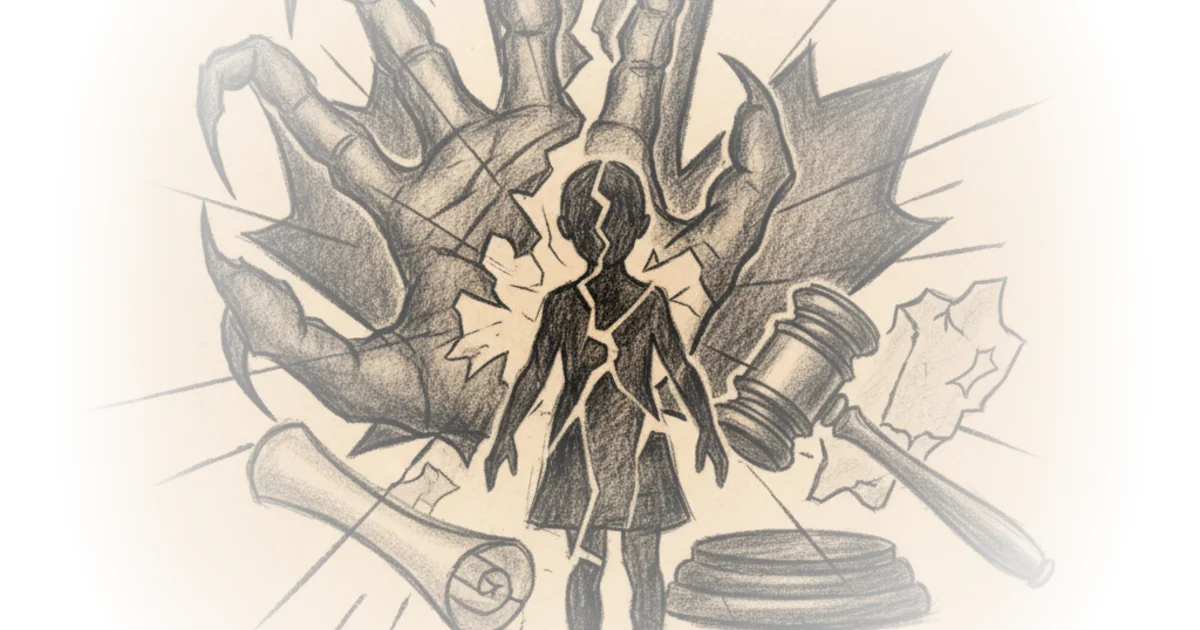
The author meticulously traces how Section 43 has evolved, noting that while protections for sailors, apprentices, and prisoners have been stripped away, children remain the only group explicitly vulnerable to physical correction. "The only group left vulnerable to physical punishment is one of the most vulnerable groups among us: children," Watkinson observes. This framing is powerful because it strips away the euphemisms of "discipline" and forces the reader to confront the reality that the law treats children differently than any other citizen. A counterargument often raised is that this law protects family privacy and parental rights, but Watkinson effectively counters this by highlighting that no other professional group—daycare workers, coaches, or nurses—enjoys such a broad license to use force.
The only group left vulnerable to physical punishment is one of the most vulnerable groups among us: children.
The Supreme Court's Blind Spot
The commentary deepens when Watkinson examines the 2004 Supreme Court decision in Canadian Foundation for Children, Youth and the Law v. Canada. Despite a Charter challenge arguing that the law violated children's rights to security and equality, the court upheld the status quo. The Walrus notes, "The outcome in this significant Charter challenge was derailed by the court's focus on parental rights." This is a crucial insight: the judiciary prioritized the autonomy of adults over the safety of minors, effectively codifying the idea that children are the property of their parents.
Watkinson details how the court attempted to create a "zone of risk" to limit the defense, yet the result was legal chaos. The author points out that the court rejected scientific evidence regarding the harm of physical punishment, choosing instead to rely on a "traditional conservative model." This refusal to engage with modern child development research is a significant weakness in the legal reasoning, one that Watkinson highlights with biting clarity. She argues that the decision missed the rights of children entirely, focusing instead on carving out a "sphere" where parents can act without criminal sanction.
The confusion resulting from this ruling is palpable in subsequent cases, such as R. v. A. (M.), where a father who left bruises on his daughter was acquitted. The judge in that case accepted that "forceful spanking" leaving bruises for weeks could be considered "trifling or transitory." As The Walrus puts it, "The judge quoted from the 2001 decision which said, 'When appropriate deference is shown to the parent's value system... the infliction of some pain and a bruise that is merely transient or trifling in nature... cannot... constitute unreasonable force.'" This standard is so subjective that it renders the law arbitrary, leaving children's safety to the discretion of individual judges and the moods of their parents.
The Human Cost of Legal Ambiguity
Watkinson does not shy away from the visceral reality of these legal abstractions. She defines corporal punishment broadly, encompassing everything from smacking to forced ingestion of hot spices, yet the law treats these acts with a disturbing leniency. "Children, like adults, value their personal safety," she writes, "Yet, even though our sense of outrage and shock over intrusions into our personal security is, at times, visceral, we do not as easily acknowledge the same reaction in children." This observation strikes at the heart of the societal failure: a collective inability to empathize with the child's experience of pain and fear.
Critics might argue that repealing Section 43 criminalizes normal parenting and invites state overreach into the home. However, Watkinson's evidence suggests the current law does the opposite: it invites violence by providing a shield for it. The fact that sixty-seven other countries have banned corporal punishment while Canada remains an outlier underscores that this is not a necessary tool for parenting, but a choice to maintain a hierarchy of power. The author's argument that the law violates the spirit of the United Nations Convention on the Rights of the Child is particularly compelling, as it positions Canada as a laggard in human rights progress.
Bottom Line
Watkinson's piece is a masterclass in legal critique, exposing how a century-old statute continues to sanction violence against the most defenseless members of society. Its strongest asset is the relentless focus on the arbitrariness of the "reasonable force" standard, which leaves children's safety to chance. The biggest vulnerability of the current system is its refusal to accept scientific consensus on the harms of corporal punishment, a stance that the Supreme Court's 2004 decision entrenched rather than corrected. Readers should watch for renewed legislative efforts to repeal Section 43, as the gap between Canadian law and international human rights standards becomes increasingly untenable.