In a field saturated with hype, this piece cuts through the noise by treating retrieval-augmented generation not as a magic bullet, but as a navigational tool. NO BS AI argues that the real power of graph-based systems lies not in summarizing data, but in the ability to traverse relationships to uncover the 'why' behind a user's failure. This is a crucial distinction for anyone deploying AI in customer support: the difference between a bot that says 'no' and one that explains the path to 'yes'.
The Mechanics of Discovery
The article moves quickly past the theoretical to the practical, focusing on 'Local Search' as the engine of discovery. NO BS AI reports, "Graph traversal is the act of moving through the graph via existing edges, which connect the nodes." This simple definition belies the complexity of the process, which involves converting a user's query into a vector, finding a starting point, and then hopping to connected neighbors. The piece outlines a four-step process: embedding the query, traversing the graph, filtering for relevance, and finally converting the resulting subgraph into context for the language model.
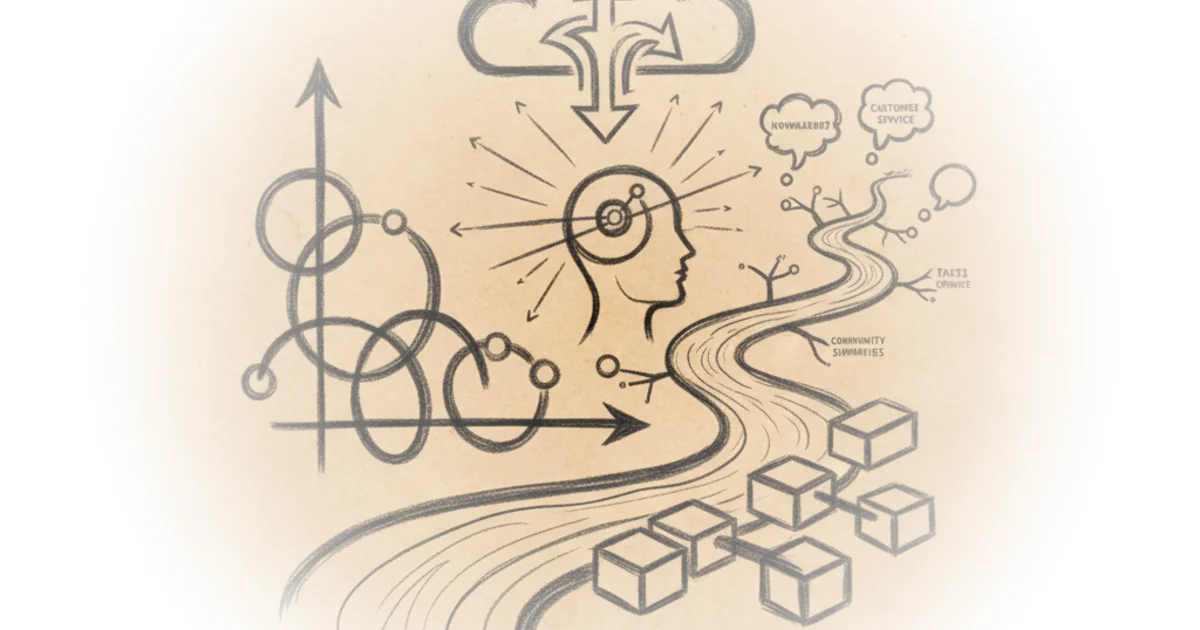
What makes this analysis compelling is its refusal to treat the graph as a static database. Instead, the editors emphasize the dynamic nature of the search. "Once a relevant node is found, explore its connected neighbors within a predefined depth," the piece explains. This allows the system to retrieve related facts without scanning the entire knowledge base, a critical efficiency for busy support teams. However, the commentary notes that this depth is a double-edged sword; too shallow, and you miss context; too deep, and you drown the model in irrelevant data.
"The upgrade process is essential for unlocking these features, including the ability to create scaled recipes and use the 'Created Recipes' functionality."
The article uses a concrete example from Thermomix manuals to illustrate the difference between a standard retrieval and a graph-based one. When a user asks, "Why can't I use scaling?", a regular system might simply retrieve a sentence stating the feature requires an upgrade. The graph approach, however, uncovers the chain of dependencies: the membership, the version number, and the specific relationship between serving size and scaled recipes. NO BS AI notes that this results in an answer that is "heavily dependent on the final prompt which builds the answer out of all available pieces of information." This is a vital admission; the technology is only as good as the curation of its prompts and the quality of its underlying data structure.
Beyond the Buzzword
The most persuasive argument in the piece is the comparison of output quality. The editors demonstrate that while a standard system gives a blunt "you cannot use the scaling feature" response, the graph traversal method provides a roadmap. It explains what the feature is, why it is locked, and exactly how to unlock it. "The scaling feature on the Cookidoo® platform is designed to allow users to adjust ingredient quantities in recipes to create larger or smaller portions," the generated response reads, followed by the specific upgrade requirements. This shift from denial to instruction is the hallmark of effective customer service AI.
However, the piece does not shy away from the pitfalls of this approach. NO BS AI warns that "using all available Graph RAG features... it is possible to create massive contexts which could be problematic in their own right." If the system retrieves too much information, the language model can become confused, resulting in "imprecise and blurry answers." A counterargument worth considering is whether the added complexity of building and maintaining these graph structures justifies the marginal gain in answer quality for simpler queries. For high-volume, low-complexity support tickets, the overhead might outweigh the benefit.
The editors also highlight a strategic choice many organizations face: the trade-off between community summaries and node-level details. "Community summaries are as their name suggests - summaries or generalizations of information," the piece argues, whereas nodes provide "concrete dimensions, version numbers, and all technical features." For technical diagnostics, the latter is indispensable. Yet, the authors admit that in practice, they often discard community summaries entirely for technical support because they are "too general."
"Node and relationship descriptions are more likely to contain detailed data than community summaries."
This observation suggests a future where AI support systems are not monolithic but modular, selecting different retrieval strategies based on the nature of the user's problem. The piece concludes by promising a Part 3 on tailoring these systems, acknowledging that "my Graph RAG is conditioned to catch information such as numeric values, sizes, dimensions, procedures, etc." This specificity is the key to moving beyond the buzz. It is not about having a graph; it is about having a graph that speaks the language of your specific domain.
Bottom Line
The strongest part of this argument is its demonstration that graph traversal transforms AI from a lookup tool into a diagnostic partner, capable of explaining the 'why' behind a system error. Its biggest vulnerability lies in the operational complexity; the risk of generating "blurry answers" from massive contexts means that without rigorous prompt engineering and data filtering, the technology can easily backfire. Organizations should watch for the next installment, which promises to address the practical tuning required to make these systems reliable in production.