More Perfect Union uncovers a political paradox that defies the standard narratives about rural America: a county that voted Democratic for 144 consecutive years didn't just flip; it swung 45 points toward the GOP, only to elect a Democrat as governor years later. This isn't a story about personality cults or cultural wars, but a granular look at how economic abandonment and the collapse of the labor movement shattered a century-old political identity. For the busy reader trying to understand the mechanics of the modern American electorate, this piece offers a crucial corrective to the idea that rural voters are simply 'angry' or 'misguided'."
The Collapse of the New Deal Coalition
The core of the argument rests on the historical bond between the working class and the Democratic Party, a bond forged in the fires of the Great Depression. More Perfect Union writes, "The New Deal put Millions to work building roads and schools and bridges created Social Security and establish by law the right to form a union and for decades it cemented the idea that Democrats were a party for the working class." This framing is essential because it grounds the political shift in material reality rather than abstract ideology. The article effectively illustrates that for generations, being a Democrat in Elliott County wasn't a cultural choice; it was an economic necessity tied to federal investment in local infrastructure.
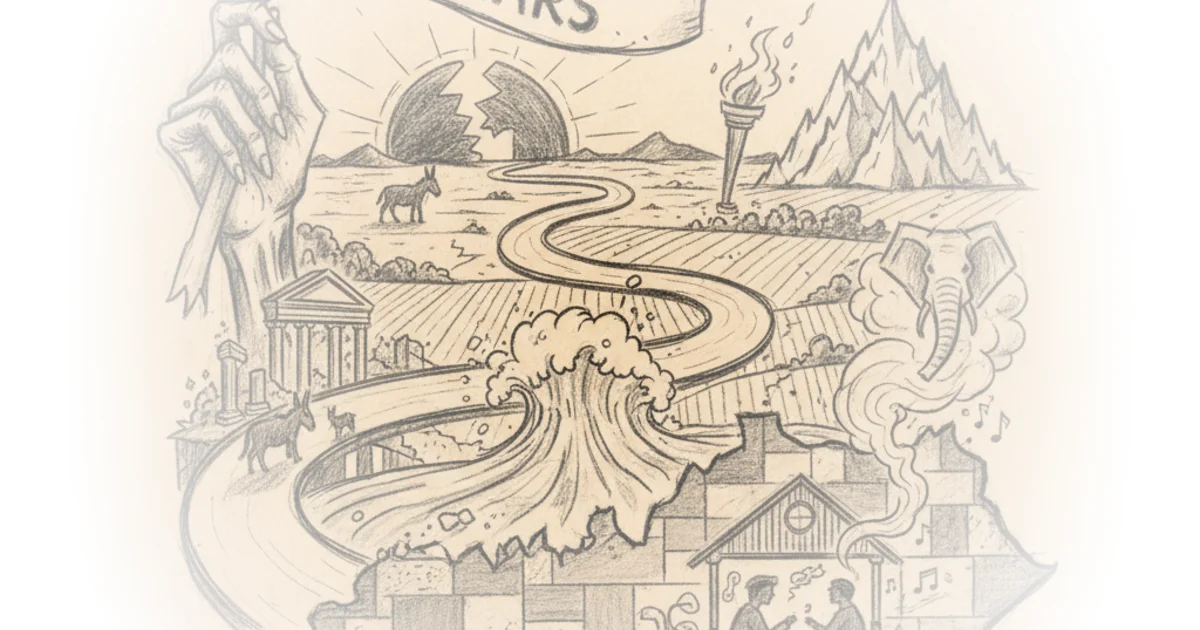
However, the narrative takes a sharp turn as the party's focus shifted away from rural labor. As More Perfect Union puts it, "the party of workers and unions became champions of free trade in Wall Street Democrats stopped chasing bluecollar voters in rural areas and shifted their attention to White Collar voters in the suburbs and that left a vacuum a vacuum that Republicans who supported basically the same corporate agenda were happy to fill." This is a powerful indictment of the Democratic Party's strategic pivot in the 1990s and 2000s. The commentary here lands hard because it highlights a betrayal of the base: the party that built the county's roads abandoned the people who needed them most. Critics might note that the Republican Party's corporate agenda was arguably more hostile to labor than the Democrats', yet the article suggests that the perception of abandonment was enough to drive the switch.
The party of workers and unions became champions of free trade in Wall Street Democrats stopped chasing bluecollar voters in rural areas and shifted their attention to White Collar voters in the suburbs and that left a vacuum a vacuum that Republicans who supported basically the same corporate agenda were happy to fill.
The human cost of this political realignment is starkly quantified. More Perfect Union notes that while the median household income sat at $37,000 in the late 1980s, adjusting for inflation, it is only about $39,000 today. "In other words they haven't seen a raise in over 30 years while the cost of living has only gone up." This statistic dismantles the notion that the economy has broadly improved for the working class. The piece argues that when voters feel they are running in place, they are willing to try anything, even a candidate who seems like an outsider to their traditional values.
The Paradox of the Governor and the President
Perhaps the most fascinating element of the coverage is the divergence between local and national voting patterns. The article highlights how Governor Andy Beshear, a Democrat, managed to win Elliott County in 2019 and 2023, even as the county continued to vote overwhelmingly for the Republican presidential candidate. More Perfect Union explains that Beshear succeeded by "distancing himself from the national Democratic brand which has become toxic in Kentucky" while running as a "pro- union candidate" who campaigned on tangible issues like teacher pay and universal pre-kindergarten.
This distinction is vital. It suggests that the barrier to Democratic success isn't an inherent conservatism in rural voters, but a rejection of the national party's perceived detachment. As one local resident in the piece articulates, "it's not the outrage of the today in Washington DC it's things like do I have a good job one where I can afford to raise a family who is moving my life forward." This quote cuts through the noise of national culture wars to the heart of voter motivation: economic survival. The article implies that when Democrats focus on bread-and-butter issues rather than cultural signaling, they can still compete in these regions.
Yet, the path forward remains obstructed by deep-seated fears and a sense of powerlessness. The piece captures the sentiment that "fear is at the heart of Trump's politics," particularly regarding immigration. When asked about the border, a local worker admits, "they're letting them come in and it's like you know it's like got to be a stop to it somewhere," even while acknowledging that migrants are simply trying to "feed their family." More Perfect Union argues that this anger is often misdirected, noting that "people who are in that situation or work working people people who don't have the luxury to not go to work MH they'll look around at other working people and say I can't get by because of what you're doing or something and meanwhile in the background we're adding more billionaires year after year."
"I can't get by because of what you're doing or something and meanwhile in the background we're adding more billionaires year after year after year these people having not just a billion dollars but 10 and 20 or $200 billion dollar where do they fit into that situation."
The article posits that the real divide isn't between working-class voters and immigrants, but between the working class and the billionaire class. A local resident sums up this realization perfectly: "I get it right I understand what's going on they just want something better... but there has to be a right way of doing it." The piece suggests that the political establishment has failed to address the root causes of this anxiety, allowing fear to be weaponized against fellow workers rather than the systems that concentrate wealth.
Bottom Line
The strongest part of More Perfect Union's argument is its refusal to treat Elliott County as a cultural outlier, instead framing it as the logical result of decades of economic neglect and the Democratic Party's strategic abandonment of the rural working class. The piece's biggest vulnerability is its reliance on the hope that a return to New Deal-style economics can overcome the deep cultural and racial fractures that have taken root in the absence of that economic security. The reader should watch for whether Governor Beshear's model of local, union-focused campaigning can scale to the national level, or if the pull of national polarization remains too strong to overcome.