This piece cuts through the noise of geopolitical fatalism by arguing that the most significant shifts in US-China relations aren't happening in the Oval Office, but in the quiet realization of American citizens that their own government has failed to deliver. Kaiser Kuo, drawing on his unique vantage point as a former heavy metal guitarist for Tang Dynasty and a veteran of Baidu's international communications, posits that the "impossible balance" is actually tipping toward a new, uncomfortable clarity for the United States. While mainstream discourse fixates on tariffs and containment, Kuo offers a startling counter-narrative: the real shockwave is the American public's growing admiration for Chinese infrastructure and stability, driven by a stark contrast in policy outcomes rather than diplomatic rhetoric.
The Shift in Perception
Kuo begins by dismantling the assumption that anti-China sentiment is monolithic or static. He points to data from the Pew Research Center to illustrate a nuanced reality: negative views in the US are not uniform, and recent declines in hostility among younger demographics and Democrats reflect a "growing disaffection with the US government" rather than a sudden love affair with Beijing. This is a crucial distinction. Kuo argues that the Chinese perspective is equally skewed, noting that "it is impossible for a Chinese person to know nothing about the United States" due to the dominance of Western cultural exports, yet they are "subjected to the same kind of heavily biased information about the United States that the American public sees about China."
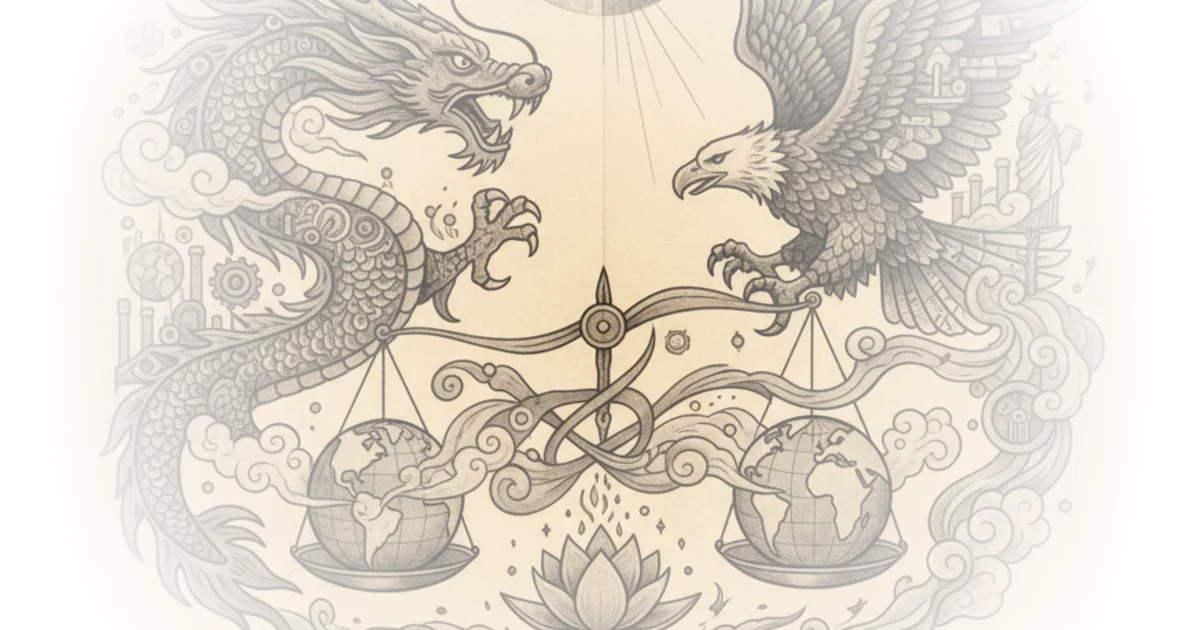
The author's framing here is effective because it removes the moral high ground from both sides, suggesting that mutual ignorance is a structural feature of the relationship, not a bug. However, this view might overlook the depth of institutional mistrust that goes beyond media consumption, particularly regarding human rights and surveillance, which Kuo briefly glosses over in favor of a broader cultural analysis.
"The dominance of Western narratives, particularly American ones, in the world means that it is impossible for a Chinese person to know nothing about the United States... I do not believe they are making any more effort to understand Americans. It simply comes down to the dominance of Western narratives."
When discussing the return of the executive branch to a more aggressive stance in early 2025, Kuo describes a scenario where China did not flinch. He notes that while the world expected another trade war, China "did not seek a deal, it did not flatter Trump and it did not attempt to evade the new tariff regime." Instead, they responded with rare-earth export controls that forced the US to yield. This narrative of Chinese "calm and level-headed" leadership contrasting with American political volatility is central to Kuo's thesis. He suggests this dynamic has fundamentally altered the American psyche, creating a sense of "unease" about the US's own trajectory.
Critics might argue that attributing China's stability solely to leadership style ignores the immense internal pressures and rigidities of the Chinese system, which Kuo seems to treat as a monolith of efficiency. Yet, the observation that American voters are increasingly comparing their crumbling infrastructure to China's high-speed rail networks is a potent political reality that cannot be dismissed.
The Infrastructure and Tech Reality Check
The most compelling section of Kuo's commentary focuses on the tangible evidence of China's rise, which he terms "Chinese infrastructure porn." He highlights how American influencers, after visiting cities like Shenzhen and Hangzhou, returned "almost unanimously, impressed," leading to a trend of "Chinamaxxing." This cultural moment is juxtaposed with the US administration's withdrawal from the Paris Agreement and the dismantling of environmental regulations.
Kuo writes, "China has built the kind of energy system the world needs: vast amounts of solar and wind power, batteries, electric vehicles and a modern, efficient ultra-high-voltage transmission grid." He contrasts this with the US "lurching from one political crisis to the next." The argument is that the US is losing the narrative war not because of propaganda, but because of visible, physical reality. The launch of DeepSeek, a large language model trained at a fraction of the cost of American counterparts, serves as a "shock" that challenges the assumption of American technological invincibility.
"Throughout 2025, many American influencers and YouTubers travelled to China... They all came back, almost unanimously, impressed. So for the whole year, Americans were immersed in a sort of 'Chinese infrastructure porn', wondering: what on earth has happened to America? Why have we stopped building?"
This section is powerful because it grounds high-level geopolitics in the daily lives of citizens. However, it risks romanticizing the Chinese model by focusing on the aesthetic of development while sidestepping the authoritarian mechanisms that often enable such rapid construction. The human cost of this "efficiency" is not addressed, leaving the reader with a picture of gleaming trains but no context on the labor or displacement behind them.
The Trap of Containment and the Future of Cooperation
Kuo turns his attention to the "technological containment" policy, describing it as a "tragedy" for humanity. He argues that the US obsession with national security is suffocating the world's two largest scientific communities. While Chinese scientists view this as a moral failure that has ironically "sparked a fuse" for greater self-sufficiency, Kuo warns that the US approach is based on a dangerous projection.
He suggests that American fear is rooted in the belief that "any nation possessing such technological strength would exercise it immediately," essentially assuming China would act exactly as the US would. Kuo calls this a "self-fulfilling prophecy" that generates the very hostility it claims to prevent. He asserts that an open, collaborative approach would have reduced China's desire to exert leverage.
"Relating to another country on this basis means demonstrating your own bad faith, proving that you are willing to bring it to its knees. How can anyone think this will not influence their perception? It will generate precisely the kind of hostility that was taken for granted from the outset, but it was their own actions that created it."
This is a bold claim that challenges the core of US strategic thinking. While it offers a path to de-escalation, it assumes a level of rationality and reciprocity that may not exist in the current geopolitical climate. The argument that China is not seeking global hegemony but merely "reform" of international institutions is also contentious, given the expansive nature of the Belt and Road Initiative and the growing influence of Chinese state-owned enterprises in the Global South.
"They are trying to reform them, not to subvert them. They are not looking to completely replace the United States in its hegemonic role. China has no real interest in this; it recognises its lack of experience in these areas and does not wish to take on this sort of responsibility."
Kuo concludes by rejecting the idea of a "Chinese model" to be exported. He argues that China views its success as unique to its specific historical conditions and national circumstances. "Whatever has worked for China is in line with its national conditions, and these conditions vary enormously from country to country," he notes. Instead of exporting a model, China is offering "best practices" in infrastructure and state coordination, which creates a "pull" rather than a "push."
Bottom Line
Kaiser Kuo's analysis succeeds in reframing the US-China rivalry from a clash of ideologies to a crisis of American self-perception, driven by tangible failures in infrastructure and energy policy. The piece's greatest strength is its identification of the "Chinamaxxing" phenomenon as a genuine, bottom-up shift in public sentiment that threatens the political consensus on containment. However, the argument's vulnerability lies in its tendency to view Chinese stability and efficiency through a lens that minimizes the authoritarian trade-offs required to achieve them. As the US grapples with its own internal fractures, the world is watching to see if Washington can articulate a vision that matches the reality of a multipolar world, or if it will continue to rely on a containment strategy that Kuo argues is already failing.