Anarchierkegaard tackles a concept that feels increasingly urgent in our current political climate: the dangerous allure of "secular messianism." The piece argues that when political movements strip away religious humility and replace it with a scientific certainty of inevitable utopia, they don't liberate humanity—they create a vacuum where the desire for absolute power rushes in to fill the void. This is not a standard political critique; it is a philosophical autopsy of why "scientific" ideologies often end up behaving like the very dogmas they claim to destroy.
The Trap of the "Big Other"
The author begins by dismantling the psychological comfort of waiting for a savior, whether that savior is a religious figure or a political system. Anarchierkegaard writes, "The helplessness of the idea-thinker in relation to the realisation of messianic promise makes for a strange jitteriness... handing off their responsibility for their salvation to some 'Big Other'." This observation cuts deep into the modern tendency to outsource moral agency to a party, a leader, or a doctrine. By framing this as a surrender of free will, the author highlights a critical vulnerability in any movement that promises a perfect future.
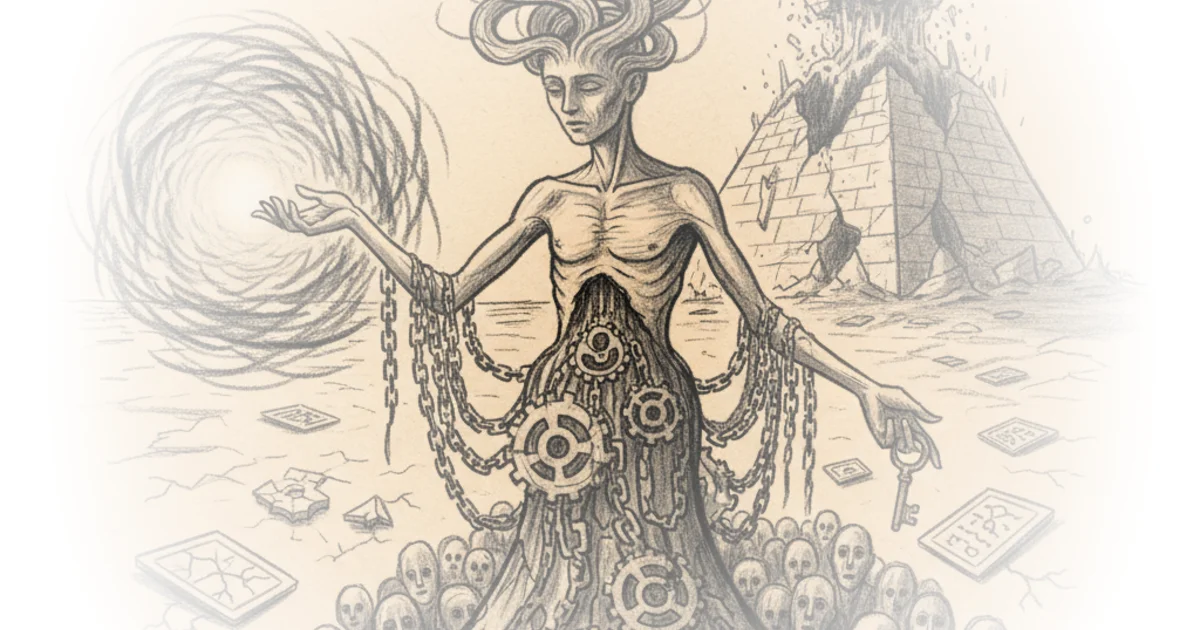
The danger, as Anarchierkegaard notes, is that this waiting game justifies extreme measures in the present. "The cry for a messiah imposes the craving for power of the individual onto the perfect image in order to justify any and all acts towards any and all ends." This is the core mechanism of political violence: the belief that the end result is so pure that the means used to achieve it become irrelevant. The argument is compelling because it connects the abstract desire for a perfect society to the concrete reality of authoritarianism.
The constant danger sits on the periphery: the cry for a messiah imposes the craving for power of the individual onto the perfect image in order to justify any and all acts towards any and all ends.
The Illusion of Scientific Socialism
Moving from the abstract to the historical, the commentary turns to Laurence Labadie's critique of state socialism. Anarchierkegaard uses Labadie to show how Marxist theory, when stripped of its eschatological baggage and treated as a hard science, falls into the same trap. The author quotes Labadie directly to illustrate the delusion: "Like Seventh-Day Adventists they have continually expected each business depression to be the messiah of the revolution which was, of course, always just around the corner... Pie was to be had, not in the sky, but here on earth, by and bye."
This comparison is striking. It suggests that the "scientific" socialists were not actually scientists, but rather secular prophets waiting for a sign that never came. Anarchierkegaard argues that this "Adventist-like" gawping ambition creates a cycle of "doom-and-lust," where every failure is just a prelude to the inevitable victory. The author's framing here is effective because it exposes the irrationalism hidden beneath the veneer of "objective" historical materialism. Critics might argue that this reduces complex economic theories to mere religious fervor, ignoring the genuine material grievances that drive such movements. However, the point stands that the promise of the revolution often functions more like a faith than a policy.
The Seduction of the Blueprint
The piece then dissects the mechanism of control within these movements. Anarchierkegaard suggests that the language of "common sense" and "objectivity" is often a mask for subjective desire. "The liberal agent, exposing a desire for power in the hungry maw hanging agape at the thought of dictating ought s and ought not s to the scattered populace, uses the malleability of language to destabilise all categories." This is a sharp critique of how political elites manipulate language to make their specific vision of the good seem like the only logical option.
The author draws a parallel between the liberal project and the Marxist project, noting that both rely on a mythical image of a future society to justify present actions. "Sitting on the horizon, 'the Revolution', this mythical event of messianic justice, attempts to seize the Christian crown and obfuscate the source of its reality." The argument here is that the desire to control society is universal, regardless of the ideological label attached to it. The "science" of politics, the author claims, is often just a way to legitimize the desire to dominate.
Hidden inside the language of the professor, of the dialectician, these sworn enemies fight over the right to seize the object of the same theme.
The Groundlessness of Existence
Finally, Anarchierkegaard contrasts the political messiah with the theological one, using Søren Kierkegaard to offer a way out of the nihilism of political utopianism. The author notes that for Labadie, there is no object that draws us out, but for Kierkegaard, there is "One Who 'draws unto Him'." The distinction is crucial: political ideologies demand that we make our ideas the source of our plan for society, while a genuine spiritual existence requires surrendering that right.
Anarchierkegaard writes, "Only by recognising that this groundlessness is the opportunity for existence and that existence must constantly travel forward... is when we overcome Labadie's nihilism." This is the piece's most profound insight: that the attempt to build a perfect society on earth is a denial of the human condition. We are not meant to be the architects of a perfect world; we are meant to live in the uncertainty. The author's conclusion is a call to reject the "blueprint of a perfect society" in favor of a more humble, individual engagement with reality.
Bottom Line
Anarchierkegaard's strongest contribution is the unmasking of "scientific" political ideologies as disguised religious fervor, revealing how the promise of a perfect future often justifies tyranny in the present. The argument's greatest vulnerability lies in its heavy reliance on theological frameworks, which may alienate readers seeking purely secular policy analysis. However, for those willing to engage with the philosophical roots of political extremism, this is a vital warning against the seduction of the messianic impulse.