Matt O'Dowd tackles one of biology's most persistent mysteries: why life on Earth is exclusively right-handed, and he proposes a solution that reaches all the way back to the fundamental laws of the universe. Rather than settling for local chemical accidents, he argues that the very fabric of reality—specifically the weak nuclear force—may have dictated the twist of our DNA billions of years ago. This is not just a story about molecules; it is a claim that the handedness of life is cosmically ordained.
The Mirror That Never Matches
O'Dowd begins by dismantling the assumption that the universe is perfectly symmetrical. While physics often treats left and right as interchangeable, nature has a distinct preference. "The molecular basis of all life is mysteriously asymmetric, only using molecules on one side of what should be the equivalent mirrored pairs," he writes. This phenomenon, known as homochirality, means that while we can build a theoretical mirror-image organism, nature never actually does. Life uses only left-handed amino acids and right-handed sugars.
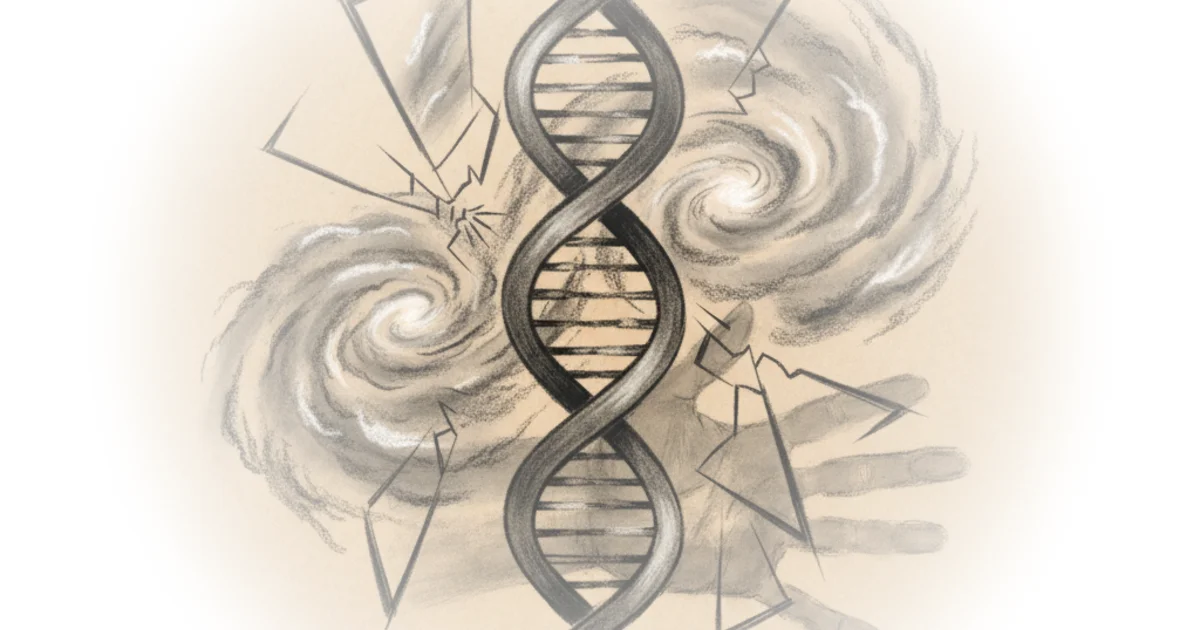
The author highlights a crucial historical pivot point to illustrate this divide. In 1848, Louis Pasteur discovered that while synthetic crystals of tartaric acid came in both mirror forms, natural crystals from grapes displayed only one. "Life only produces the right-handed version of it," O'Dowd notes, emphasizing that this isn't a random quirk but a universal rule for Earth's biology. He contrasts this with the Miller-Urey experiment, which showed that prebiotic conditions create a 50/50 mix of both forms. The mystery, then, is how life broke this symmetry to achieve total dominance of one side.
"In principle, you could build a perfectly stable organism with all molecules having the opposite handedness, but we never ever see that nature."
Critics might note that assuming a single origin for this bias ignores the possibility of parallel evolution where different chiralities competed and one simply won by chance. O'Dowd acknowledges this "random chance" hypothesis but suggests it is less satisfying than a fundamental physical cause.
From Cosmic Rays to RNA
The core of O'Dowd's argument shifts from local chemistry to astrophysics. He introduces a hypothesis by Nomi Globus and Roger Blandford, which posits that cosmic rays—high-energy particles from supernovae—acted as the sorting mechanism. The weak nuclear force, which governs particle decay, violates mirror symmetry. When cosmic rays hit Earth's atmosphere, they create muons, which are inherently left-handed due to this fundamental asymmetry.
O'Dowd explains that these muons don't just pass through matter; they interact with it. "The ability of muons to dump energy into a molecule to break it depends in part on the relative chirality of the muon and the molecule," he writes. This creates a subtle but persistent evolutionary pressure. While the effect on simple amino acids is too weak to matter, the damage is significant for complex polymers like RNA. "Left-handed RNA is preferentially damaged and perhaps by enough to initiate the path to a right-handed RNA world," he argues.
This mechanism relies on the environment of the early Earth. O'Dowd points out that the young Sun was more active and the galaxy had more supernovae, meaning the flux of cosmic rays was much higher than it is today. "Star formation and so supernova activity must have been higher when the earth first formed, giving more chances for cosmic ray spikes," he writes. This timing is critical; the pressure needed to tip the scales only existed during the narrow window when life was first emerging.
"If we find that these molecules are always biased to left-handed enantiomers, it's evidence of a fundamental cosmic bias."
A counterargument worth considering is the difficulty of proving this without pristine samples. O'Dowd admits that meteorite evidence is often disputed due to potential Earth contamination. The hypothesis remains unproven, relying on computational models rather than direct observation of the early Earth's chemistry.
The Universal Test
The most compelling aspect of O'Dowd's coverage is the testable prediction it offers. If life's handedness is a result of local chance, we might expect to find mirror-life elsewhere in the universe. However, if the weak force is the driver, the entire cosmos should share our twist. "This hypothesis that homochirality originates from the chiral symmetry of the weak interaction does make a dramatic prediction that we could maybe test," O'Dowd writes. He suggests that finding alien life with the opposite chirality would disprove the theory, while finding the same handedness would strongly support it.
He concludes with a touch of humor regarding the implications of finding mirror life. "We should also probably not try to shake hands with that mirror life. It would be socially awkward and a potential biohazard," he jokes. This serves as a reminder that the abstract physics of particle decay has very real, tangible consequences for the biology of the entire universe.
Bottom Line
Matt O'Dowd effectively bridges the gap between subatomic physics and the origins of life, offering a plausible mechanism for why DNA twists the way it does. The argument's greatest strength is its reliance on a fundamental, unchangeable law of physics rather than a lucky chemical roll of the dice. However, the theory remains vulnerable to the lack of direct evidence from the early Earth, leaving the final verdict dependent on future discoveries of pristine extraterrestrial amino acids.