The Black Box Opens
Thirty years of British political life played out behind locked doors, and it took files from a disgraced financier to crack the seal. Jonathan Cook's latest piece cuts through the Westminster noise to ask a question most commentators won't: what happens when a political system was never meant to be democratic in the first place?
Laboratory-Grown Leadership
Cook argues that British politics stopped being about voters long ago. The transformation began in the 1990s, when the Labour Party shed its democratic socialist roots and rebranded itself as a vehicle for corporate capital. At the center of that reinvention stood Peter Mandelson, the architect who turned a workers' party into a concierge service for billionaires.
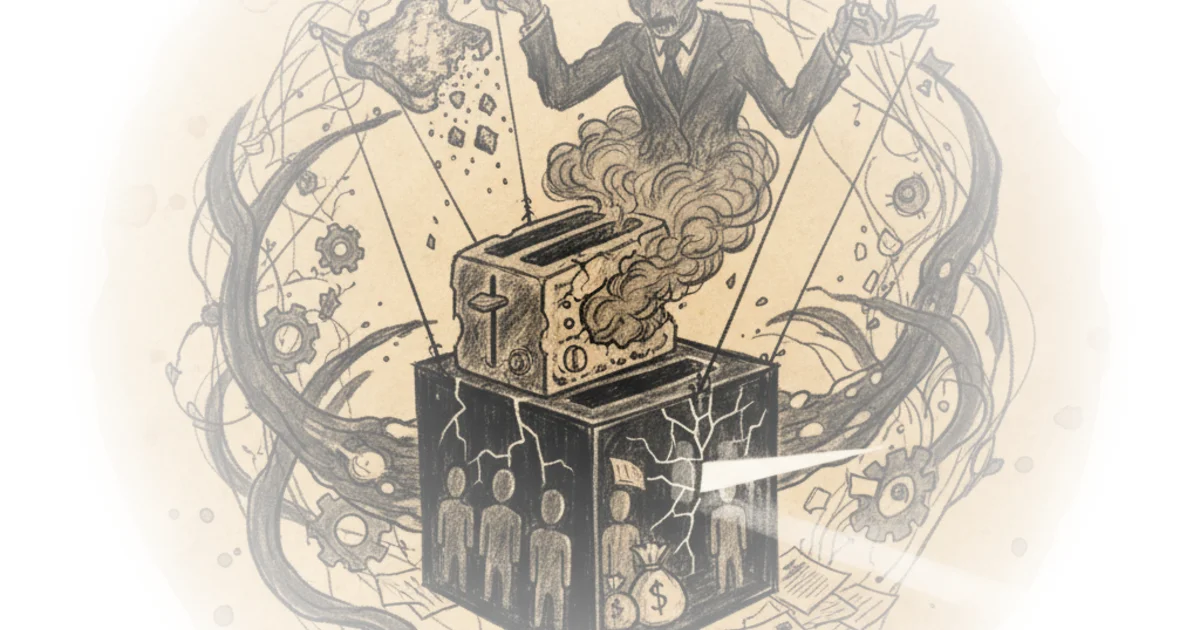
Jonathan Cook writes, "British politics became, by design, a black box—an arena for moneyed power brokers to wield political influence hermetically sealed off from the view of voters."
The metaphor holds. What Cook calls a "laboratory-grown" prime minister—Keir Starmer—didn't emerge from any grassroots movement or ideological conviction. His own advisers joked that Starmer wasn't driving the train; he was seated at the front of an automated railway, hands on a wheel that controlled nothing. The Docklands Light Railway reference was deliberate: a driverless system connecting the banking district, chosen by people who understood their audience.
The Mandelson Nexus
Now police are investigating Mandelson for misconduct in public office—specifically, whether he fed insider government information to Jeffrey Epstein in 2009 and 2010. Epstein, a convicted sex offender with a network of powerful friends, could use that information to enrich himself. Around the same period, Mandelson lobbied the Treasury to weaken a tax on bankers' bonuses, even coaching JP Morgan's chief executive on how to pressure the chancellor.
"Keir's not driving the train. He thinks he's driving the train, but we've sat him at the front of the DLR."
Mandelson's lobbying firm, Global Counsel, represented Palantir, TikTok, OpenAI, Shell, JP Morgan, Barclays, and dozens more. Cook notes the crucial point: none of this is necessarily illegal. The system was built so that the boundary between legitimate lobbying and captured governance would become impossible to distinguish.
As Cook puts it, "The murkiness of this system is its very point."
Corbyn: The Exception That Proved the Rule
The piece pivots sharply when it introduces Jeremy Corbyn, the one major British politician of the past generation who escaped the billionaire capture apparatus. Under his leadership from 2015, Labour actually contested elections on substance rather than personality. Voters responded with enthusiasm that terrified the establishment.
Cook writes, "During his tenure as Labour leader, Britain's elections stopped being pure political theatre. The vote mattered."
What followed was a coordinated demolition. The billionaire-owned press painted Corbyn as scruffy, sexist, unpatriotic, too stupid to govern, a Russian spy, and antisemitic—all within a five-year window. Behind the scenes, a former US Secretary of State warned in a leaked recording that Washington would not wait for Corbyn to take office before pushing back. The machinery of the Anglo-American establishment moved to stop him.
Mandelson himself admitted to working "every single day" to end Corbyn's leadership. Something—however small—an email, a phone call, a meeting. Every day.
What Corbyn Would Have Changed
Cook lays out the stakes with specific policy contrasts. A Corbyn government would have ended bipartisan austerity. It would have pursued wealth taxes, curbs on excessive executive pay, workers' part-ownership of large firms, and the nationalization of utilities. Each one would have hit the billionaire class where it counted.
On foreign policy, the contrast becomes starker. Cook argues Corbyn would never have prioritized weapons manufacturers over Palestinian lives in Gaza. He would never have authorized British aircraft to transport two-thousand-pound bombs to Israel, or operated Royal Air Force spy flights over the enclave. He would have rejected the doubling of military spending—a policy demanded by a billionaire former US president whose influence on allied governments runs deep.
Jonathan Cook writes, "We know the answer, because Corbyn has told us." When asked whether Britain would hand its National Health Service database to a US surveillance contractor already embedded in Israeli military operations, the answer was clear.
Critics Might Object
Critics might note that Cook's portrayal of Corbyn as an untainted alternative glosses over genuine governance questions. Corbyn never won a general election, and his actual record as opposition leader included internal party dysfunction, antisemitism controversies that were not solely media-manufactured, and policy positions that many economists argued would have destabilized the UK economy. The piece presents his potential policies as unambiguous goods without addressing why voters ultimately rejected his vision at the ballot box.
Others might argue that the Epstein files, released by a US administration more interested in protecting its own secrets than in British democratic accountability, are an unlikely savior for transparency. The selective leak serves a purpose: redirecting public anger toward Mandelson personally, rather than toward the financial structures that made his influence possible.
The One-Bad-Apple Theory
Cook closes by dismantling the comforting narrative that Mandelson is an aberration. The billionaire-owned media would prefer the public fixate on one man's relationship with a sexual predator rather than examine the entire architecture of influence.
"There is a reason why it is now open season on Mandelson," Cook writes. "Because the billionaires—and their media—would rather you were directing your hate at their arch-creature than at them directly."
The list of Global Counsel's clients reads like a who's-who of global capital. When those firms started bailing on Mandelson this month, it wasn't moral awakening—it was reputation management. The system works whether Mandelson is in it or out.
Bottom Line
This is a piece that refuses to treat British politics as a competition between serious people with different ideas. Cook argues convincingly that the competition itself was rigged decades ago, and that every prime minister since Blair—including the current one—was selected, not elected. Whether the Epstein files actually crack open that system or simply provide new names for old problems remains the unanswered question.