Economics Explained delivers a stark, counterintuitive diagnosis: New Zealand isn't failing because of poverty or instability, but because its very success and proximity to a larger neighbor have turned it into a staging ground for its own citizens' departure. The author argues that the country's unique economic structure has created a paradox where the most productive workers flee not to escape hardship, but to access opportunity that simply cannot exist in a nation the size of a single Australian city.
The Geography of Opportunity
The piece begins by dismantling the tourism brochure image of New Zealand. "Genuinely one of the most beautiful countries in the world," the author notes, yet this beauty is inextricably linked to its isolation. This isolation, combined with a tiny population of 5.3 million, creates a structural ceiling for economic growth. The author writes, "building globally competitive industries there is extremely difficult because almost anything that can be done in New Zealand can be done much cheaper at a much larger scale and much closer to shipping lanes up in Asia." This observation is crucial; it reframes the issue from a policy failure to a geographic inevitability. Financial services, a typical export for advanced nations, simply cannot compete with Singapore or Sydney. The argument lands because it explains why the economy looks the way it does without resorting to political blame.
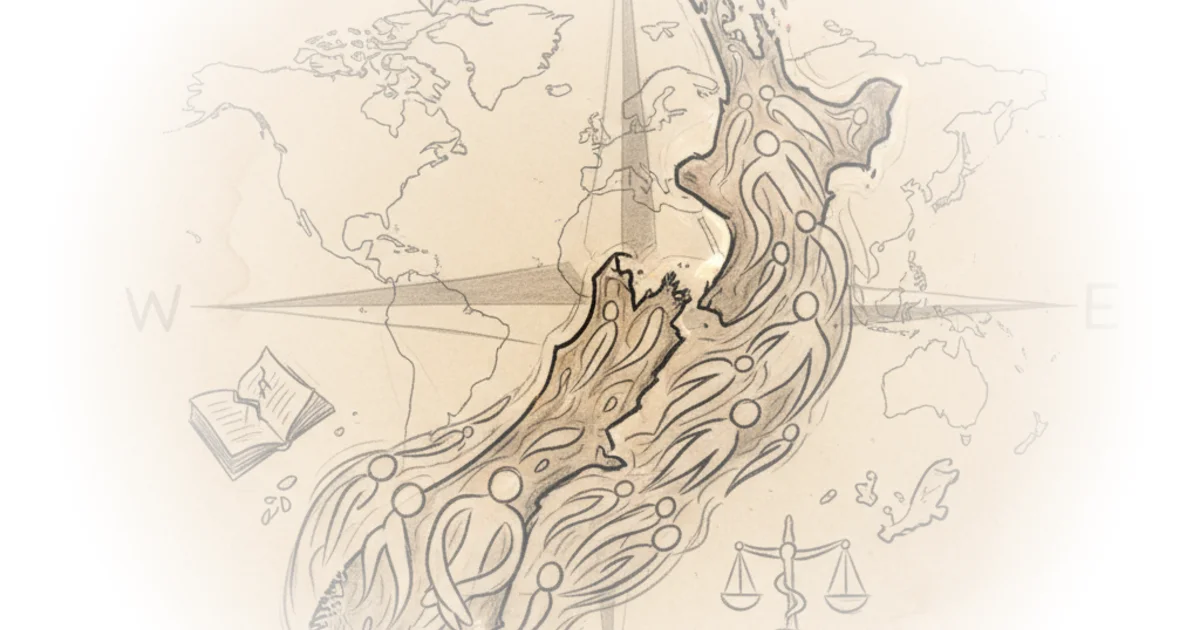
The author points out that the only industries that survive are those that must be there: tourism, local services, and agriculture. Yet, the agricultural sector, while highly productive, is so mechanized that it requires little labor. This leaves a vacuum for the educated workforce. "The biggest industries in the country by far are all centered around housing," the author states, noting that real estate activities collectively make up about half of the country's economic output. This is a devastatingly efficient critique of a distorted economy. When half your GDP is tied up in moving the same bricks around, there is little room for innovation or high-value employment.
Critics might note that this focus on housing ignores the potential for tech or creative industries to thrive in a remote, high-quality-of-life environment, as seen in other small nations. However, the author's data on the sheer dominance of the property market suggests that capital is indeed locked in this cycle.
"Young Kiwis who can't afford to start a life in New Zealand are moving out to somewhere where they can. The problem with that assumption is that more than half of them are moving out of the frying pan and into the fire that is Australia."
The Australian Siphon
The most compelling part of the analysis is the explanation of why New Zealanders don't just move to cheaper places, but specifically to Australia. The author highlights the unique political and cultural proximity that makes this exodus effortless. "For simplicity, the legal and political connections between these two countries are kind of like those within the EU," the author writes, emphasizing that people are free to live, work, and buy housing with very few restrictions. This is not a typical brain drain; it is a seamless migration between two English-speaking, culturally identical nations.
The author argues that the push factor isn't just cost, but a lack of career depth. "If someone wanted to work as a fine arts curator, a high-end researcher, or even just a senior manager, most of those jobs can't really be found in small country towns," the author explains. In New Zealand, these roles don't exist at all. The pull of Australia is the availability of specialized careers. The author adds a poignant detail about education: "when my partner went to medical school, about half of the students in their year were from New Zealand because there were just more places available for this kind of study in Australia." This anecdote personalizes the structural issue, showing how the pipeline of talent is diverted before it even enters the workforce.
The author also touches on the demographic irony: New Zealand is filling the gaps left by departing Kiwis with immigrants, who then often leave for Australia as well. "New Zealand is just becoming an expensive retirement home for wealthy Australians and Kiwis to enjoy the views while being served by a workforce just waiting for their turn to jump ship to Australia." This is a sharp, if slightly cynical, summary of the current trajectory. It suggests that the country is becoming a playground for the wealthy and a transit hub for the ambitious, rather than a destination for building a life.
The Political Trap
Why doesn't the government fix this? The author suggests the solution is politically impossible. "Remember, 10% of New Zealand's population currently lives in Australia, and as a general voting block, they aren't going to support a policy that makes their lives harder," the author writes. This creates a feedback loop where the very people leaving the country hold the votes that could potentially stop the exodus, but have no incentive to do so. The author notes that tightening borders would be "very difficult just simply from a political perspective" and geopolitically unwise given the deep friendship between the two nations.
The author concludes that the trend is hard to reverse because the mechanism is so simple: "So yeah, the reason that so many New Zealanders are leaving New Zealand is because it's really easy." This simplicity is the core of the tragedy. There is no complex bureaucracy to dismantle, no war to end, just a lack of opportunity in a small market next door to a giant one.
"New Zealand is just becoming an expensive retirement home for wealthy Australians and Kiwis to enjoy the views while being served by a workforce just waiting for their turn to jump ship to Australia."
Bottom Line
Economics Explained's strongest contribution is reframing New Zealand's crisis not as a failure of governance, but as a structural consequence of its geography and its relationship with Australia. The argument's greatest vulnerability is its near-total reliance on the Australian comparison, potentially underestimating niche opportunities in technology or green energy that could diversify the economy. However, the verdict is clear: until New Zealand can create high-value industries that do not require a massive domestic market, it will remain a beautiful, high-cost waiting room for its own future leaders.