In an era defined by relentless external noise and institutional volatility, Ryan Holiday offers a counterintuitive thesis: true liberty is not a political grant or a legal status, but a rigorous internal discipline. This piece, a translation and meditation on ancient Greek philosophy, argues that the most critical battlefield is not the legislative chamber or the street, but the immediate reaction of the mind to a stimulus. For the busy professional navigating complex systems, the claim is startlingly simple yet demanding: your freedom depends entirely on your ability to audit your own emotions before they dictate your actions.
The Architecture of Internal Freedom
Holiday frames the ancient text of Epictetus not as historical artifact, but as a manual for modern cognitive defense. He writes, "注意自己對事物的感想,隨時隨地關注,因為你守護的並非微不足道的小事:是自尊、忠誠和沉著,也是不被情感、痛苦、恐懼、困擾糾纏的心智──簡而言之,是自由。" ("Pay attention to your thoughts at all times, because what you are guarding is not a trivial matter: it is self-respect, loyalty, and composure, and a mind unentangled by emotion, pain, fear, or distress—in short, it is freedom.")
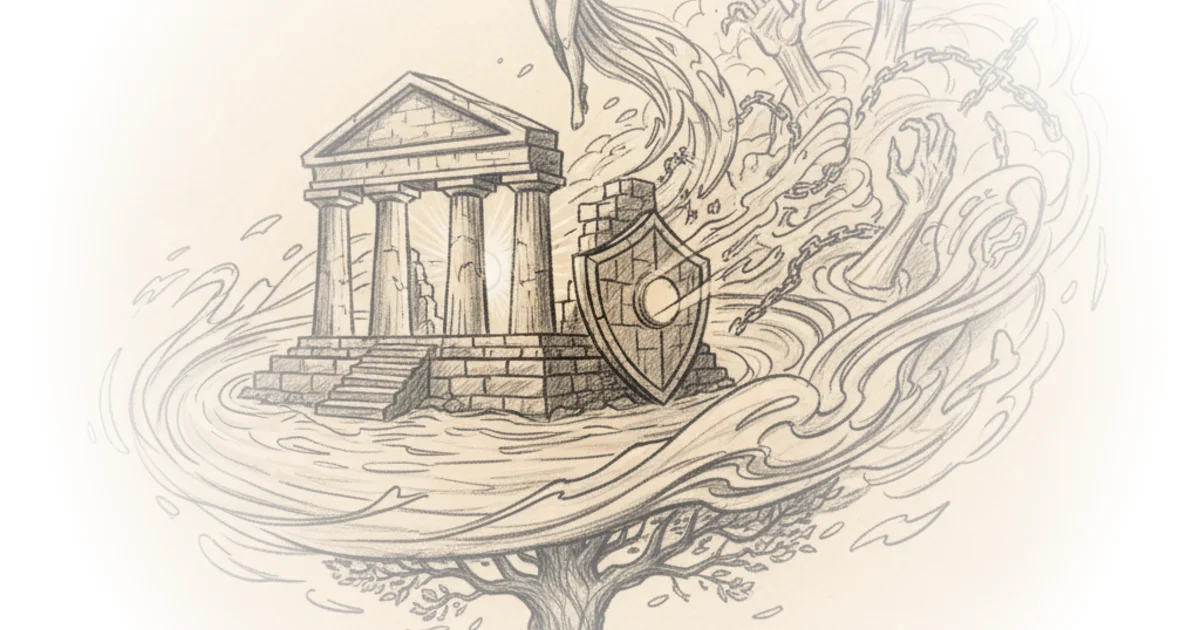
This is the piece's central pivot. Holiday suggests that the stakes of self-observation are often misunderstood as merely about mood management, when in reality, they are about the preservation of agency. The author argues that by maintaining a critical distance from our immediate impulses, we prevent external chaos from dictating our internal state. "愛比克泰德認為,一個人應該始終對自己的感想和情緒保持高度的警覺和批判性思考,因為這些感想和情緒決定了他或她的心理狀態和行為。" ("Epictetus believes that a person should always maintain a high level of vigilance and critical thinking regarding their thoughts and emotions, because these thoughts and emotions determine their psychological state and behavior.")
The strength of this framing lies in its shift of locus of control. In a world where institutions often seem unpredictable, Holiday posits that the only variable one can truly master is the interpretation of events. "唯有透過不斷地對自己的內心狀態進行反思和審視,我們可以更好地控制自己的情緒和行為,從而達到一種真正的“自由”。" ("Only through constant reflection and examination of our inner state can we better control our emotions and behaviors, thereby achieving a true 'freedom'.")
True freedom is not the absence of external constraints, but the presence of internal discipline.
Critics might note that this focus on internal control risks minimizing the very real, structural barriers that prevent people from acting on their choices. While mental resilience is vital, it does not dismantle systemic injustice or policy failures. However, Holiday's argument is not that internal work replaces external action, but that it is the prerequisite for effective action.
The Distinction Between Event and Reaction
Holiday goes further to dismantle the idea that our environment determines our happiness. He paraphrases the Stoic view that suffering is often a product of our judgment, not the event itself. "這種自由不僅僅是對外界因素的獨立,更是一種內在的平靜和自律。" ("This freedom is not just independence from external factors, but an inner peace and self-discipline.")
The commentary here is particularly sharp because it addresses the modern tendency to seek happiness through external acquisition or political victory. Holiday asserts that these are fragile foundations. "通過持續的自我察覺和自我控制,我們可以學會如何在面對各種外界壓力和挑戰時保持冷靜和理智,從而達到一個更高層次的心理和精神自由。" ("Through continuous self-awareness and self-control, we can learn to remain calm and rational in the face of various external pressures and challenges, thereby achieving a higher level of psychological and spiritual freedom.")
This is where the text moves from philosophy to practical strategy. The author suggests that the ability to remain "calm and rational" is not a passive state of being, but an active skill honed through "不斷地對自己的內心狀態進行反思和審視" (constant reflection and examination of one's inner state). The implication for the reader is clear: the most effective response to institutional pressure or societal chaos is not a reactive outburst, but a calculated, internal pause.
The Definition of the Good Life
The piece concludes by redefining the ultimate goal of human existence. Holiday writes, "這個也展現出斯多葛哲學所強調一個觀點:真正的自由和幸福來自於內在的自我控制和平靜,而不是外在的物質或環境條件。" ("This also demonstrates a point emphasized by Stoic philosophy: true freedom and happiness come from inner self-control and tranquility, not from external material or environmental conditions.")
This final argument serves as a corrective to the modern obsession with optimization and acquisition. By grounding the "good life" in internal stability rather than external validation, Holiday offers a durable framework for navigating uncertainty. The text implies that when the external world becomes volatile, the internal citadel remains the only reliable sanctuary. While some may argue that this perspective can lead to political quietism, the text frames it instead as a way to maintain the clarity needed to act effectively when the moment arises.
Bottom Line
Ryan Holiday's commentary on Epictetus succeeds by stripping away the mysticism of ancient philosophy to reveal a hard-nosed strategy for mental autonomy. Its greatest strength is the reframing of "freedom" as a daily practice of cognitive discipline rather than a political outcome. The argument's vulnerability lies in its potential to be misused as an excuse for inaction in the face of tangible injustice, but as a tool for maintaining clarity and agency, it remains a potent and necessary guide.