In an era where artificial intelligence is often framed as a threat to human intellect, Andy Masley offers a startlingly counterintuitive correction: the fear that AI drains our mental capacity relies on a logical error as old as economics itself. By reframing the debate through the lens of the "lump of cognition fallacy," Masley argues that outsourcing thought to machines doesn't empty our minds—it actually expands the frontier of what we can think about. This is not a defense of laziness, but a rigorous case for cognitive specialization that challenges the very way busy professionals view their own productivity and the role of technology in their lives.
The Economic Analogy of Thought
Masley begins by dismantling the intuitive but flawed notion that there is a fixed amount of thinking to be done in the world. He draws a direct parallel to the "lump of labor fallacy," the mistaken belief that there is a finite number of jobs in an economy. "One of the most common bad ways people think about economics is the lump of labor fallacy: the idea that there is a fixed, finite amount of work to do in an economy," Masley writes. He explains that just as opening a factory creates demand for mechanics, tools, and supplies, engaging in complex thought generates new questions and avenues for inquiry.
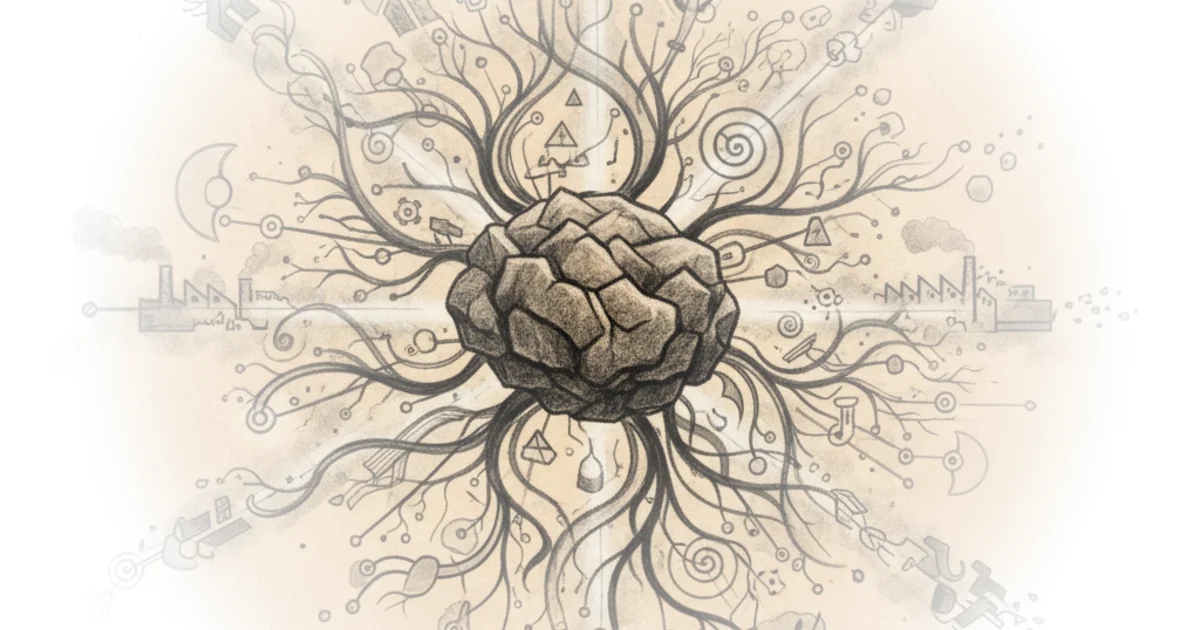
The author identifies a modern manifestation of this error in the backlash against generative AI. He cites a Guardian article where a writer claims that using chatbots is inherently lazy, quoting a source who asserts that relying on an app means you "can't think for yourself." Masley finds this reasoning fundamentally broken. "I see this come up a lot in AI discourse," he notes, pointing out that critics assume a zero-sum game where every thought the machine performs is a thought stolen from the human. This framing is effective because it exposes the absurdity of the premise: if we accepted this logic, we would have to conclude that reading a book written by someone else is a waste of our own cognitive potential.
"Thinking often leads to more things to think about."
This insight lands because it aligns with historical patterns of human progress. Masley implicitly taps into the concept of the "extended mind thesis," a philosophical framework developed by Clark and Chalmers in 1998, which posits that our cognitive processes are not confined to our skulls but extend into our environment. Just as a notebook or a smartphone acts as an external hard drive for memory, AI can act as an external processor for reasoning. The fear that AI makes us stupid ignores the reality that civilization has always been about offloading routine cognitive tasks to free up mental bandwidth for higher-order problems.
The Built Environment and Cognitive Liberation
To illustrate the benefits of outsourcing, Masley turns to the mundane architecture of daily life. He argues that we already live in a world designed to minimize the cognitive load of basic survival. "The reason many parts of society are standardized is to reduce the cognitive load of navigating them," he explains, citing how grocery stores, keyboards, and door handles are all engineered to require almost no conscious thought. We don't marvel at the fact that we don't have to invent a new way to open a door every morning; we accept that this "outsourcing" to design allows us to focus on more meaningful concerns.
Masley extends this analogy to the arts, asking why we don't accuse moviegoers of being lazy for not imagining the entire film in their heads. "Choosing to watch a movie is a massive outsourcing of thought," he writes. "The fact that other people have put in so much mental effort into so many parts of it opens up way more potential ways to think about it compared just making up a movie in your head." This comparison is powerful because it shifts the metric of value from the effort expended to the depth of the resulting engagement. When we consume a complex work like Lord of the Rings, we are not passively receiving thoughts; we are engaging with a dense web of ideas that would be impossible to generate in isolation.
Critics might note that this analogy risks conflating passive consumption with active engagement. Watching a movie is not the same as using a chatbot to solve a problem, and the line between "outsourcing" and "abdication" can be thin. However, Masley anticipates this by distinguishing between the process of thinking and the content of thought. He argues that the modern world has not reduced the amount of thinking we do, but rather shifted the type of thinking we are capable of. As the philosopher Alfred North Whitehead famously observed, "Civilization advances by extending the number of important operations which we can perform without thinking of them." Masley uses this to suggest that AI is simply the latest step in this long historical arc.
When Outsourcing Becomes a Trap
Despite his defense of cognitive offloading, Masley is careful not to advocate for a blanket surrender of mental effort. He draws a sharp distinction between tasks that build tacit knowledge and those that are merely transactional. He lists specific scenarios where outsourcing is detrimental: homework, personal messages on dating apps, and summarizing complex books one has the time to read. "It's bad to outsource your cognition when it builds complex tacit knowledge you'll need for navigating the world in the future," he argues.
The author's reasoning here is grounded in the idea of skill acquisition. Just as hiring someone to take your place in a classroom would prevent you from learning, using AI to do your homework prevents the brain from forming the neural pathways necessary for future problem-solving. Similarly, he notes that in personal relationships, the value often lies in the effort itself. "If a friend or partner asks for your help with a problem, they often want to feel your mental presence just as much if not more than they want a technical solution," Masley writes. In these cases, the cognitive labor is the point, not a hurdle to be cleared.
"The lump of cognition fallacy causes people to see this backwards: instead of cognition leading to more and more thought, they see it as draining a finite pool."
This section is the piece's most practical contribution. It moves the conversation from abstract philosophy to actionable advice. Masley suggests that the key is to identify where the "spillover effects" of thinking are high. For example, he describes using chatbots as research assistants to handle the "drudgery of long boring internet searches," which frees him to read and synthesize the actual sources. This mirrors the economic principle of comparative advantage: let the machine handle the repetitive data retrieval so the human can focus on synthesis and judgment.
Bottom Line
Masley's argument succeeds in reframing the AI anxiety from a crisis of capacity to a misunderstanding of how human cognition scales. The strongest part of his case is the historical and economic grounding, which effectively neutralizes the emotional panic surrounding "lazy" thinking. However, the piece's biggest vulnerability lies in the difficulty of drawing the line between helpful offloading and dangerous dependency; the criteria for when to outsource remain somewhat subjective. As the technology evolves, the challenge will be to ensure that the "built environment" of AI continues to liberate our minds rather than atrophy them. Readers should watch for how institutions and educators adapt these principles, moving beyond the fear of replacement to the reality of augmentation.