Matt O'Dowd of PBS Space Time delivers a stunning verdict on one of physics' most holy grails: the universe may have built a wall so high that the "graviton" is forever beyond our reach. While most science journalism celebrates our ability to measure the cosmos, O'Dowd argues that the laws of nature themselves conspire to hide the quantum building block of gravity, making its detection not just difficult, but fundamentally impossible.
The Black Hole Paradox
O'Dowd begins by dismantling the idea that we can simply build a better detector. He revisits the 2012 speculation by legendary physicist Freeman Dyson, who suggested that the universe seems designed to keep this answer out of our grasp. O'Dowd writes, "In some cases, it seems to be impossible for all practical experiments. The experiments are just too outlandish to ever happen." He then moves to the more terrifying conclusion: in other scenarios, detection is "in principle and fundamentally impossible."
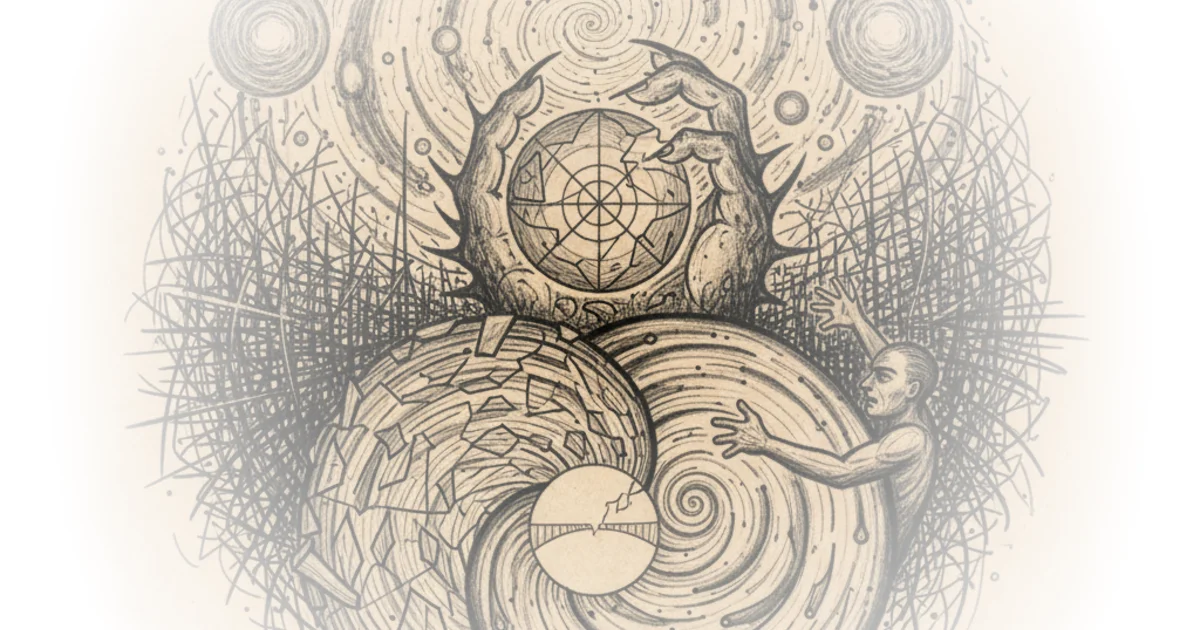
The core of his argument relies on the limits of measurement itself. To detect a single graviton, a device like the Laser Interferometer Gravitational-Wave Observatory (LIGO) would need to be sensitive enough to measure a change in distance equal to a single Planck length. This is the scale where our current understanding of space and time breaks down. O'Dowd explains that the Heisenberg uncertainty principle creates a catch-22: to measure such a tiny distance, you need high-energy photons, but those photons impart so much momentum that they would push the detector's mirrors apart. To counteract this, the mirrors would need to be incredibly massive and close together. As O'Dowd bluntly puts it, "If we want a one plank length position precision... the mirrors need to be massive enough and close enough together that they form a black hole."
This is a masterful use of physical constraints to prove a negative. By showing that the act of measurement would destroy the experiment, O'Dowd turns the problem from an engineering challenge into a cosmic prohibition. Critics might argue that we haven't yet discovered a theory that unifies quantum mechanics and gravity, so assuming current limits are absolute could be premature. However, within the framework of known physics, the logic holds water.
By definition, the formation of an event horizon prevents our distance measurement.
The Stupidly Large Collider
If we cannot detect the gravitational effect of a single graviton, perhaps we can create one and catch it like a particle in a collider. O'Dowd explores this "particle collision method," noting that gravity is the weakest force by a staggering margin. He writes, "It's 24 orders of magnitude weaker than the weakest of the other fundamental forces." To overcome this weakness and generate a graviton, we would need collision energies around a billion joules.
The scale required for such an experiment is mind-boggling. O'Dowd calculates that a collider with the same magnets as the Large Hadron Collider would need to be "around 3 light years in diameter, much bigger than our solar system." He dubs this hypothetical machine the "SLC," or "stupidly large collider." Even if humanity could somehow construct this interstellar behemoth, the detection problem remains. O'Dowd points out that the probability of a graviton interacting with matter is so low that the "cross-section is proportional to the square of the plank length."
He illustrates this futility by looking at natural sources. Even the Sun, which emits a flood of high-frequency gravitons, would only allow a single interaction with a particle of matter "roughly once every billion years or so across the entire volume of the Earth." The sheer scale of the required detector—potentially the size of a planet or star—combined with the overwhelming background noise of neutrinos, makes this approach equally hopeless. O'Dowd notes that for any graviton source, "our detector will interact with 10 the^ of 34 neutrinos per single graviton."
This section effectively shifts the reader's perspective from "we need a bigger machine" to "the machine is irrelevant." The argument is that the universe is not just sparse in gravitons; it is actively hostile to their detection.
Distinguishing that graviton from the neutrino noise seems practically impossible.
The Final Barrier
O'Dowd briefly touches on the Gertsenshtein effect, a theoretical method where gravitational waves convert into photons in a strong magnetic field. While this offers a glimmer of hope by bypassing the need for direct matter interaction, the author suggests the universe has one last trick up its sleeve. He implies that even this resonance effect is likely thwarted by the same fundamental coupling issues that plague the other methods. The narrative arc is tight: every door we try to open leads to a wall, whether it's a black hole, a star-sized detector, or a noise floor of neutrinos.
Bottom Line
Matt O'Dowd's coverage is a rare example of science communication that embraces the limits of human knowledge rather than pretending they don't exist. The strongest part of his argument is the rigorous application of the Heisenberg uncertainty principle to show that the act of measuring a graviton would inevitably collapse the detector into a black hole. His biggest vulnerability is the reliance on current physical models, which could be upended by a future theory of quantum gravity. However, until that theory arrives, O'Dowd's conclusion stands: the universe may have successfully hidden its deepest secret from us forever.