Ten thousand years ago, before Britain became an island, a lost civilization thrived on a landmass that today lies beneath the North Sea. Stefan Milo introduces us to the Mesolithic people of Doggerland — and the shocking evidence they left behind.", ## The World That Died
But when Cheddaman was alive, the island of Britain didn't exist. The English Channel hadn't formed yet. Instead, a now-vanished landmass called Doggerland connected Britain to continental Europe — a world of meandering rivers lined with pine, hazel, and oak. The Rhine, the Thames, the Seine, and the Severn all drained into what we now call the Channel River: an enormous tidal waterway splitting Doggerland in half.
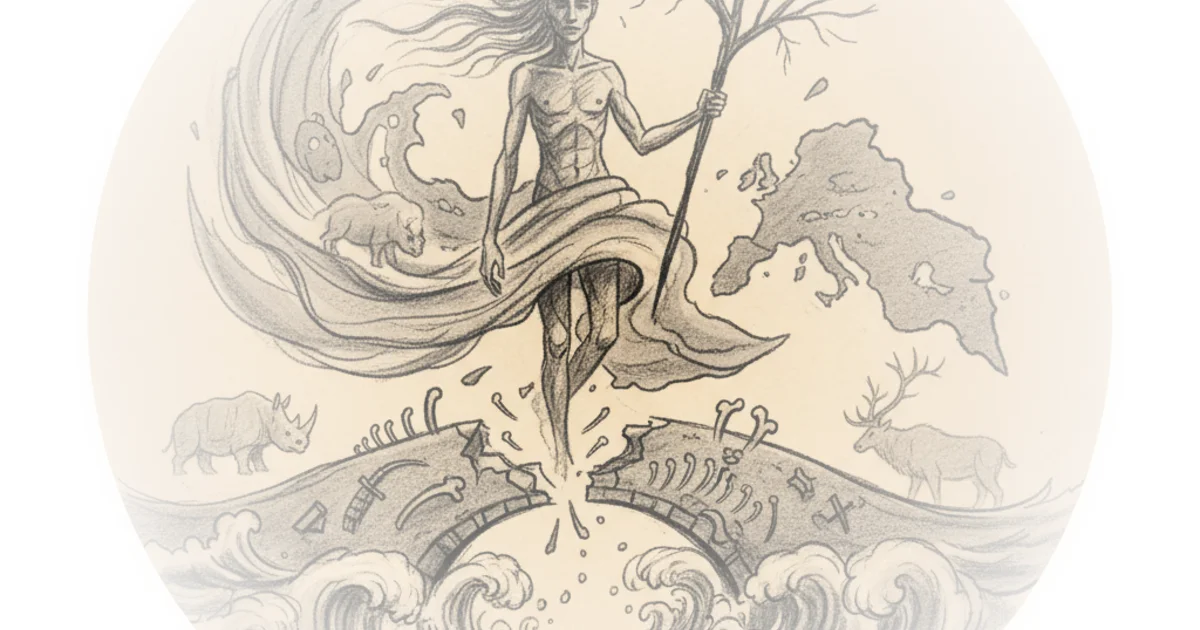
It's incredible to imagine famous landmarks like the White Cliffs of Dover not as a coastline, but as the edge of a vast plain bordering this massive river. The landscape was so different that it feels almost science fiction.
But this world lived on borrowed time. Ten thousand years ago, sea levels were rising roughly 70 centimeters every century. Within a couple thousand years, Doggerland would sink beneath the waves — swallowed by the North Sea we know today.
The First Evidence
In 1931, the fishing vessel Kindana was operating off Norfolk when crew members noticed something unusual in their nets: a lump of peat that had come up with their catch. Captain Pilgrim Lockwood struck the lump and heard a ring — thinking he'd found metal, but what he actually discovered was a harpoon, 22 centimeters long, made of antler. An absolutely beautiful artifact.
This was the first tangible evidence that the North Sea had once been home to prehistoric people. Previously, sunken forests had hinted at human presence, but this confirmed it. Harpoons and barbed points have since become some of the most common artifacts pulled from Doggerland.
Doggerland was a wet place, surrounded by rapidly rising seas and giant rivers — an ideal environment for fishing. These harpoons likely resembled something like a Lyster Listister: a three-pronged design similar to tools made by Inuit peoples, perfect for catching slippery fish. Many bone and antler points served as spear tips or arrow heads.
Antler and deer bones were versatile materials these prehistoric people had readily available. But human bones also served a purpose — and that was a surprise.
The Human Element
Scientists examining artifacts from the Dutch side of Doggerland discovered something unexpected: two harpoon points or arrow tips made from human bone. This revelation came through a process called zooarchaeology mass spectrometry, known by its acronym ZOOMS.
The technique works because collagen in living creatures is species-specific — certain markers reveal which animal species a bone came from. It's incredibly smart technology, constantly revealing new ways scientists can untangle our past.
What can we say about human harpoons and human bone arrow points? Perhaps back then, you had to be resourceful. If you needed to go hunting and all you had was Uncle Flugfart's shin bone, that's what you used. It's impossible to rule out that there was also symbolic meaning in using human bones as tools — potential ritual significance hidden behind practical necessity.
A Village From the Deep
When we imagine Mesolithic life, we picture a purely natural world untarnished by built environments. But humans have always built. Star Carr in Yorkshire now sits as coastal farmland. Ten thousand years ago, it was a village at the northern edge of Doggerland, sitting quietly beside an ancient lake.
It's probably the best-preserved Mesolithic site in the entire UK — an incredible place full of artifacts. Archaeologists unearthed a series of concentric post holes forming a conical house with a slightly sunken floor, about 20 centimeters deep, filled with dark sediment: likely remains of grass or reed flooring providing insulation. These homes were hubs of activity.
In the trench that revealed this house, archaeologists found 8,000 stone artifacts and 210 pieces of animal bone. A timber platform along the lake edge provided dry workspace — perhaps a dock for living. The village spanned roughly two hectares, about five acres. People lived there for substantial periods: almost semi-permanent settlement.
Building required tools like stone axes and antler axes. One from the Netherlands still has a tiny piece of the handle intact. Another favorite is an axe made from the radius of a bison — just saying "bison son" makes it feel prehistoric. Antler was strong enough to chop wood, though stone or metal would have been better if available.
Resourcefulness defined these people. A bone tooth inserted into antler served as a chisel for finer woodworking — the epitome of making do with what you had.
Archaeologists in the Netherlands also found plenty of bone needles and stitched skins that probably formed house walls, along with fibers for clothes and arrows. These villages were absolute hubs of activity, home to people completely familiar with their environment's natural resources — far more capable of surviving on their own wits than modern humans feel comfortable admitting.
Finding the Lost World
Star Carr is fantastic, but how do we find other lost villages beneath the waves? In the past ten to twenty years, there's been a huge effort to map Doggerland and understand this lost world.
One major player is Europe's Lost Frontiers team at Bradford University, with many European partners. They use seismic data — the same information used for hunting oil and gas — to identify areas of interest and understand topography.
One area of interest is just south of Dogger Bank: Outer Silver Pit Lake. Fishermen discovered abundant silver fish there, but ten thousand years ago when Cheddaman was alive, this was a giant lake on Doggerland home to animals and humans alike. Prehistoric people really valued lakeside spots — game, fish, fresh water.
Another area is the Elb Paleo Valley: a big continuation of the River El into Doggerland, no doubt a huge wetland. The Channel River where rivers converged must have been surrounded by humans.
Scientists led by Vincent Gaffne investigated this region on an eleven-day voyage called the Southern River. In core samples they took, they found stone artifacts — probably hammerstones — discovered in that expedition. It's incredible that we can use technology developed for oil and gas exploration to find archaeological sites, get cores, and find human-made artifacts.
We'll learn much more about Doggerland as long as funding continues. It lies waiting to be discovered.
The Rare Art
Something harder to untangle than the whereabouts of Mesolithic villages is the beliefs of those who lived there. With Doggerland, we've found thousands of points and artifacts but very little art.
One exception: an engraved bone from a bison metatarsal covered in zigzag markings. It's very similar to a horse's jawbone found in Kendrick's Cave in Wales — about 10,000 years old, same age as Cheddar Man. This zigzag pattern appears across time and geography, but it's interesting nonetheless.
Star Carr remains the place to look for this kind of evidence. In 2015, archaeologists led by Nikki Milner found something called the Star Car Pendant: a small smooth piece of shale engraved with lines and drilled through for a string. Who knows what it means? It's almost maplike, but probably not.
The most enigmatic artifacts from Star Carr are deer skull caps — red deer skulls. As of 2016, twenty-four were found at Star Carr. Many were drilled through the top of the skull to be strapped on, presumably for something like clothing or costume.
There's been big debate about whether these skull caps served as hunting aids or shamanic garb. The current debate swings toward shaman — though archaeologists are always picking ritual. We lack great examples ethnographically of people dressing as deer to go hunting in Europe and Asia. But we do have plenty of examples worldwide of shamans embodying animals.
One of the most well-documented examples comes from the Aeni people in North Asia, modern Russia. The word shaman actually comes from their language. Traditionally, they're hunters and reindeer herders — their religion reflects that environment."} {NULL