Rohin Francis does something rare in medical storytelling: he treats the history of the heart not as a dry timeline of dates, but as a four-chambered narrative where the architecture of the organ dictates the flow of human discovery. While most histories focus on the triumph of modern surgery, Francis argues that the delay in operating on the heart was not due to a lack of skill, but a profound cultural belief that the organ was too sacred to touch. This reframing transforms a lecture on cardiology into a meditation on how superstition can stall science for centuries.
The Sacred Pause
Francis begins by dismantling the assumption that medical progress is a straight line. He notes that while humans have performed surgery for millennia, "bizarrely it wasn't until the late 19th century that we decided to even operate on the heart." The author attributes this delay to a cross-cultural conviction that the heart was "the seat of the soul," a belief so powerful that doctors feared "even touching it might cause it to stop irreversibly." This is a crucial distinction; it wasn't that surgeons lacked the dexterity, but that the prevailing philosophy of the era deemed the heart "almost magical really." By highlighting this psychological barrier, Francis forces the reader to confront how deeply held beliefs can act as invisible walls in scientific advancement.
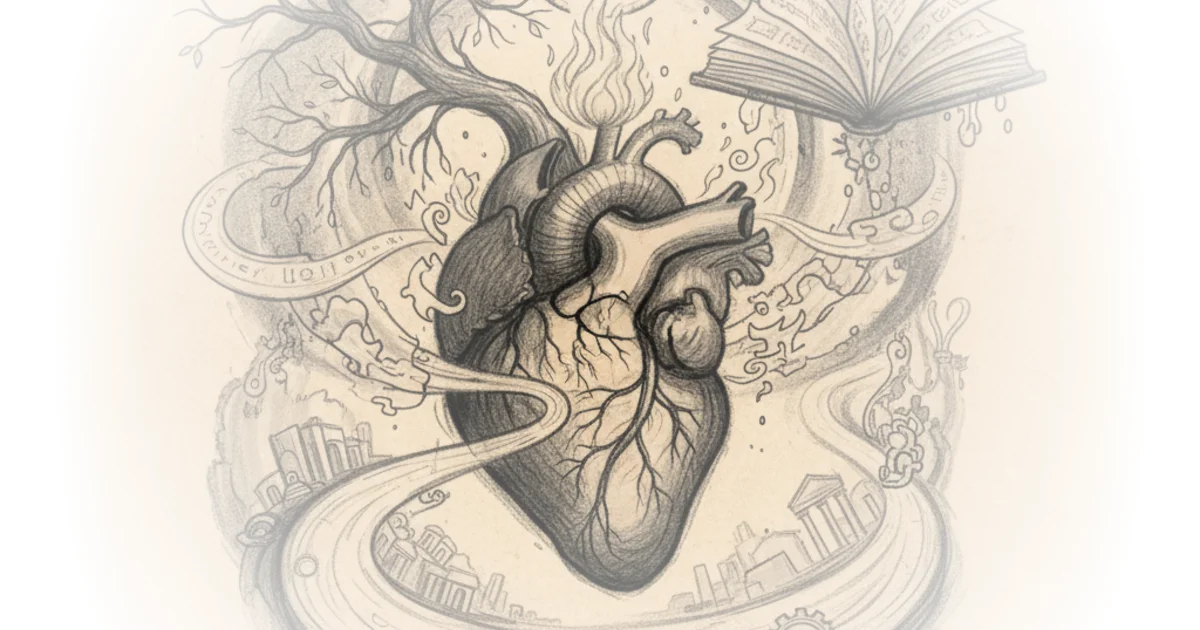
The narrative then shifts to the Renaissance and Enlightenment, where the tide began to turn through the work of three specific figures. Francis identifies William Harvey, Stephen Hales, and Leonardo da Vinci as the trio that finally cracked the code. He describes Harvey's De Motu Cordis as the text that first proposed the heart is "a pump moving blood around the body," a concept so obvious today that it is hard to believe it overturned 1,400 years of Galenic theory. Francis writes, "before this people had all kinds of crazy ideas which were mostly traceable back to galen some 4 1400 years earlier." The commentary here is sharp: the persistence of error is often just a lack of a better model, not a lack of intelligence.
"Galen thought the heart was a producer of heat and that the lungs and blood vessels were ways of cooling it down."
Francis gives equal weight to Stephen Hales, a clergyman and polymath who measured blood pressure by inserting glass tubes into animal arteries. He notes that Hales "correctly deduced the function of the aortic and mitral valves" and described hemorrhagic shock, yet Francis emphasizes that these insights were often buried in the broader context of a polymath's career. The most striking section, however, is dedicated to Leonardo da Vinci. Francis reveals that da Vinci didn't just draw anatomy; he understood fluid dynamics. "He realized it must have a purpose it can't just be coincidental," Francis says of da Vinci's observation of the sinus of Valsalva. By comparing blood flow to water eddies in a dam, da Vinci predicted the mechanism of valve closure five centuries before engineers could prove it with models. This is a powerful argument for the value of cross-disciplinary thinking: an artist observing water flow solved a problem that baffled physicians for hundreds of years.
The Human Cost of Innovation
As the narrative moves into the 20th century, the tone shifts from intellectual history to a gritty account of human collaboration against impossible odds. Francis uses the story of the Blalock-Thomas-Taussig shunt to illustrate that medical breakthroughs are rarely the work of a single genius. He focuses on the treatment of "blue babies"—children with tetralogy of Fallot, a condition that was, as Francis bluntly puts it, "a death sentence back then." Half of these children died before age three, and the rest lived miserable lives, told to "avoid any form of excitement" and forbidden from school.
The brilliance of Francis's storytelling lies in how he centers the three unlikely collaborators behind the first successful surgery. He highlights Helen Taussig, a cardiologist who was told she would never make it as a doctor because she was a woman and who later lost her hearing, forcing her to "diagnose murmurs using her hands by just by feeling." He then introduces Vivian Thomas, a Black man whose dreams of medical school were crushed by the Great Depression, forcing him to work as a janitor while he "taught himself to become a gifted surgeon pioneering techniques on animals." Francis notes the stark irony: "despite his huge contribution... he was paid as a janitor because that was all that a black man could be paid that was the only pay scale available to him."
"When blaylock suggested trying an experimental technique on her he was criticized heavily from all sides and accused of recklessness."
The procedure itself was a desperate gamble on a fifteen-month-old girl named Eileen. Francis describes the moment the team realized the vessels were "absolutely tiny" and that Blalock had never performed the surgery before, requiring Thomas to guide his hand despite having no legal authority to touch the patient. This section effectively argues that the "teamwork" required to save lives often involves navigating systemic racism and sexism just as much as it involves surgical skill. A counterargument might suggest that focusing on individual heroes obscures the broader systemic failures that created the conditions for such desperate measures in the first place. However, Francis's point is not to glorify the system, but to show how human ingenuity can pierce through it.
Bottom Line
Francis's greatest strength is his ability to humanize the history of medicine, showing that the "sands of time" are composed of individual struggles against cultural and institutional inertia. The piece's only vulnerability is its brevity; the sheer density of historical figures and technical details risks overwhelming a reader unfamiliar with the anatomy. Yet, the core message remains clear: the heart's history is not just about biology, but about the people who dared to look at it differently. The strongest takeaway is that the most profound medical breakthroughs often come from those who refuse to accept the status quo, whether it's a woman who lost her hearing, a man denied a medical degree, or an artist who saw the physics of blood flow in a stream of water.