Matt Stoller delivers a startling exposé on how the very legal establishment tasked with upholding antitrust law has become the primary vehicle for its erosion. The piece's most disturbing claim is not merely that corruption exists, but that it has been systematized by the nation's most prestigious corporate lawyers, who are now openly facilitating a "fat envelope" culture to bypass the rule of law.
The Architecture of Influence
Stoller begins by dismantling the facade of legitimate business deals, pointing to the proposed consolidation of Hollywood giants like Netflix and Paramount. He argues that these aren't just market transactions but political maneuvers. "Paramount owner David Ellison openly told Donald Trump he'll change CNN if allowed to buy the firm, in order to get permission to buy the firm," Stoller writes, highlighting the brazen nature of these negotiations. The author identifies a specific mechanism for this influence: Ballard Partners, a lobbying firm that serves as a funnel for corporate cash, employing former officials from the very administration now regulating these deals.
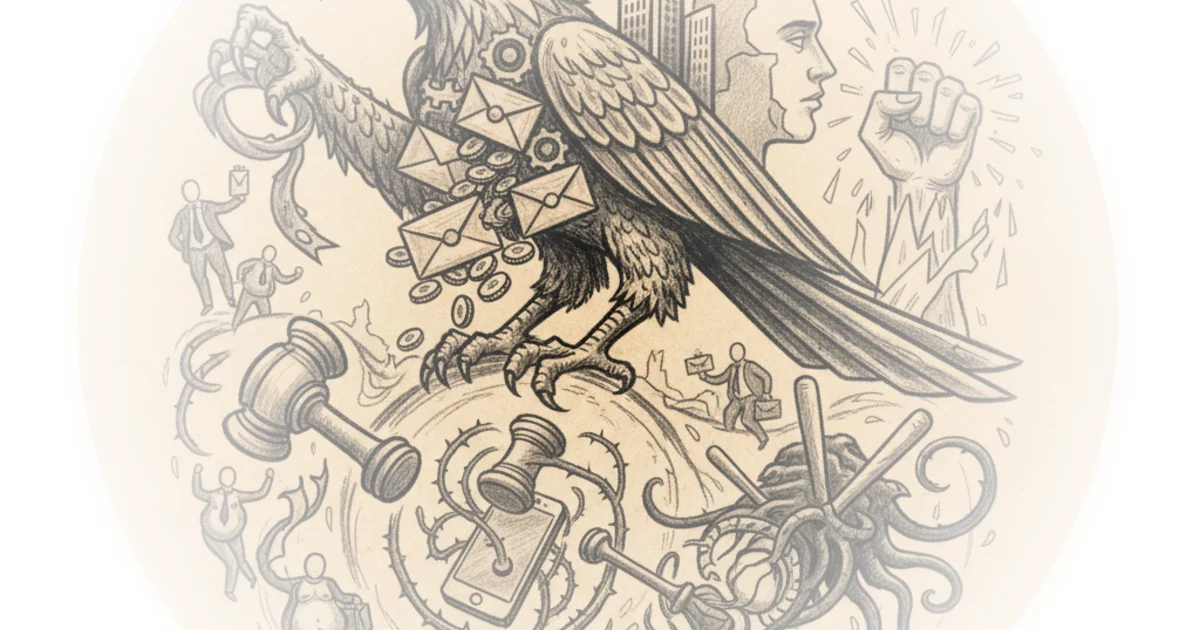
The core of the argument is that the legal profession has abandoned its ethical oaths to serve as the post office for these corrupt exchanges. "Corporate lawyers who have all sworn an oath to the Constitution... have, Democrats and Republicans, wholly and eagerly embraced the corruption," Stoller observes. This framing is effective because it shifts the blame from a single political actor to a structural failure of the legal bar. It suggests that the problem isn't just a rogue administration, but a profession that has decided the "rule of law thing" is an obstacle to be removed.
Everyone in corporate America is openly saying they can use a fat envelope to overcome that pesky rule of law thing, and Ballard seems like the post office for these fat envelopes.
Critics might argue that lobbying is a protected form of speech and that corporations have a right to petition the government. However, Stoller's evidence of direct quid-pro-quo arrangements and the specific targeting of enforcement officials suggests this is not standard advocacy, but a subversion of the regulatory process.
The Internal Coup
The narrative takes a darker turn when Stoller details the internal dynamics of the Department of Justice. He describes a "de facto coup" where corporate lobbyists allegedly seized control of antitrust enforcement from Senate-confirmed leaders. The case of the Hewlett Packard and Juniper Networks merger serves as the primary evidence. Stoller notes that while the deal itself was unremarkable, the battle over it revealed a fracture in the executive branch. "MAGA-connected corporate lobbyists demanded the Antitrust Division allow the merger through, while MAGA populists running it said no," he explains.
The author presents a chilling account of how lobbyists allegedly engineered the removal of career officials to force a favorable settlement. "MAGA lobbyists reportedly are liberally pitching their services to clients, starting at a mere $225,000 a month—more than the annual salary of senior DOJ officials," Stoller quotes from former enforcer Roger Alford. This detail is crucial; it quantifies the disparity between the influence peddlers and the public servants they are displacing. The silence that followed this event, where the Antitrust Division "hasn't proposed blocking a single deal," reinforces the author's point that the enforcement mechanism has been neutralized from within.
The Silence of the Bar
Perhaps the most damning section of Stoller's commentary focuses on the American Bar Association (ABA) Antitrust Section. He contrasts the vocal opposition these lawyers mounted against the Biden administration's enforcement efforts with their current silence regarding corruption. Stoller highlights Renata Hesse, a prominent lawyer and former Obama official, as a key figure in this silence. "Her silence, and that of other ABA Antitrust Section members, is important," Stoller writes, noting that the section claims to speak for 12,000 attorneys yet is run by a narrow committee with no pro-enforcement background.
The author connects this silence to a broader historical trend, noting that the ABA has consistently defended monopolization. He points out that the section's comments to international bodies often advocate for "behavioral remedies" that effectively allow monopolies to persist. "These are extremely boring ways of saying that antitrust law should facilitate more monopolization," Stoller asserts. This critique is powerful because it exposes the disconnect between the profession's public image and its private actions. The reference to the 2017 ABA report, which disavowed the need for a "radical reorientation" of enforcement even as public frustration grew, underscores the long-standing nature of this institutional resistance.
The lawyers I debated were furious that there was finally meaningful enforcement. They were particularly incensed that Lina Khan and Jonathan Kanter were trying to enforce statutes with words like 'unfairness' in them.
Stoller's recollection of the "rage" he faced at an ABA panel in 2023 serves as a vivid illustration of the legal establishment's hostility toward any challenge to the status quo. The fact that the audience cheered when someone muttered, "He's not even a lawyer!" reveals a deep-seated veneration for hierarchy over the actual administration of justice. While one might argue that legal professionals are simply defending the predictability of the law, Stoller's evidence suggests they are defending a system that privileges corporate power over public interest.
Bottom Line
Stoller's most compelling contribution is his identification of the legal bar not as a check on power, but as the primary enabler of monopoly. The piece's greatest strength lies in its detailed account of the internal DOJ coup and the specific role of the ABA Antitrust Section in shielding these actions. The argument's vulnerability is its reliance on allegations of a "coup" that, while supported by whistleblower testimony, remain contested by the administration. Readers should watch for the upcoming judicial review of the HPE-Juniper settlement, as this will be the first real test of whether the courts can pierce the veil of this corporate-legal collusion.