In a media landscape increasingly defined by algorithmic churn and disposable content, Ted Gioia offers a rare curatorial act: a deliberate excavation of the year's most intellectually dense, emotionally resonant, and structurally daring long-form journalism. This isn't just a list of links; it is a manifesto for the value of deep attention in an era of distraction, arguing that the most vital stories of 2025 are those that refuse to be summarized in a tweet or a headline.
The Architecture of Attention
Gioia opens by confronting the economic realities that have hollowed out the middle class of journalism. He highlights Bryan Burrough's retrospective on Vanity Fair, where the writer reveals the staggering compensation of the past to underscore what has been lost. "For twenty-five years, I was contracted to produce three articles a year, long ones, typically ten thousand words," Gioia writes, quoting Burrough. "For this, my peak salary was $498,141. That's not a misprint—$498,141, or more than $166,000 per story." This figure serves as a stark benchmark for the depth of reporting that the current market no longer supports. The argument here is not merely nostalgic; it is a structural critique of how the collapse of the old business model has severed the link between writerly ambition and readerly access.
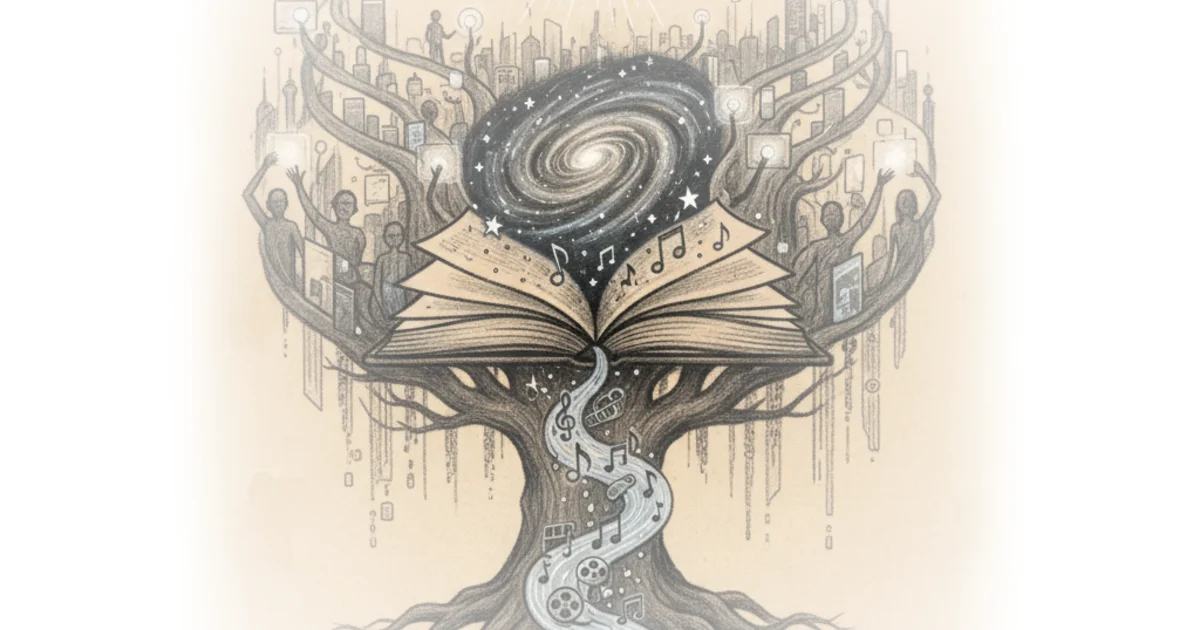
This economic erosion is mirrored in the disappearance of cultural infrastructure. Gioia turns to Gabriel Kahane's lament over the death of event listings, noting how the New York Times and The Village Voice have abandoned their roles as community guides. "The New York Times killed its weekly arts listings at the end of 2016, and its online arts-and-entertainment guide remains frozen, like a butterfly pinned and dried, in March 2020," Gioia observes. The framing is effective because it treats the loss of a simple calendar as a symptom of a broader cultural amnesia. When we lose the map, we lose the territory of our shared cultural life.
The collapse of the old business model has severed the link between writerly ambition and readerly access.
Critics might argue that digital aggregation has democratized discovery, making lists obsolete. Yet, Gioia's selection suggests that algorithms cannot replicate the human judgment required to distinguish signal from noise in a saturated information environment. The curated list becomes a necessary act of resistance against the chaos of the feed.
The Unseen and the Forgotten
A significant portion of Gioia's curation focuses on the invisible lives that slip through the cracks of official history. He champions Amanda Gefter's profile of Peter Putnam, a physicist whose contributions to quantum mechanics were erased from the public record. "His name might have been Anonymous. But it wasn't," Gioia writes, quoting the article. "His name was Peter Putnam. He was a physicist who'd hung out with Albert Einstein, John Archibald Wheeler, and Niels Bohr." The piece serves as a reminder that history is often written by the survivors, while the quiet geniuses who refused the spotlight are left to fade. This resonates deeply when considering the fate of other historical figures who were marginalized, much like the Indonesian author Pramoedya Ananta Toer, whose Buru Quartet was written in a concentration camp and only gained global recognition after his release in 1979.
Similarly, Gioia highlights the human cost of systemic erasure in Perry Link's account of being denied entry to China since 1996. "One of the questions I am asked most often is what it feels like, as a China scholar, not to be able to go to China," Gioia notes. The silence of the state is as loud as the words of the scholar. This theme of erasure extends to the personal, as seen in Sarah Zhang's story of Terry Wallis, who spoke after nineteen years in a vegetative state. "In 2003, Terry Wallis, in Arkansas, suddenly uttered 'Mom!' after 19 years as a vegetative patient in a nursing home," Gioia writes. These stories are not just curiosities; they are testaments to the persistence of the human spirit against the odds of being forgotten.
The Absurdity of Power and the Cost of Innovation
Gioia does not shy away from the bizarre intersections of technology, power, and human folly. He points to Chris Roberts' investigation into a 1955 proposal to expose football players to radioactive material. "In January 1955, a lifelong football fan approached Lou Spadia... with a peculiar request: Would his players like to participate in a science experiment at an atomic research lab?" Gioia writes. The casualness with which human bodies were treated as data points in the name of progress is chilling. It echoes the modern reckoning with the energy footprint of artificial intelligence, as detailed by James O'Donnell and Casey Crownhart. "The new model uses more than 30 times more energy on each 5-second video... This is equivalent to riding 38 miles on an e-bike, or running a microwave for over an hour," Gioia quotes. The parallel is striking: whether in the 1950s or 2025, the pursuit of technological advancement often proceeds with a reckless disregard for the human and environmental costs.
This theme of unchecked ambition is further explored in the story of the bulldozer, an invention born from the religious fervor of Robert G. LeTourneau. "'God,' he declared, 'is the chairman of my board….'" Gioia writes. The spiritual justification for industrial might is a recurring motif in the history of technology, often masking the destructive potential of the machines themselves. As the article notes, the bulldozer has a "shrouded, sinister history," a reminder that innovation is rarely neutral.
The pursuit of technological advancement often proceeds with a reckless disregard for the human and environmental costs.
A counterargument worth considering is that these stories of absurdity and excess are outliers, not representative of the broader trajectory of progress. However, Gioia's curation suggests that these anomalies are actually the clearest indicators of the underlying values driving our society. When the stakes are highest, the flaws in our systems become most visible.
The Power of Close Reading
Ultimately, Gioia's list is a defense of the act of reading itself. In a world of fragmented attention, the ability to engage with a complex argument or a nuanced narrative is a radical act. He highlights Johanna Winant's reflection on the state of the English department, where "hallways of empty offices" contrast with "classrooms of students... overflowing, plentiful." This image of vitality amidst institutional decay is a powerful metaphor for the resilience of human curiosity. Even as institutions crumble, the desire to understand, to connect, and to learn remains.
The inclusion of Emma Loffhagen's piece on the Initial Teaching Alphabet serves as a cautionary tale about the dangers of well-intentioned but poorly executed educational reforms. "The Initial Teaching Alphabet was a radical, little-known educational experiment... that radically rewrote the rules of literacy for tens of thousands of children seemingly overnight," Gioia writes. The experiment failed, leaving thousands unable to spell, a stark reminder that literacy is not just a technical skill but a cultural inheritance that cannot be rushed. This connects to the broader theme of the list: that true understanding requires time, patience, and a willingness to engage with complexity.
Bottom Line
Ted Gioia's curation succeeds because it refuses to accept the status quo of digital media, instead pointing toward a future where depth, nuance, and human connection are prioritized over speed and volume. The strongest part of this argument is its implicit call to action: to seek out and support the writers who are willing to do the hard work of deep reporting. Its biggest vulnerability is the assumption that the audience is still willing to invest the time required to engage with these stories, a gamble that the current media ecosystem is increasingly skeptical of. The reader should watch for how these narratives of erasure, absurdity, and resilience shape the next decade of cultural discourse, and whether the institutions of the past can be rebuilt or if new forms of storytelling must emerge from the ashes.