A Reviewer's Confession About Confusion
Sarah Longwell, Tim Miller, Bill Kristol open their review with an admission that sets the tone for what follows: they once subjected a friend to an earnest explanation of insights gained during a mushroom trip. The friend listened patiently before escaping to childcare duties. This anecdote becomes the lens through which they examine Patricia Lockwood's novel Will There Ever Be Another You—a book that asks readers to do something similar: endure the rambling, associative thoughts of someone whose mind has been altered by illness and psychedelics.
The Mushroom Memoir
Lockwood's book defies easy categorization. Sarah Longwell, Tim Miller, Bill Kristol note that "styled as a novel, the book is essentially a memoir covering several disparate episodes: Lockwood's time dealing with the effervescent-yet-dreadful brain fog of long COVID, the identity-shattering experience of caring for her very ill spouse, and, yes, the time she did a bunch of psychedelics while trying to make sense of classic literature."
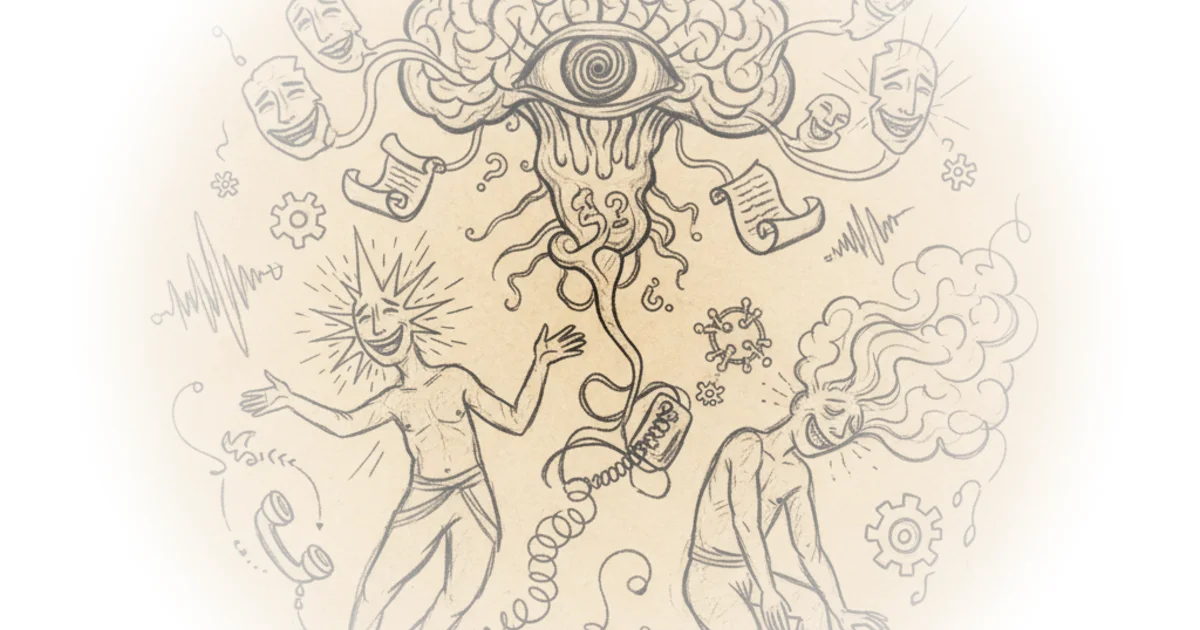
The narrative structure mirrors the author's mental state. As Sarah Longwell, Tim Miller, Bill Kristol puts it, "the text jumps between first-, third-, and, briefly, second-person descriptions of Lockwood's thought processes while dealing with a brain fog that refuses to lift even in her recounting of it." Early passages read like delirium captured in prose—gasping at one's own foot, haunted by a steak company's corporate motto, chasing iced tea through Scottish hotels.
"Lockwood claims... that she aspired for Will There Ever Be Another You to be a 'masterpiece about being confused.'"
The Twitter Poet Problem
Lockwood's reputation rests on sharp, compressed wit. Sarah Longwell, Tim Miller, Bill Kristol write that "profiles of her often describe her as the 'poet laureate of Twitter'" and credit her with "at least two of the greatest tweets of all time." Her first novel was a Booker Prize finalist built on tweet-length jokes.
This skill survives in the new book. Sarah Longwell, Tim Miller, Bill Kristol observe that "there is at least one decent joke or delightfully surprising turn of phrase every few pages in Will There Ever Be Another You." The problem is accumulation. "But by the end of the second section, one may start to feel that this ever-expanding verbal miasma isn't cohering into much of anything; the feeling is inescapable by the novel's end."
The Lockwood Cinematic Universe
A central tension emerges: the book assumes its readers already know Lockwood's life. Sarah Longwell, Tim Miller, Bill Kristol ask directly: "Would the book be intelligible at all to someone not already well versed in Lockwoodiana? I cannot say for certain, but I suspect that it would not."
References to her father—a married Catholic priest—require prior knowledge of her memoir Priestdaddy. Allusions to Twitter as "the portal" depend on having read No One Is Talking About This. Even passages about her husband's illness become clearer if you've read her London Review of Books essay on the same subject.
Sarah Longwell, Tim Miller, Bill Kristol crystallize the complaint: "I expect, I suppose, a text that provides its own context." What reads as blog-post intimacy in 2012 feels like exclusion in a book sold to strangers.
Piranesi vs. Lockwoodiana
The review pivots to comparison. Sarah Longwell, Tim Miller, Bill Kristol invoke Susanna Clarke—author of Jonathan Strange & Mr. Norrell and Piranesi—who also suffers from chronic fatigue syndrome. Clarke's Piranesi features a protagonist trapped in an infinite House of statues, his memories stolen, his mind altered.
The parallel is deliberate. Sarah Longwell, Tim Miller, Bill Kristol quote from Piranesi: "Where do the empty crisp packets come from, if there exists only the House? Why does he know what crisp packets are?" Clarke's novel models confusion while telling a coherent story. Lockwood's novel is confusion without the story.
The verdict arrives stark: "Will There Ever Be Another You is a disorienting jumble of thoughts that stubbornly refuse to cohere." Faced with both books, Sarah Longwell, Tim Miller, Bill Kristol know which they will choose.
Counterpoints
Critics might note that the review's standards privilege coherence over authenticity. Lockwood's brain fog is not a literary device—it is her lived reality. A book that refuses to cohere may be the most honest representation of that experience possible.
Others might argue that autofiction has always demanded reader labor. Karl Ove Knausgaard's My Struggle assumes familiarity with Norwegian life. David Foster Wallace's footnotes require navigation skills. Lockwood's demand—that readers know her previous work—is no different from a sequel assuming you saw the first film.
Finally, the review's mushroom anecdote undermines itself. The reviewer admits their own psychedelic ramblings were "very funny and not at all worrying" to the friend who heard them. Why does Lockwood's written equivalent fail the same test?
Bottom Line
Sarah Longwell, Tim Miller, Bill Kristol deliver a review that is itself a performance of patience—enduring Lockwood's disorientation so readers don't have to. The verdict is clear: Piranesi achieves what Will There Ever Be Another You attempts but cannot sustain. Confusion without architecture becomes fatigue, not art. Readers seeking Lockwood's Twitter wit will find it in flashes. Readers seeking a book that stands alone will find one that leans heavily on everything she has written before.