This piece dismantles a comforting historical myth: that the brutal machinery of American slavery was a uniquely American invention. Kahlil Greene traces the lineage of chattel slavery not to the American South, but to a Portuguese port town in the fifteenth century, revealing a business model perfected decades before the first ship arrived in Virginia. For readers seeking to understand the deep structural roots of racial inequality, this is not just a history lesson; it is a necessary correction to the timeline of oppression.
The Excavation of Lagos
Greene anchors his argument in a visceral, physical discovery that forces a confrontation with the past. In 2009, construction workers in Lagos, Portugal, unearthed a mass grave containing 158 skeletons of men, women, and children of West and Central African ancestry. "Nobody gave these people a burial, and someone threw them into the dump alongside butchered animal bones and broken pottery," Greene writes. The evidence of filed teeth and binding marks transforms these remains from abstract statistics into victims of a specific, dehumanizing system.
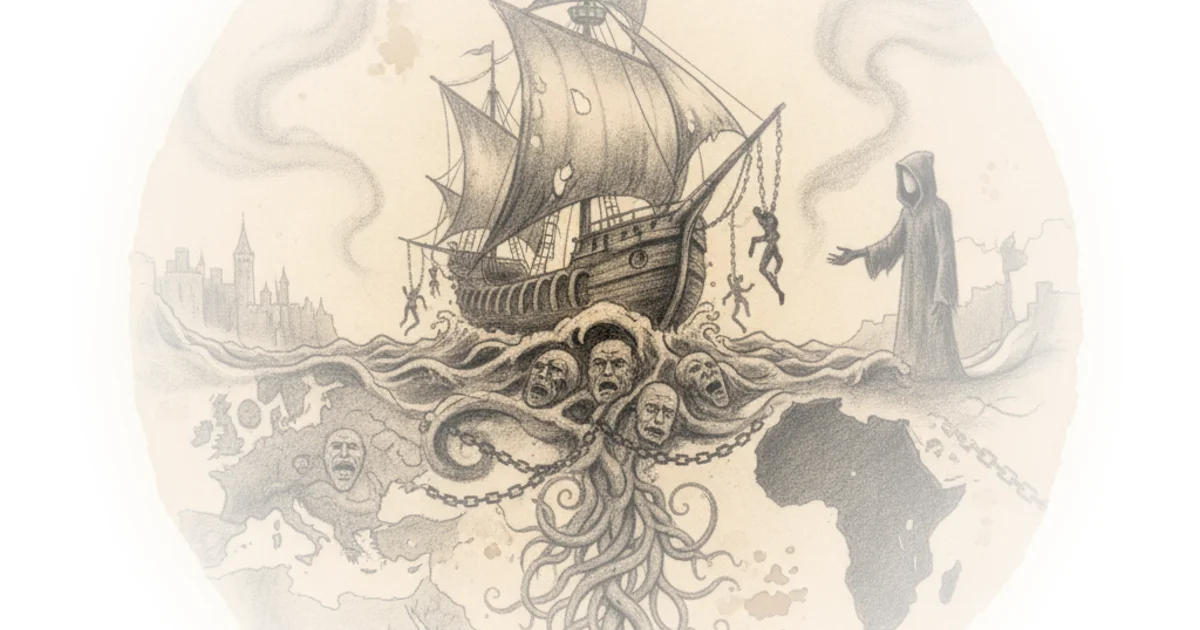
The location of this dump is the crux of the piece's power. It sits beneath a modern parking complex and a minigolf course on the site of the former customs house where the first recorded public sale of enslaved Africans in Europe took place in August 1444. Greene notes that this event occurred 175 years before the White Lion arrived in Virginia. "The plantation system that American slaveholders later ran took its shape on Portuguese islands in the Atlantic," he argues. This reframing is critical; it suggests that American slavery was not an anomaly but an expansion of an existing, profitable enterprise.
American slavery grew out of an older business, and knowing that origin does not make American slavery smaller.
The author's choice to highlight the juxtaposition of the minigolf course and the mass grave is a masterstroke of editorial framing. It illustrates how societies often bury uncomfortable truths under layers of leisure and modernity. However, critics might note that focusing so heavily on the Portuguese origins could inadvertently dilute the specific, intensified brutality of the American plantation system, which Greene himself warns against. He is careful to distinguish between the two, but the risk of false equivalence remains a challenge for any comparative history.
The Blueprint of the Atlantic System
Greene moves beyond the initial sale to explain how the system was engineered. He details how Portuguese merchants, operating under papal authorizations like Dum Diversas and Romanus Pontifex, assembled a model on the islands of Madeira and São Tomé. Here, the system was refined: no indigenous population existed, so every worker was imported; a single export crop, sugar, drove the economy; and labor was demanded continuously. "On São Tomé, Portuguese planters assembled the parts of a system that later spread across the Americas," Greene explains.
This section effectively connects the dots between the Iberian experiments and the later expansion into the Americas. The author cites the 1526 arrival of enslaved Africans in San Miguel de Gualdape, near present-day Savannah, as the moment this imported model touched the soil of what would become the United States. The argument gains further depth when Greene references the trans-Saharan trade, noting that while merchants moved enslaved people north for centuries, the nature of that slavery differed significantly from the chattel system developed by Europeans.
The distinction is vital. Greene points out that in West African households, enslaved people were often absorbed into kinship groups and could gain freedom, whereas in the Americas, "they made the status permanent and heritable by law, and they attached it to African descent." This legal rigidity is the defining feature of the American system, even if the economic model of plantation labor was inherited from the Portuguese.
The Weight of Memory and Erasure
The piece concludes by examining how Portugal currently grapples with this history. Despite the archaeological evidence, the memory of the site remains contested. "Portuguese officials have not settled how to mark any of this," Greene observes. While a museum was opened in 2016, the burial site itself remains covered by a parking lot, and a planned memorial has yet to break ground. The statue of Prince Henry, erected during the Salazar dictatorship, still stands guard over the square.
Greene's critique extends to the historical narratives that have long obscured these realities. He references the chronicler Gomes Eanes de Zurara, who described the captives as "living without reason or custom," a dehumanizing rhetoric that provided the intellectual cover for their enslavement. "I'm fighting to document stories like this before they get dismissed or erased entirely," Greene writes, underscoring the urgency of preserving these narratives against the tide of historical amnesia.
American slaveholders did not invent the system they ran. Portuguese merchants assembled it across the fifteenth century on the Iberian coast and the Atlantic islands, and Spanish and English colonists carried it across the ocean.
One counterargument worth considering is the potential for this narrative to be co-opted to minimize the specific horrors of the trans-Atlantic trade. By emphasizing the European origins, there is a risk of shifting blame away from the specific American institutions that sustained slavery for centuries. Greene anticipates this, arguing that tracing the origin "does not make American slavery smaller," but the balance is delicate. The article also briefly touches on the trans-Saharan trade, noting estimates of nine million Africans enslaved between 800 and 1800, but rightly distinguishes this from the racialized, hereditary chattel slavery of the Americas.
Bottom Line
Kahlil Greene's most compelling contribution is the geographic and temporal repositioning of slavery's industrial origins, forcing a recognition that the American system was a scaled-up version of a European invention. The piece's greatest vulnerability lies in the difficulty of maintaining this distinction without inadvertently softening the unique brutality of the American experience, though Greene largely succeeds in holding that line. Readers should watch for how this historical reframing influences contemporary debates on reparations and memorialization, particularly as the physical evidence in Lagos demands a reckoning that modern infrastructure has tried to hide.