A philosophical debate about whether artificial intelligence might end the human race seems an unlikely jumping-off point for one of ethics' oldest questions. But Bentham's Bulldog — the pen name of writer Matthew Adelstein — uses that detour to pivot into a sustained assault on moral anti-realism, the view that no objective moral facts exist independent of human attitudes. The argument is that if anti-realism were true, the entire edifice of human reasoning would collapse into a vacuum where no choice is genuinely better than any other.
Reasons Built on Sand
Adelstein's opening move leans on Derek Parfit's famous concern: if anti-realism holds, "all our reasons to act are built on sand. No action is more worth taking than any other." The standard anti-realist account traces reasons back to desires. You have a reason to eat because you want to stop being hungry. You have a reason to pursue a goal because you happen to care about that goal. But Adelstein presses a simple and devastating question. "Why do my reasons come from my desires and not from, say, my neighbor's desires?" Nothing in the anti-realist framework explains why your own preferences get privileged status over anyone else's. It is an arbitrary starting point disguised as a philosophical foundation.
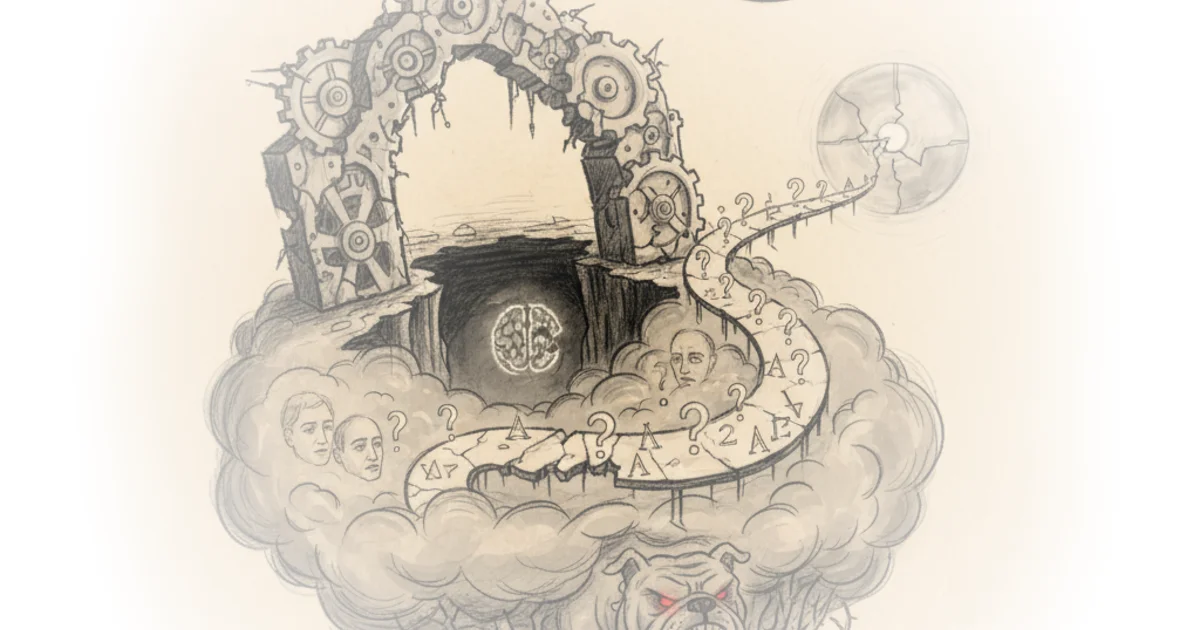
The argument cuts deeper. Anti-realists often claim that reasons-tracking-desires is true by definition — an analytic truth about how the word "reason" works in English. Adelstein demolishes this. When he tells a friend "you have reason to stop murdering," he argues, he is making a substantive claim, not committing a category error. If "reason" simply meant "what you want," his sentence would reduce to the absurd "you want to stop murdering" — which might be false, but it certainly would not be nonsense. The very fact that the sentence is coherent proves the anti-realist definition wrong.
"The fact that I decided to aim at something doesn't seem to make aiming at it the wise or prudent thing to do."
The Colon Pain Problem
Where Adelstein's case becomes most vivid is in his thought experiments. He asks readers to imagine a person who simply does not care whether the pain destroying their life originates in their colon or their pancreas. If the pain comes from the colon, they instruct the doctor: leave it. "This just seems so clearly irrational!" Adelstein writes. The desire is real — the patient genuinely does not care about colon pain — yet the behavior remains irrational regardless. Desire and reason have come apart.
He offers other examples. A person with a sudden urge to hurl a coffee mug across the room. Someone who craves a drug they know will bring no pleasure at all. His younger brother, who once insisted that sandwiches be cut into triangles rather than squares and later grew out of it. "He came to see that there wasn't really any reason to care about the shape of the sandwich," Adelstein observes. In each case, the person has a genuine desire and no genuine reason. The two categories do not overlap perfectly. They barely overlap at all.
This is where David Hume's shadow falls across the argument. Hume famously held that reason is merely the servant of passion — that rationality only tells you how to get what you want, never what you should want. Adelstein is arguing, across two and a half centuries, that Hume had it backwards. Rationality does not just calibrate means to ends. It evaluates the ends themselves.
The Problem with Idealized Selves
Anti-realists have responses, and Adelstein takes them seriously. One common move is to appeal to long-term or reflective desires. You have a reason to do what your future self or your ideally reflective self would want. The triangle-sandwich preference dissolves under reflection; therefore it was never a real reason.
Adelstein finds this unsatisfying for several reasons. First, it still cannot explain cases like the colon-pain patient who, even after full reflection, simply does not care. Second, it is unclear why anyone should care about their reflective desires in the first place. "What if I just don't care about my reflective desires?" he asks. The account assumes what it is supposed to prove.
Third, and perhaps most memorably, Adelstein questions whether the "ideally reflective self" is even a coherent concept. He cites writer Joe Carlsmith's observation that a fully informed version of oneself would be so alien — knowing every fact in the universe, with "a brain the size of a galaxy" — that "there's no important sense in which he remains me." Which version of that godlike being you become might depend on the order in which you learn things. There is no single, stable target for ideal reflection to converge upon.
Critics might note that this last objection cuts both ways. If the ideally reflective self is incoherent, it is equally difficult to see how objective moral facts could be discovered by any finite creature. The anti-realist could simply shrug and say that Adelstein has proven nothing exists worth discovering — not that things are worth discovering and we just can't find them.
When Irreducible Normativity Enters
Adelstein's closing move is the strongest. Even if one grants that some brute normative fact exists — that you should do what you desire, not as a definition but as a substantive moral claim — that move already smuggles in irreducible normativity. And once you have accepted that irreducible normative facts exist, Adelstein argues, there is no principled barrier to accepting the ones moral realists want. "Once irreducible normativity is in the picture, it isn't clear why one wouldn't simply be a realist."
It is a clean dialectical trap. The anti-realist who reaches for brute normative facts to save their position has already surrendered the ground that made anti-realism attractive in the first place — the supposed parsimony of a world without objective values.
Critics might argue that Adelstein moves too quickly from "desire-based accounts are incomplete" to "full moral realism must be true." There is a broad middle ground between hard anti-realism and robust moral realism — positions like constructivism or expressivism that neither reduce reasons to desires nor posit mind-independent moral facts. Adelstein acknowledges none of these.
Critics might also note that the piece leans heavily on intuitions about what counts as "irrational" — intuitions that vary considerably across cultures and individuals. The colon-pain thought experiment works because most readers share Adelstein's intuition about its absurdity. But intuitions are precisely what anti-realists doubt.
Bottom Line
Adelstein does not settle the anti-realism debate in a single blog post. Nobody has. But he exposes the soft underbelly of desire-based accounts of reasons with unusual clarity and a willingness to chase arguments into uncomfortable places. The case is not airtight — and the dismissal of intermediate positions between realism and anti-realism is a real gap — but for anyone who has always found the "reasons are just desires" position intuitively unsatisfying, this is the argument they have been waiting for.